


Program
The rush of wings, stories and birds of prey up close
Free school materials: booklets, quizzes and films →
Between Tversted and Ålbæk, surrounded by dunes, heath and forest, Eagleworld invites you into the world of birds of prey. Here you can experience their flying skills and gain an insight into the partnership between people and birds – a partner ship built on patience, training and trust.
Our display takes you through humankind's long relationship with birds of prey – from the Viking Age and classical falconry to the methods we use in training today. Along the way you will meet birds, horses and falconers, and hear about the biology and behaviour of birds of prey and the different ways they move through the landscape.
A display under the open sky
The program lasts about an hour and takes place outdoors by Eagleworld's lake. From the stands you look out over the open terrain, where the birds' flight becomes part of the landscape.
As the birds of prey show off their different flying skills, our guides tell you about each species and about our work with the birds. You will gain an insight into the history of falconry, both worldwide and in Denmark, and into the daily training here at Eagleworld. There is the rush of wings to feel, but also stories and knowledge to take home with you. Read more about falconry as UNESCO heritage.
From horseback to four-wheel drive
In our programs featuring the training of our birds of prey, you can watch the falconers work from the ground and in the demanding, classical discipline of falconry on horseback. Horse, rider and bird must learn to understand each other's movements, and working together takes practice and attentiveness.
You will also see how we use a four-wheel drive as a tool when training our birds of prey in the dunes. The vehicle allows us to move through the terrain and work on the birds' flight over longer distances. Here we use the wide-open spaces and changes in elevation of the landscape as part of the training, while the birds follow the falconer's movements through the area.
This gives you the chance to see the birds of prey use their wings out in the terrain and to experience how a modern training method has become part of a craft with a long history.
Meet the birds and the people behind them
During the display you get close to a range of different birds of prey – from the swift falcons to the eagles and the distinctive bearded vulture. As the falconers move along the stands with the birds, you can see details of their plumage, beaks and talons that are otherwise hard to spot.
Every program is shaped by the birds taking part and by the day's wind and weather. Following living animals under the open sky is part of the experience: there is a set framework, but also room for unexpected moments.
We look forward to welcoming you to an hour of nature, closeness and stories from life with our birds of prey.
Follow our news on Facebook and Instagram
Below you can read more about the many different animals that you meet during our program:
All the above videos are with English and Danish subtitles. Click on settings in Youtube to get them
BIRDS OF PREY AT EAGLEWORLD
Peregrine Falcon (Falco peregrinus)
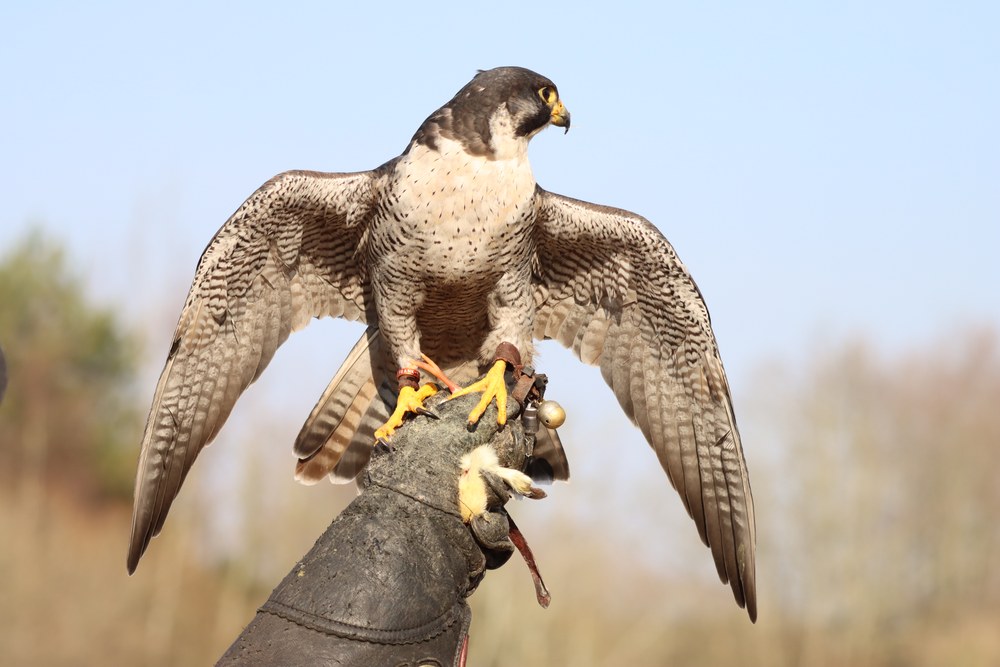
- Wingspan: 95-115cm
- Length: 40-47cm
- Weight: Males 600-750g & Females 900-1300g
The lightning speed Peregrine is the smallest bird in our program, and will chase to the falconers lure in unbelievable aerial plunges. The species is with its measured top speed of 390km/h the world's fastest animal and actually occurs in the wild here in Denmark, where it has seen an increase in recent years. This medium sized falcon feeds primarily on pigeons, sea birds, smaller ducks, thrushes etc. and is with its superior speed an apex predator in both cities, coastal regions and in mountainous habitats. The name derives from 'pilgrim' or 'wanderer' as it is one of the most widely distributed species of birds, occurring on all continents, even migrating from the northern to the southern arctic circle. The bird is due to its aerial superiority and ability to stand still, waiting in the air above its handler, an often used and highly treasured bird with falconers.
Saker Falcon (Falco cherrug)
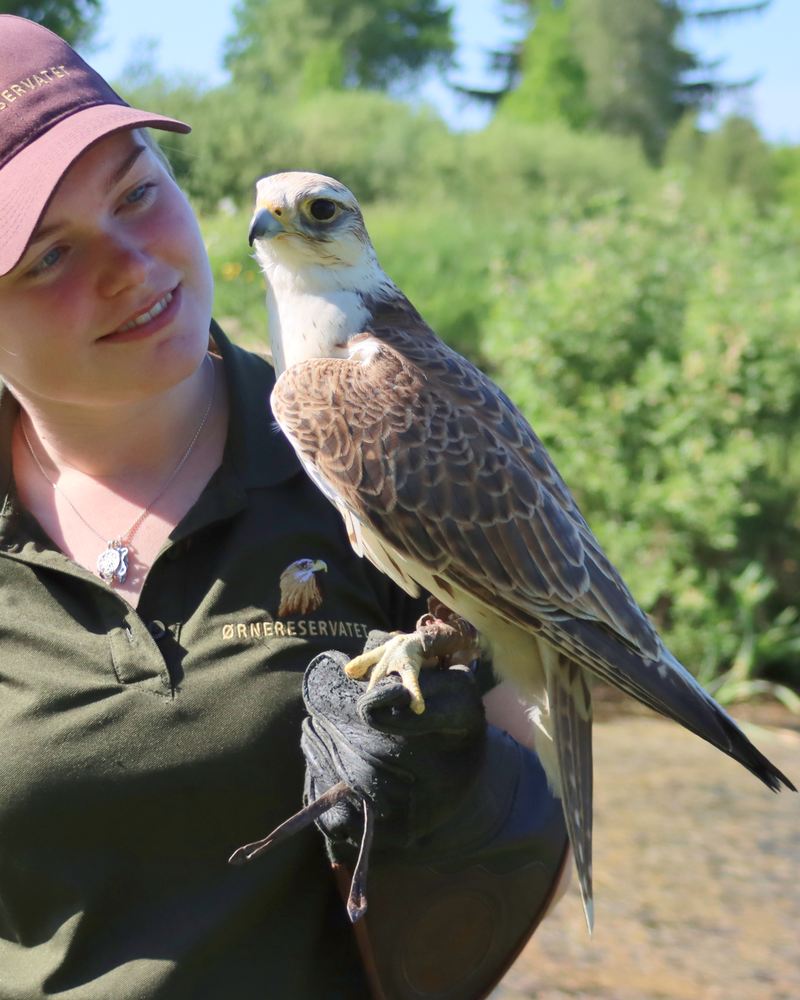
- Wingspan: 110-130cm
- Length: 47-55cm
- Weight: Males 800g & Females 1150g
This falcon, is one of the largest species and has its name from the arabian word 'Ssakar'. And it is indeed in the Middle East, Central Europe and across the Asian continent all the way to China, that this bird is found in the wild. Through history it has been cherished as a falconry bird for royalty even counting the lord of the steppes, Djenghis Khan himself. At Eagleworld you will therefore experience this species used in the original falconry discipline, in which the falconer is mounted on horseback. The Saker is especially fast in horizontal flight where it with its 110km/h quickly can fly off to far away destinations. It is not a picky eater, and this versatile bird of prey will hunt anything from pigeons, smaller herons, marmots, lizards, larks, hares and more.
Gyrfalcon (Falco rusticolus)
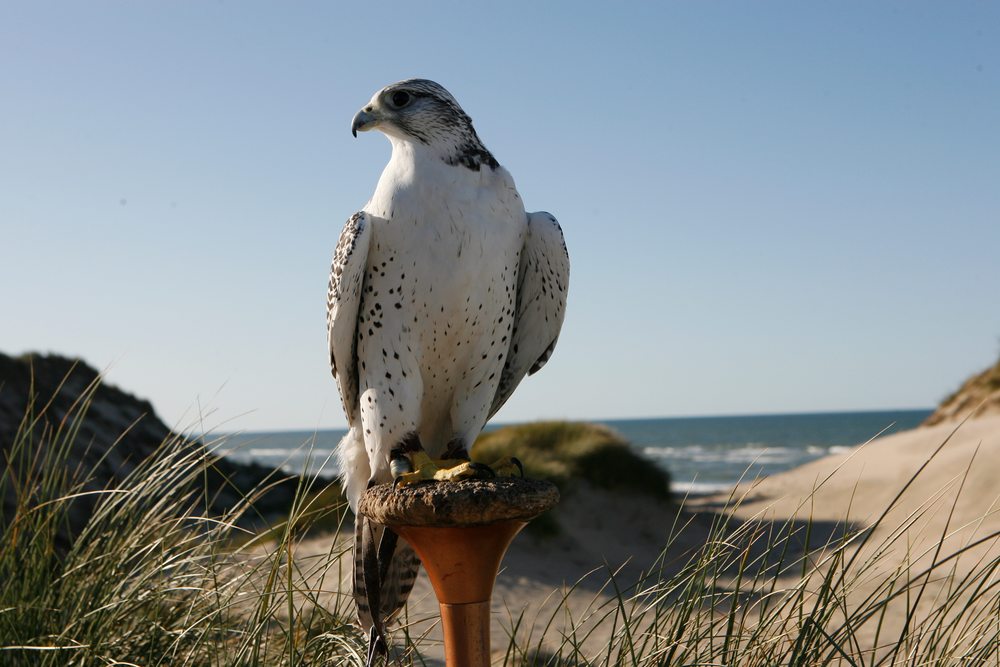
- Wingspan: 110-160cm
- Length: 48-65cm
- Weight: Males 800-1350g & Females 1180-2100g
The Gyrfalcon is the world's largest species of falcon, and has been used for hunting by man for more than 1500 years. This big, powerful falcon is found in plumages ranging from coal black, slate and pure white with all kinds of beautiful patterns in between, and is also a fabulous hunter. The species can take down quite large birds such as herons and even geese and is because of its strength and stunning presentation one of the most highly treasured falconry birds bred throughout history till now, for both kings, emperors and the sheikhs of the Levant. The Gyr lives in harsh arctic climates across the Northern hemisphere, also counting Greenland and Iceland. At Eagleworld we have a long and proud history of breeding and studying the Gyrfalcon as both a falconry bird and in the wild. You will meet this robust and charming falcon in our displays and see its enchanting skills unfold in midair with its falconer.
North-Atlantic Sea Eagle (Haliaeetus a. albicilla)
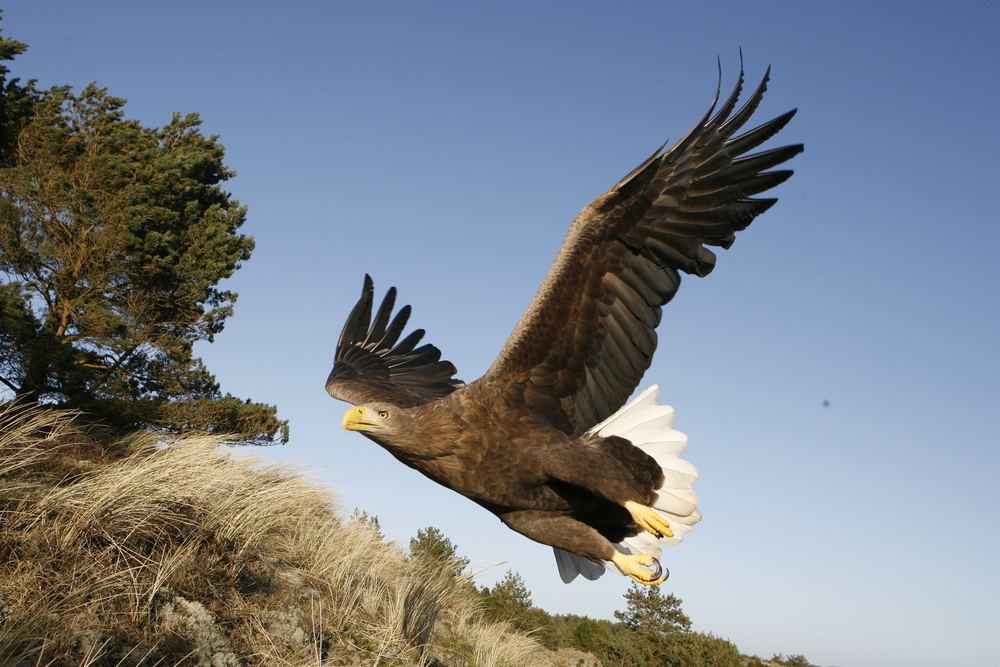
- Wingspan: 220-250cm
- Length: 65-95cm
- Weight: Males 3,1-5,4kg & Females 4-6,9kg
The North-Atlantic Sea Eagles you see here at Eagleworld, belongs to the largest species of eagles in Europe. Also known as the White-Tailed Sea Eagle, these especially big northern specimens can be found along the Danish coastlines, living mainly of fish and sea birds. Every so often it happens that they during our program will dive towards the lake before the audience, and therefore be seen exercising their most natural hunting behaviour. The eagles that let themselves be thrown through and maneuvering even the harshest stormwinds, are not classic falconry birds, but have been studied and bred as a means of wildlife conservation, here at Eagleworld through decades. This is one of the reasons why we as something quite special, have achieved training a large Sea Eagle to fly to a falconers glove, mounted on horseback. In the program you will witness these hardy eagles – up to three at once – showing off their astonishing flying skills, occasionally in blazing dives over the lake and also gliding right above the seated audiences, onto the glove of its falconer on the Friesian horse, with whom a remarkable friendship has risen.
Golden Eagle (Aquila chrysaetos)
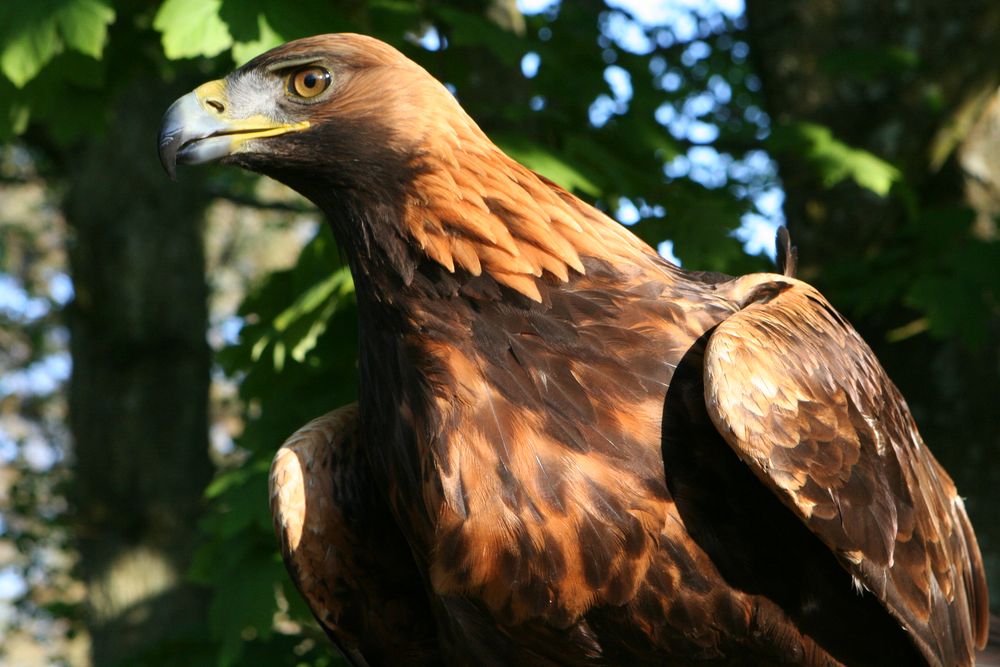
- Wingspan: 185-225cm
- Length: 65-100cm
- Weight: Males 2,8-4,6kg & Females 3,8-7kg
The Golden Eagle is the largest of all classically used falconry birds. They are still to this day used for hunting wolves by the famous riding nomads of the Mongolian steppes, and are hereby capable of taking down quite sizable mammals, when hunting with man. With a vision that is about 8 times better than ours, they can search enormous areas for prey – this consisting mainly of lemmings, rabbits, hares, foxes and even smaller species of deer.
In Denmark this beautiful, top-of-the-foodchain bird of prey has seen progress with a couple of breeding pairs nesting in recent years, sadly however, there has also been comparably many that have perished, as a result of shooting or poisoning by the hand of humans. It is one of Eagleworld's most important tasks to convey knowledge in order to support the conservation of and respect for the wild birds of prey, and during the program you will be able to see the Golden Eagle as it flies about in a terrain quite natural for the species.
Verreaux's Eagle (Aquila verreauxii)
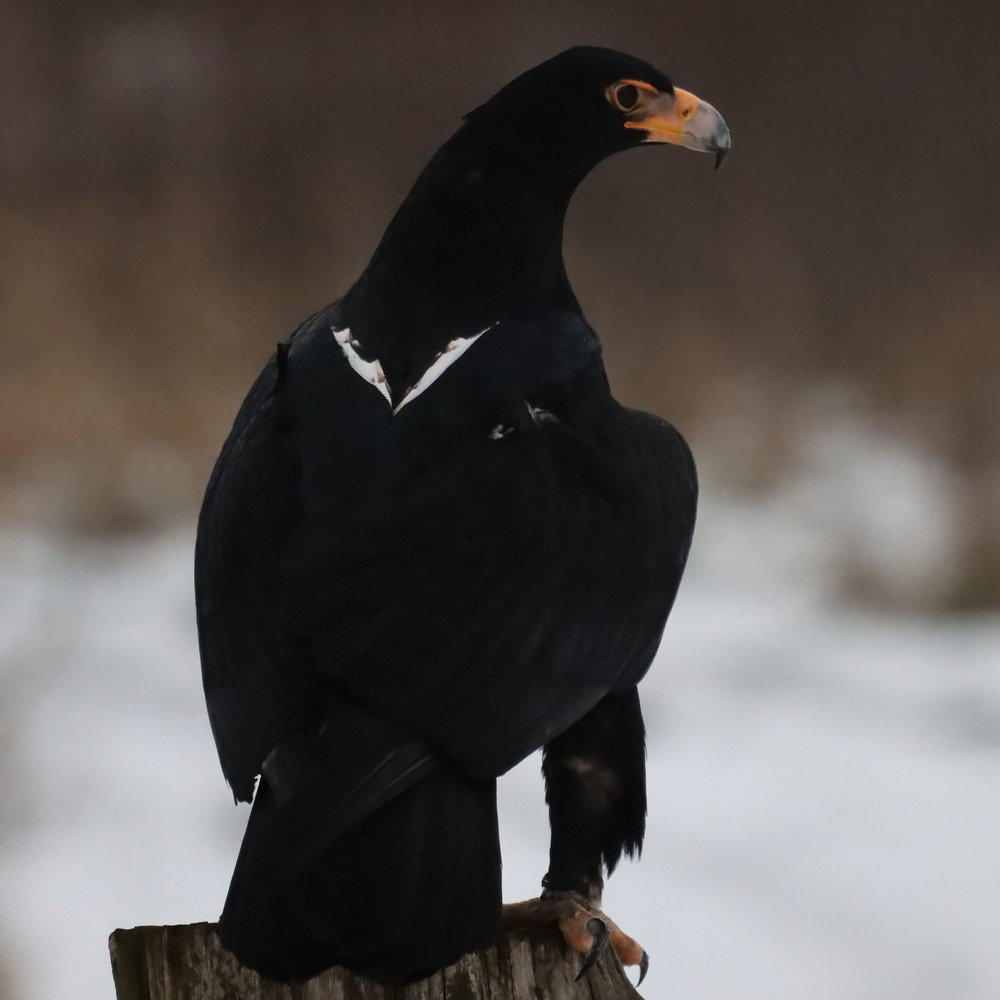
- Wingspan: 180-220cm
- Length: 75-90cm
- Weight: Males 3-4,2kg & Females 3,1-5,8kg
The glorious, jet black eagle that is found living in the mountainous regions of Africa, is easily recognised by its unique, shining plumage and the white 'V' across its back. It has received its name as a fitting homage to the French naturalist Jules Verreaux. This species, that is of the same family as the Golden Eagle, is a skilled hunter that mates for life. However opposite to the Golden Eagle, this species is quite the picky eater, and its prey consists almost entirely of two species of cliff hiraxes that live near their nesting spots, that remarkably can be found in heights of up to 4 kilometres. At Eagleworld you will therefore have the exceptionally rare opportunity of seeing the gorgeous Verreaux's Eagle at closest proximity, as it wanders about in the midst of the seated audience with its falconer, before again taking off right before the bleachers.
Bearded Vulture (Gypaetus barbatus)
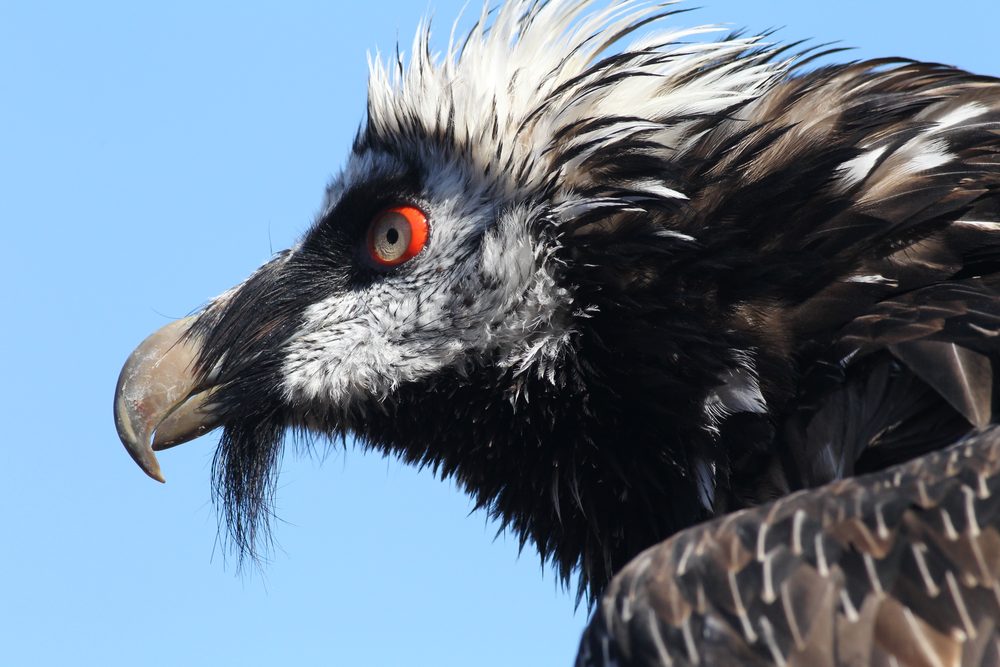
- Wingspan: 2,3-3 metres
- Length: 95-125cm
- Weight: 4,5-7,8kg
The Bearded Vulture, at times known as the Lammergeier, is in a class of its own. The enormous bird that sports a slate, scaly-looking plumage and white chest, black beard tufts by its beak and red eye-circles, resembles nothing less than a great, flying dragon. The species is found widely distributed across the central Eurasian continent, from the Pyrenees to China and even with rare occurrences in Eastern Africa. They live in raw, mountain regions where it decorates itself to attract mates, with powders of red iron oxide/ochre and live off what ever carcasses it finds. Something rather special for this vulture, that quite unlike other carrion birds does not have a naked head or neck, is that the acids in their digestive system, are far stronger than even battery acids. This is necessary in order for it to dissolve bones and marrow, seeing as this mythical looking bird will swallow quite large femur bones in one piece. The incomparable Bearded Vulture can be seen and notably also heard in our program, as its colossal wingspan rushes it right nearby the audience, presenting its remarkable self as our so far largest raptor, here at Eagleworld.
Steller's Sea Eagle (Haliaeetus pelagicus)
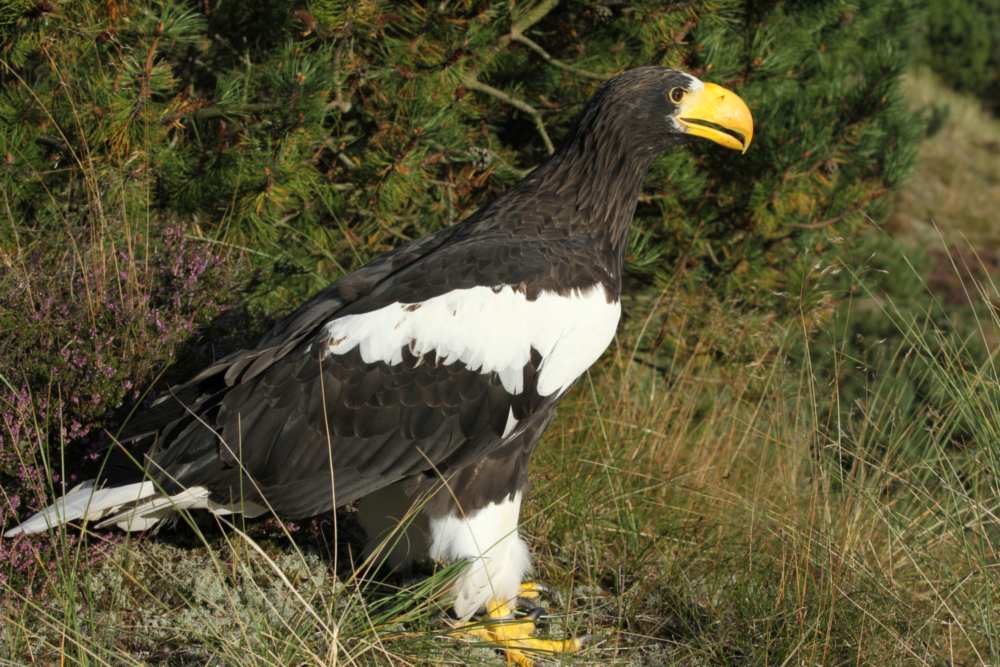
- Wingspan: 2-2,6 metres
- Length: 85-100cm
- Weight: Males 4,9-6,8kg & Females 6,2-9,5kg
The Steller's Eagles are by many considered the largest eagles in the world – only disputed with competition from the Harpy and Philippine Eagle. These bears of the sky, that are closely related to the North-Atlantic Sea Eagles, are also a species of sea eagles living along coastal regions, that seek their food by both fishing, catching sea birds and even feeding off whale and seal carcasses. This bird of prey lives by the Northern coasts of Asia and all the way onto Sakhalin in Japan and on the Kamchatka peninsula of Eastern Russia. At Eagleworld we will, as the only place in the world, present something as action packed to you, as a genuine eagle-car chase, where the giant eagle with its 150km/h flies through the rough terrain chasing a four wheel drive, landing on the stretched out glove of the driver – thereby showing off the cooperation between man, technology and eagle in a top modern and if we should say so ourselves, pretty cool way!
Andean Condor (Vultur gryphus)
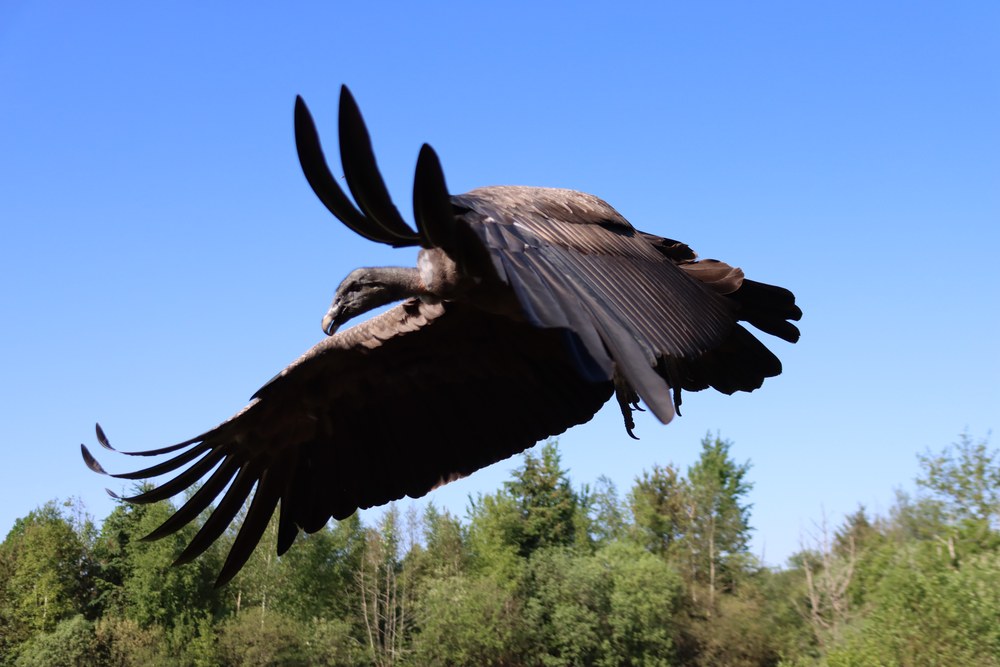
- Wingspan: 3–3.5 m
- Length: 120 cm
- Weight: approx. 7 kg for females – up to approx. 15 kg for males
The Andean condor, named Molina, was just a fluffy chick when it arrived at Ørnereservatet in November 2018 from Wildpark Lüneburger Heide in Germany. The park runs a major condor breeding program for the endangered species and is the only place that has succeeded in getting this large bird of prey to reproduce in captivity.
Since Molina’s arrival, the owner of Ørnereservatet, Peter Wenzel, has trained the condor every day. The progress has exceeded all expectations, and Molina is now ready to take flight under the open sky.
The rapid results and the strong bond between Molina and Peter Wenzel have made a positive impression south of the border.
“Training and handling an Andean condor requires special skills, knowledge, experience, and that innate sense for birds that can’t be taught. We’re very happy to see and hear that Molina has found a perfect new home and a wonderful new ‘father’ in Peter at Ørnereservatet! We are in close contact and look forward to future collaboration and sharing of experiences,” says Michael Kirchner, head of the condor program at Wildpark Lüneburger Heide, where Molina was born.
A Misunderstood Animal
And when Peter Wenzel is affectionately referred to as the condor’s “father,” it’s not just a figure of speech.
The Andean condor is highly loyal and forms strong bonds.
“In the wild, a condor depends on its parents until it’s eight years old, but since Molina was born in captivity, I’ve taken on something of a parental role,” says Peter Wenzel.
There is already a vulture living at Ørnereservatet, and Wenzel is passionate about spreading knowledge about vulture species, as many myths and misunderstandings surround them. Just think about how vultures are portrayed as cold omens of death in, for example, Lucky Luke comics—or how the word “vulture” is used as a synonym for greed in inheritance disputes.
Myths and unfounded fears have also contributed to the Andean condor becoming endangered in South America, where locals sometimes lay out poison for them.
“At Ørnereservatet, we want to contribute to greater understanding and respect for vulture species. Condors are nature’s cleanup crew and do an irreplaceable job in preventing the spread of disease by consuming dead animals. They are strong and can handle partially decayed food—but they cannot withstand human-made threats,” he says.
Can you tell the birds apart? Play our memory game and meet the birds of prey →
EAGLEWORLD'S HORSES
At Eagleworld you will not only meet a selection of fascinating birds of prey, seeing as we also love horses and through many years have mastered and developed the challenging and importantly also historically original discipline of mounted falconry. Below you can read a brief description of the horses you will encounter during the program.
Danish Warmblood
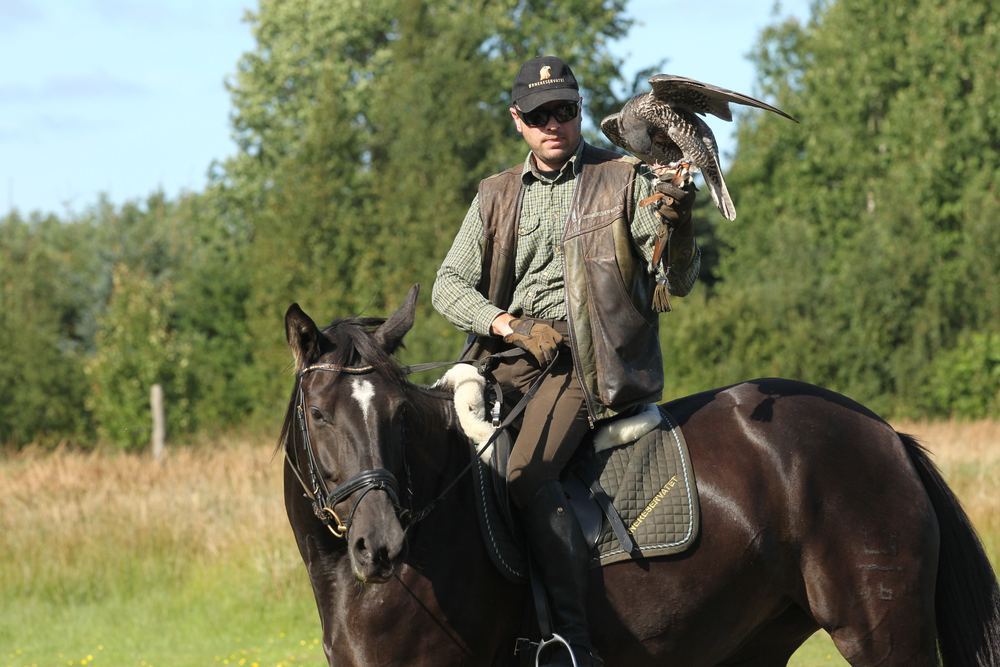
The Danish Warmblood is a quite recent breed of horses, established here in Denmark in the middle of the 20th century, bred from older European horse breeds. Denmark has an old and proud tradition in selective breeding of horses, that began already in the 14th century with the Cistercian monks of German Holstein, that once lay under Danish rule. They crossed the best Spanish horses with large, northern German mares, from which the Frederiksborg Horse arose. From this we bred in Holsteiners, Trakehners and Fullbloods, with which the Danish Warmblood was founded. Today, the breed is a versatile sporting horse used in all disciplines spanning both dressage, jumping, military and in hunts. It is known for its cooperative nature, sturdiness and alertness, which here at Eagleworld have made it a surefire horse for classic mounted falconry using Saker- and Gyrfalcons.
The Friesian
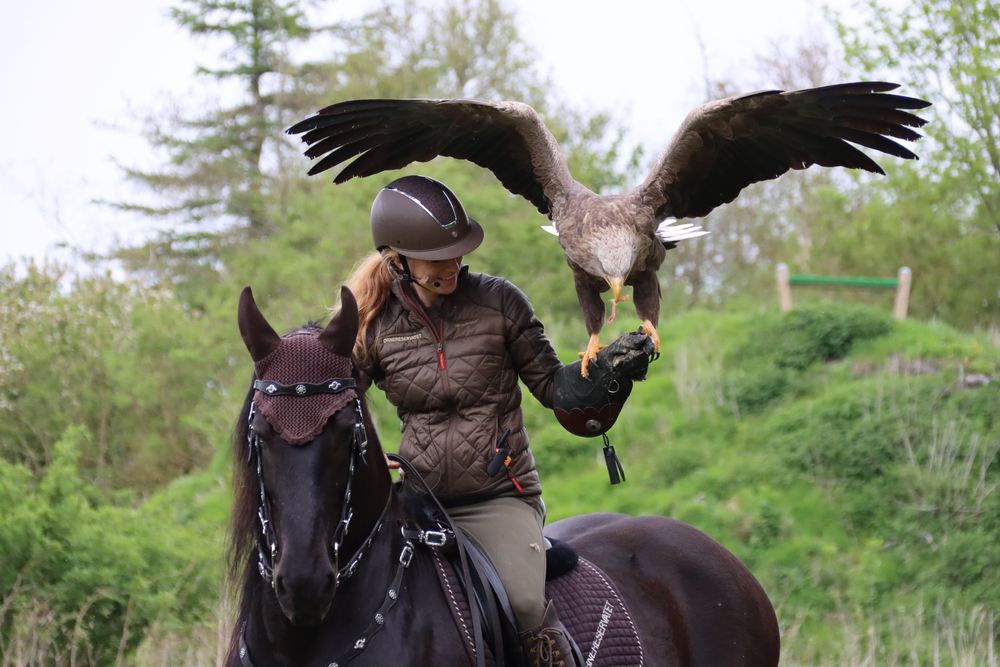
From the world of movies most of us now know the always black Friesian horse, with the wavy mane and feathered hoofs. This cold blood is one of the baroque breeds, and stems from The Netherlands where it through the ages have been used perhaps more diversely than any other breed of horses. Both as a show horse, carriage horse, for dressage and even in historical wars as for instance employed by the Roman legions as sturdy warhorses. The breed has an ancient origin with the primitive, European forest horses and thereby has roots stretching back before the birth of Christ. This horse is besides its good looks characterized by a sociable mind and a robust presentation, all adding to why we here at Eagleworld have been lucky to produce a highly unlikely friendship with one of our great North-Atlantic Sea Eagles. Right in front of the audience you will see how the grand eagle lands on a riders glove, with its wingspan spread out above the proud black horse.
Andalusian/PRE
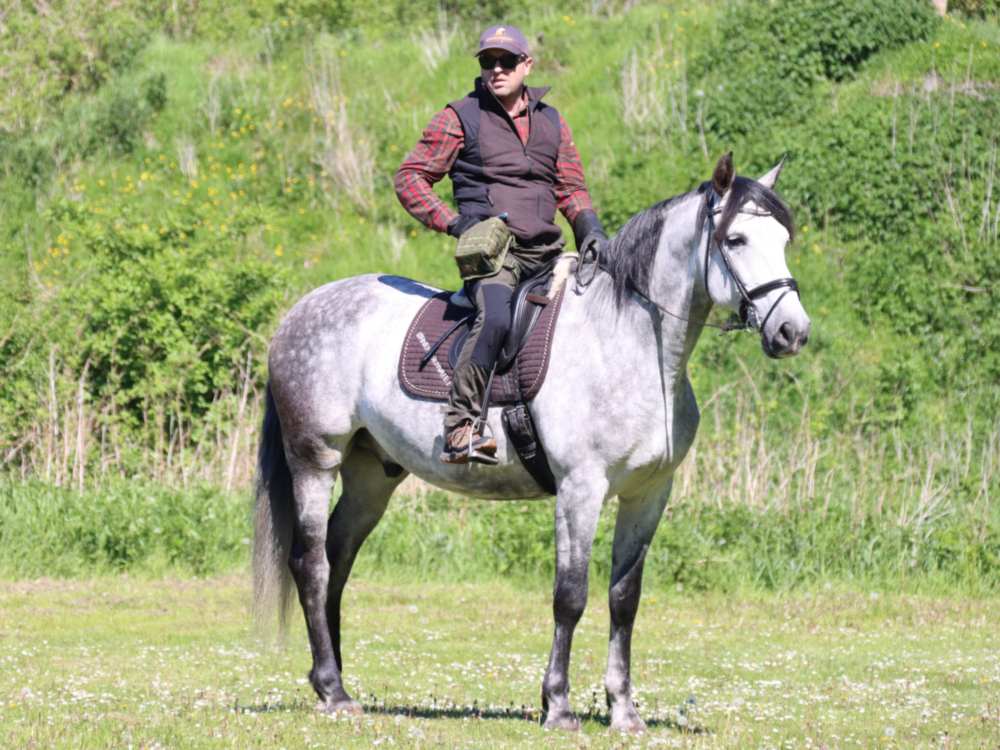
The Andalusian horse of Spain, is the number one horse breed to influence the breeding of domesticated horses across the globe. From the renaissance and all the way to the French revolution, it was the horse all desired to master in dressage. The royals and nobles of Europe's finest courts have therefore had their own Andalusians, and seeing as falconry in earlier times were reserved for nobility only, you can imagine how the Andalusian must have carried many falconers throughout the centuries. This athletic and agile horse is a genuine muscle car of horse breeds; its compact and upright posture makes it highly manoeuvrable and their intelligent nature and sharp senses that have been developed and refined through the ages, allows it to work with super fast falcons diving towards the mounted falconer from constantly changing angles. Here at Eagleworld we are happy to present an Andalusian horse that is being trained in this highly demanding equestrian discipline, that you can sit back and take in during our program.
Special guests: the owls
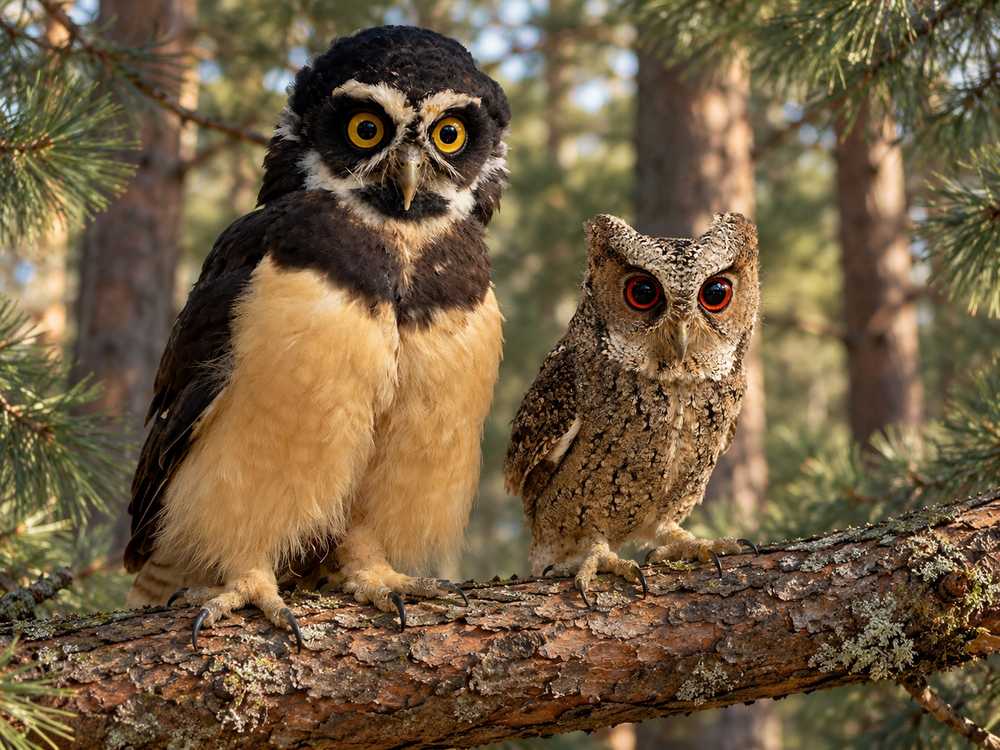
On special occasions you may also meet two of our owls during your visit: the spectacled owl (Pulsatrix perspicillata) and the Philippine scops owl (Otus megalotis). They are not a fixed part of the daily display, but appear when the occasion calls for it.
New: Owl Ears – can you find the mouse in the dark with an owl's hearing? →
Plan the drive: see Traffic info →
Arriving by cruise ship in Skagen? See information for cruise guests
New in the shop: Eagle World T-shirts and caps – for kids and adults

