


Being a falconer: a craft with wings, all over the world
From the steppes of Mongolia to the moors of Scotland and the fields of North Jutland, there are people all over the world who have devoted their lives to training and hunting with birds of prey. What does a falconer actually do, how do you become one, and what does the law say? Here is a guide to falconry from an international point of view.
According to UNESCO, falconry is a tradition that has been practised for more than 4,000 years. Today people of all ages practise it in many countries, and it is inscribed on UNESCO's list of the Intangible Cultural Heritage of Humanity.1 The international falconry body IAF (International Association for Falconry and Conservation of Birds of Prey) represents around 120 member organisations in 90 countries.2 BBC World Service has described falconry as present in more than 90 countries.3
In the mid-13th century, Emperor Frederick II wrote his great work on hunting with birds, De arte venandi cum avibus. One of its best-known manuscripts can be viewed online at the Vatican Library.1045 In Denmark, a royal falconry stood in the 1600s where Falkoner Allé in Copenhagen runs today, and white gyrfalcons from Greenland were a royal gift.34 Eagle World's founder, Frank Wenzel, tells that story in Kongernes jagtfalke (2010, in English Gyrfalcons of the Kings), which you can read for free on Issuu.47
Frank Wenzel is regarded as one of the best-known falconers in the world. In 2016 the Danish newspaper Ekstra Bladet called him "an icon among the world's falconers and ornithologists" (translated from Danish).60 At 20 he was apprenticed as a falconer in Germany under the president of the German falconry association, and in 1962 he became the first person in Scandinavia to resume falconry in Denmark.61 His own words accompany you through this article.
Contents
- What is a falconer?
- How do falconers hunt, and with which birds?
- Equipment: from glove to GPS
- The ABC of the hunt, step by step
- How to become a falconer, country by country
- Countries at a glance
- International law: UNESCO, the EU and CITES
- Denmark: what is allowed today?
- Hunting seasons: a few examples
- Can anyone become a falconer?
- Everyday life: care, time and responsibility
- How to get started as a visitor or beginner
- Falconry words
- See falconry up close
- On eagleworld.dk
- Read more
- Notes
What is a falconer?
UNESCO describes falconry as the art of training and flying falcons, and sometimes eagles, hawks, buzzards and other birds of prey.1 The Austrian falconers' association, the Österreichischer Falknerbund, puts it simply: a falconer is a person who keeps one or more birds of prey in order to train them and use them for hunting.4 The Danish regulations say almost the same thing but add that, through training, the falconer must have gained the control over the bird that hunting requires.5
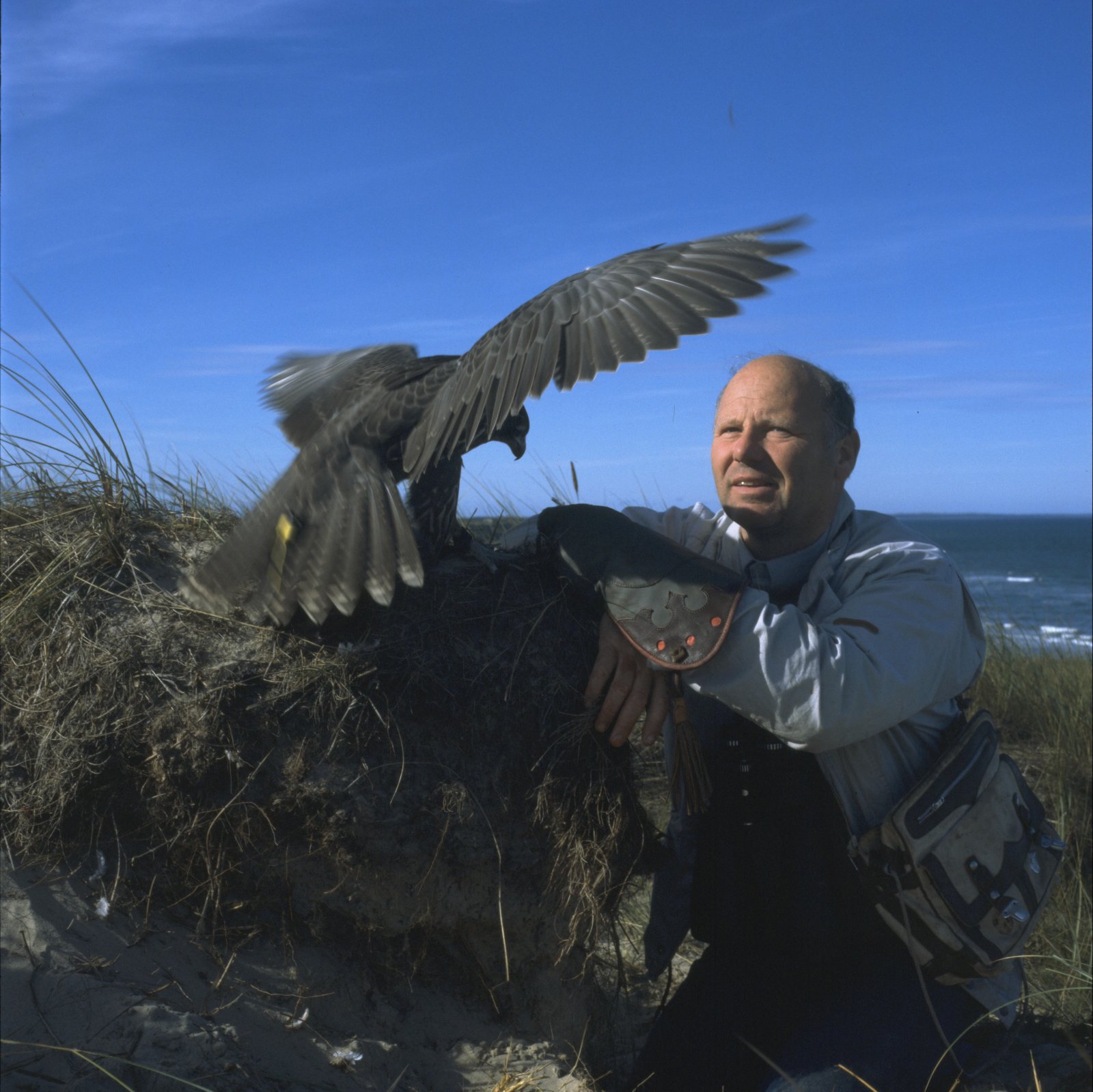
Frank Wenzel with a gyrfalcon on the glove by the sea.
At its heart, then, falconry is a partnership. The bird hunts because that is its nature. The falconer's job is to create the right conditions and to be there when the bird catches its prey. According to UNESCO, modern falconry also focuses on protecting the birds, their quarry and their habitats.1
"As they are shyer than other animals and harder to get close to, it has also taken me many, many years to learn their body language."
— Frank Wenzel (translated from Danish)62
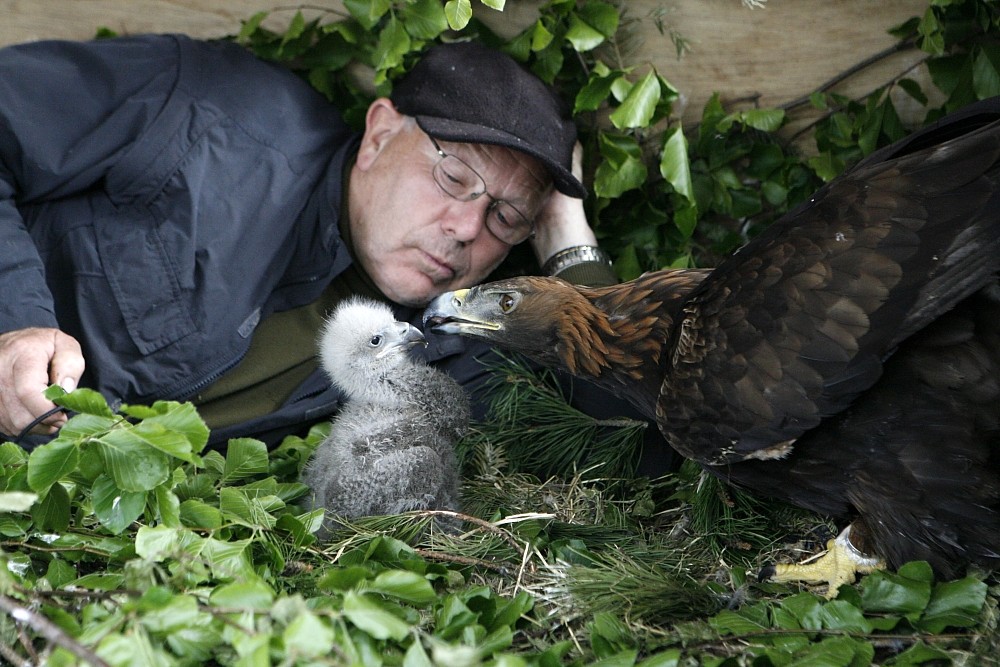
How do falconers hunt, and with which birds?
Falconers traditionally divide hunting birds into three groups. You can see this, for example, in the reading list for new falconers published by the New York State Falconry Association.6
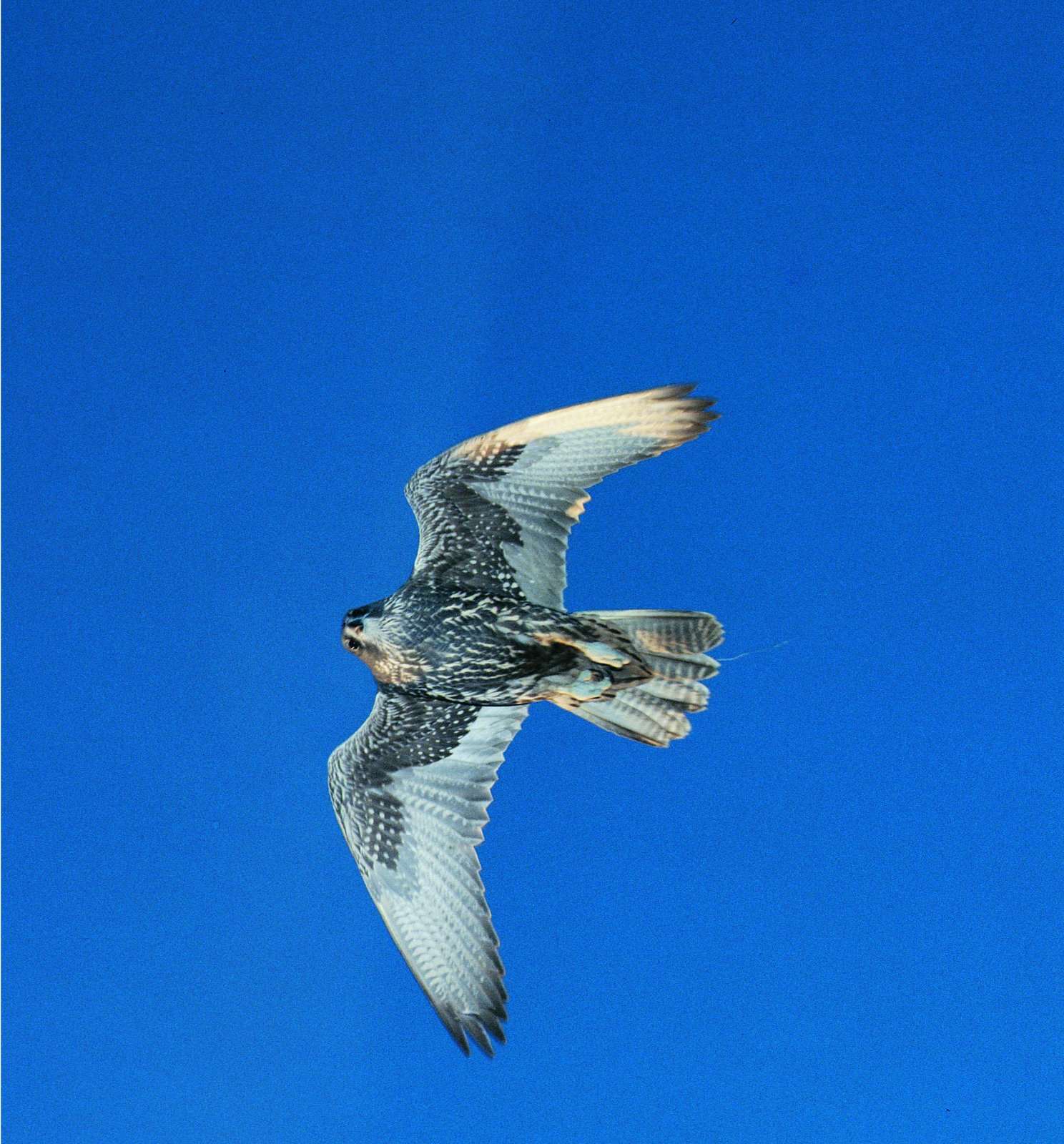
A gyrfalcon at full speed. Falcons hunt in open country.
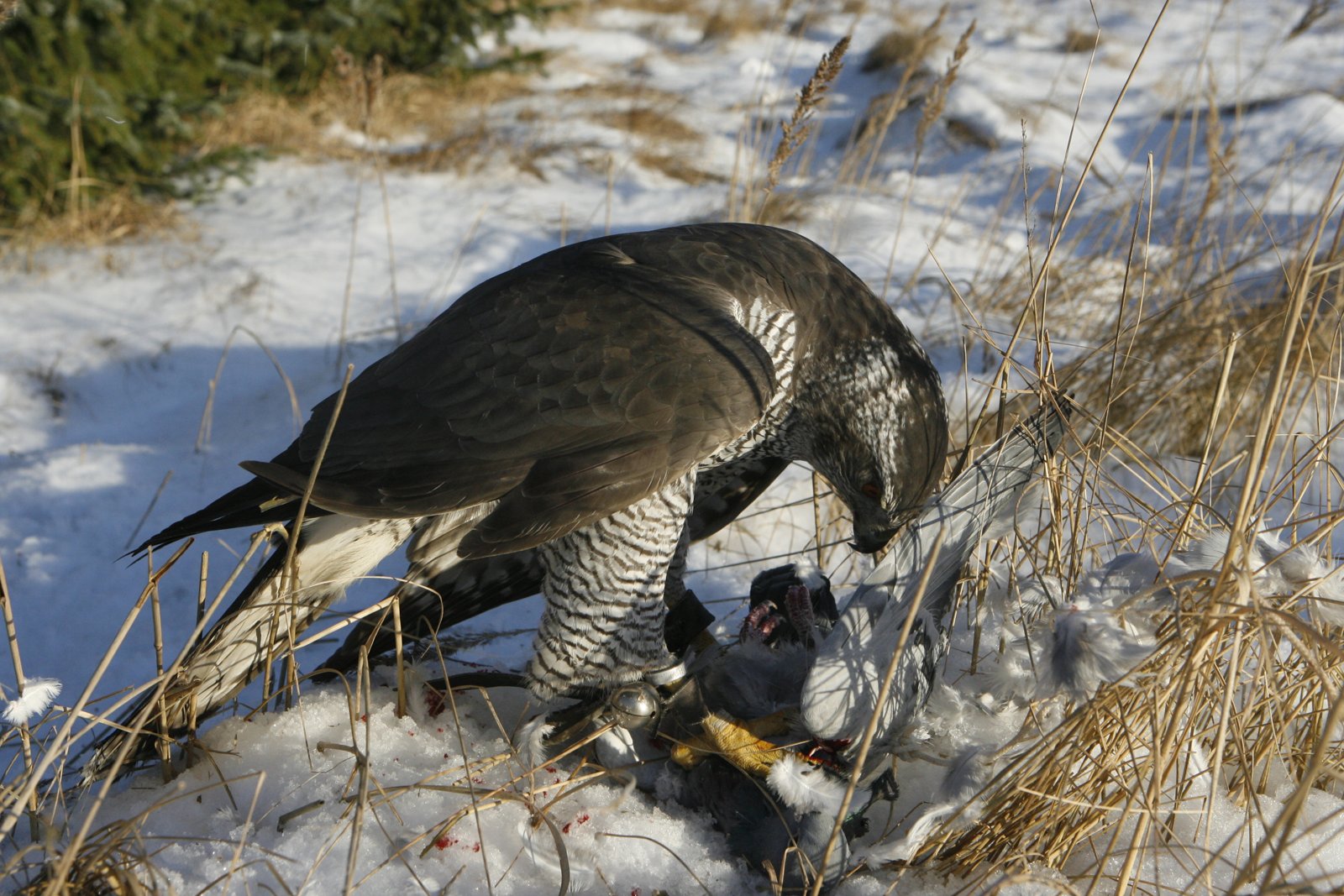
A goshawk on its quarry in the snow.
Facts
- Longwings (falcons) such as the peregrine, saker and gyrfalcon. The falcon climbs high and then dives (stoops) at its prey, often birds such as ducks and gamebirds.10 In Spanish this is called altanería, high flight.7
- Shortwings (hawks) such as the goshawk and sparrowhawk hunt close to the ground, in Spanish bajo vuelo (low flight).7 Deutschlandfunk Kultur followed a falconer in Berlin's Tiergarten park, where a goshawk hunts rabbits that damage trees and shrubs. A dog flushes the rabbits, and the hawk catches them with its talons.8
- Broadwings (buzzards and eagles) such as the Harris's hawk and golden eagle. Among Kazakh eagle hunters in western Mongolia, the hunt takes place on horseback. The eagle rides on the hunter's arm with a hood over its eyes, and the hood only comes off when it is time to scan for prey.9
In the large falcons, by the way, the female is about a third bigger than the male.10
"The falcon itself is nature's masterpiece in terms of beauty and elegant flying skills."
— Frank Wenzel63
Denmark offers a concrete example. In the first four seasons after falconry became legal again (2018–2022), Danish falconers used seven species: peregrine, Barbary falcon, lanner, saker, Harris's hawk, black-chested buzzard-eagle and African goshawk. The peregrine accounted for 47% of reported game and the Harris's hawk for 21%. Quarry included ducks, pheasants, hares, rabbits and crows.11
Equipment: from glove to GPS
Much of the equipment is ancient, but new technology has been added too.
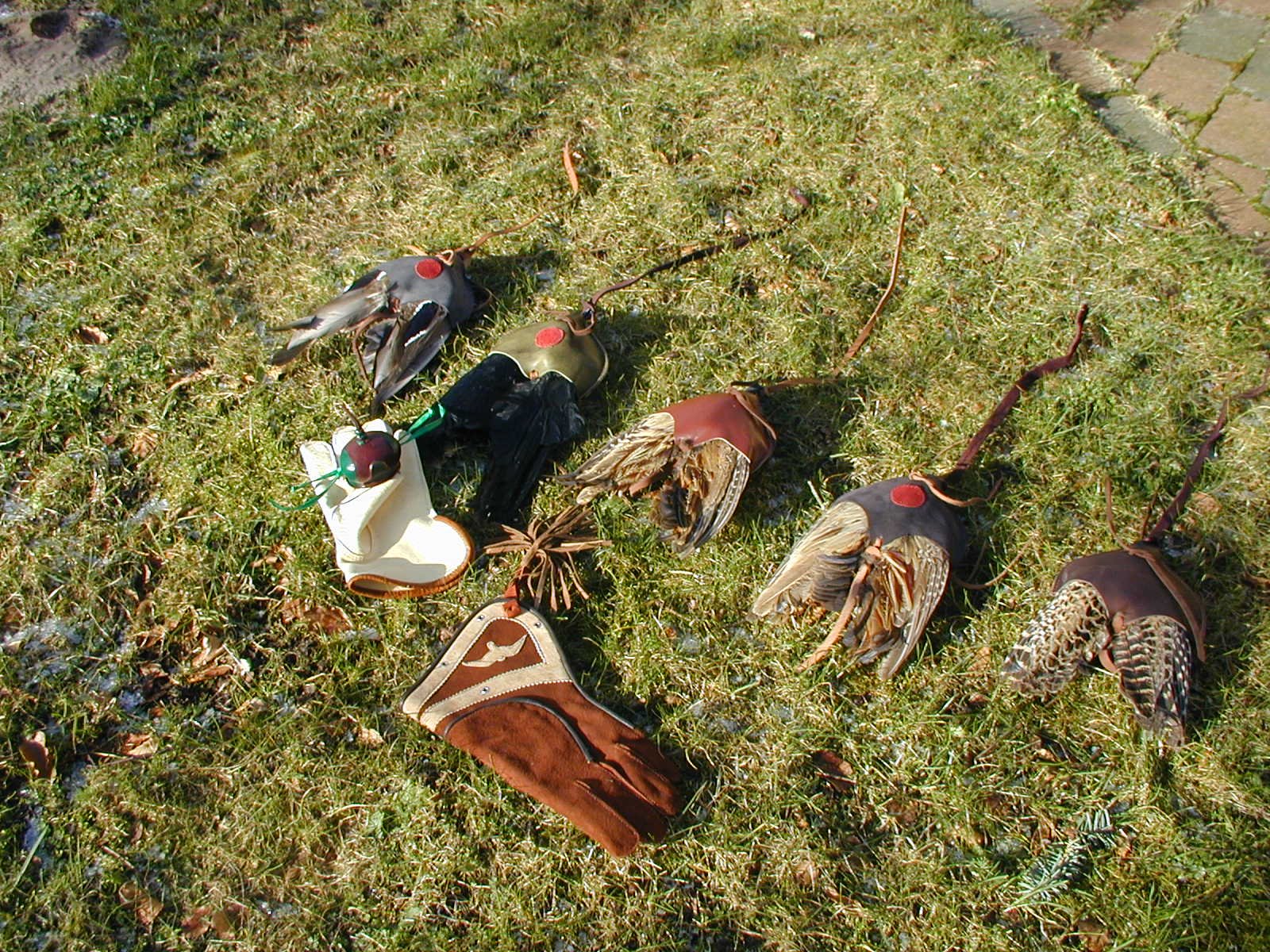
The falconer's kit: hoods, glove and bag.
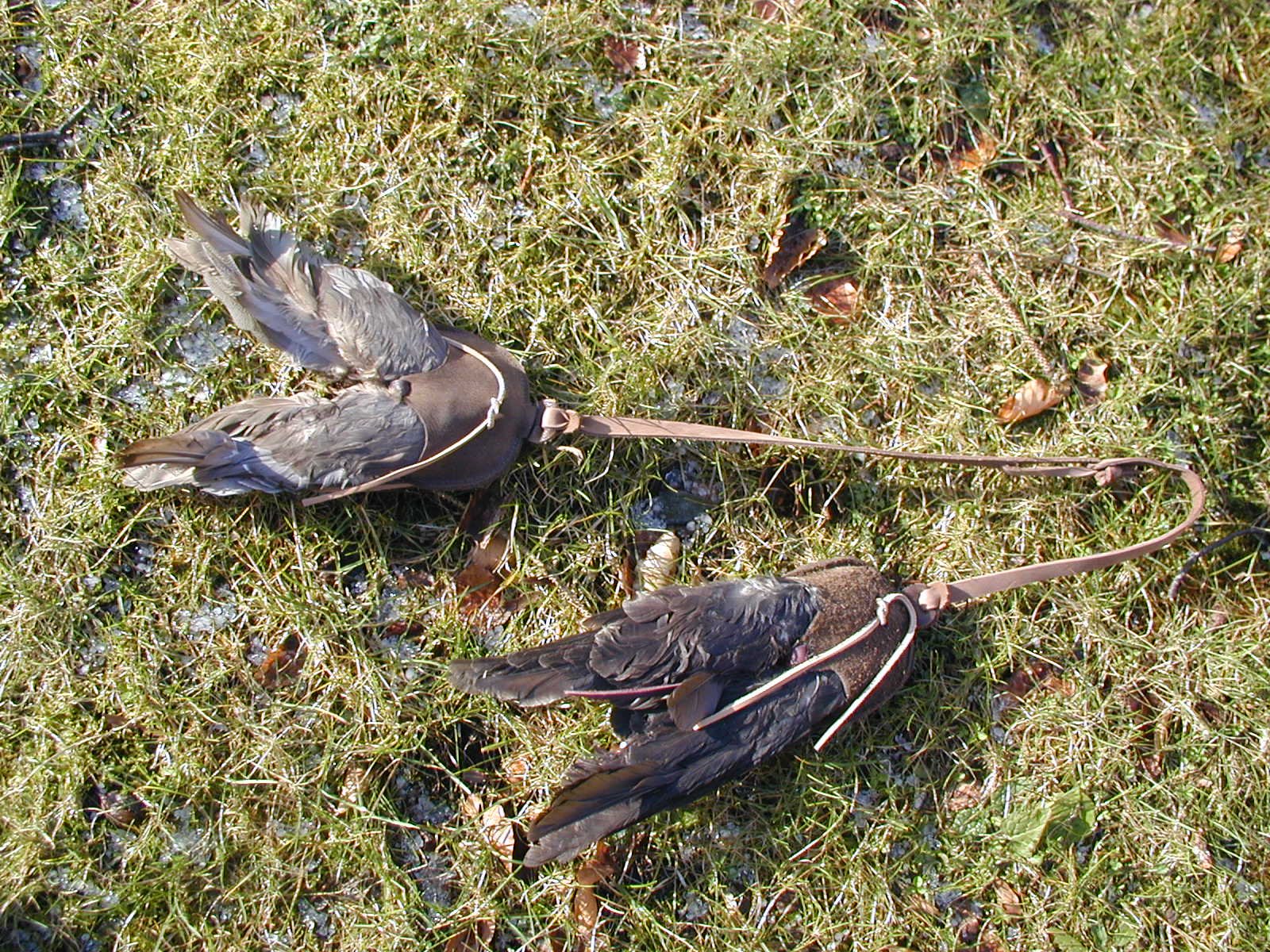
The lure is used to train the falcon and call it back.
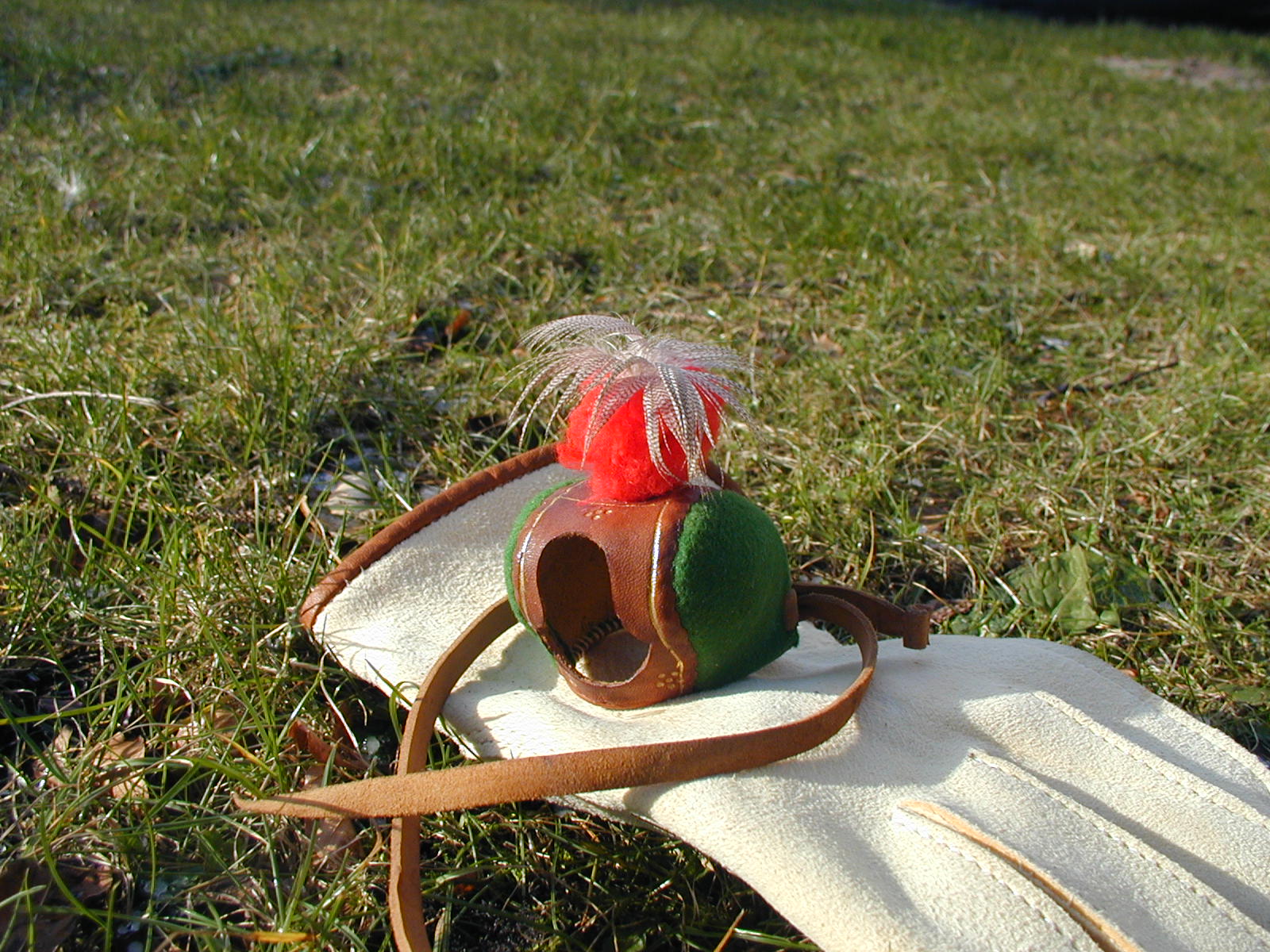
The hood covers the bird's eyes so it stays calm while being carried and until the hunt begins. The hood came to Europe from the Middle East in the Middle Ages.
Read more about the falcon hood →
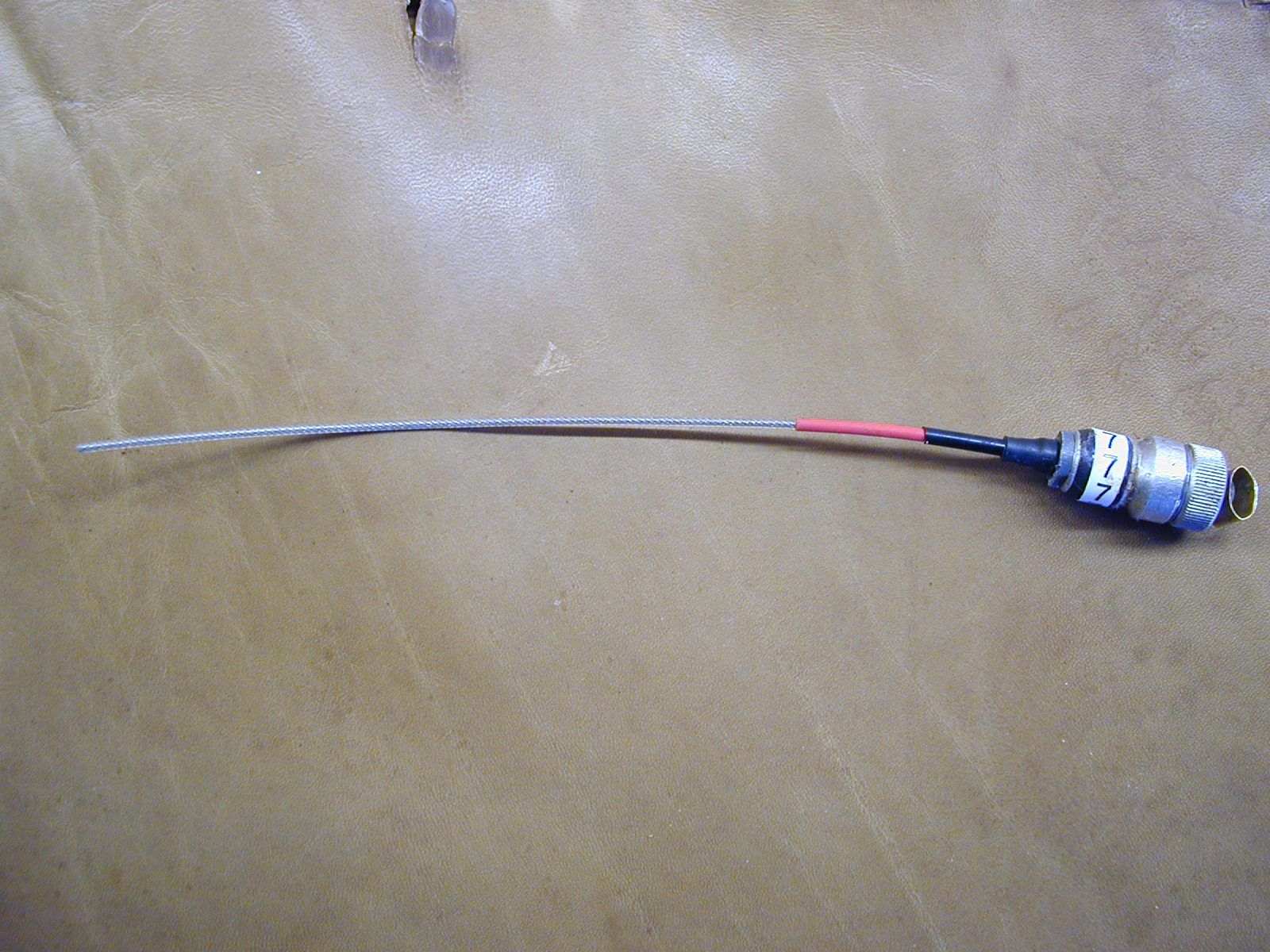
A small radio transmitter is fitted to the bird before the hunt. If it flies out of sight, the falconer can find it again with a receiver and antenna. The transmitter weighs only about 10 grams. A GPS transmitter has a short battery life, typically 2–4 days, while the traditional transmitter without GPS can last up to 10 days or longer, depending on conditions.
Facts
- The glove is made of thick leather and protects the hand and forearm while the bird sits on it.8
- Jesses (leather straps on the legs; Geschüh in German) are used with a leash and swivel (a rotating link) to hold and tether the bird. The US rules require exactly these items, plus a bath and scales.12
- The hood is a leather cap over the eyes. It is used, for example, while the bird is carried to the hunting ground.9 The UK's Hawk Board recommends that hoods should not be left on for long periods.13 Read more about the falcon hood.
- Bells make the bird easier to find and show that it is a falconer's bird.8
- Telemetry means a radio or GPS transmitter. It is required in Denmark during training, hunting and pest control5 and in Andalusia during free flight.7
- Perch and mews: the bird must have a suitable perch and a safe place to live.12
- The lure (a dummy the bird flies to) and the creance (a long training line) are used during training.12
The ABC of the hunt, step by step
Before a bird of prey can hunt, it must be trained carefully, step by step, until it knows the falconer and reliably comes back.54 The hunting day itself follows much the same steps all over the world, although the details depend on the bird, the quarry and the landscape.54
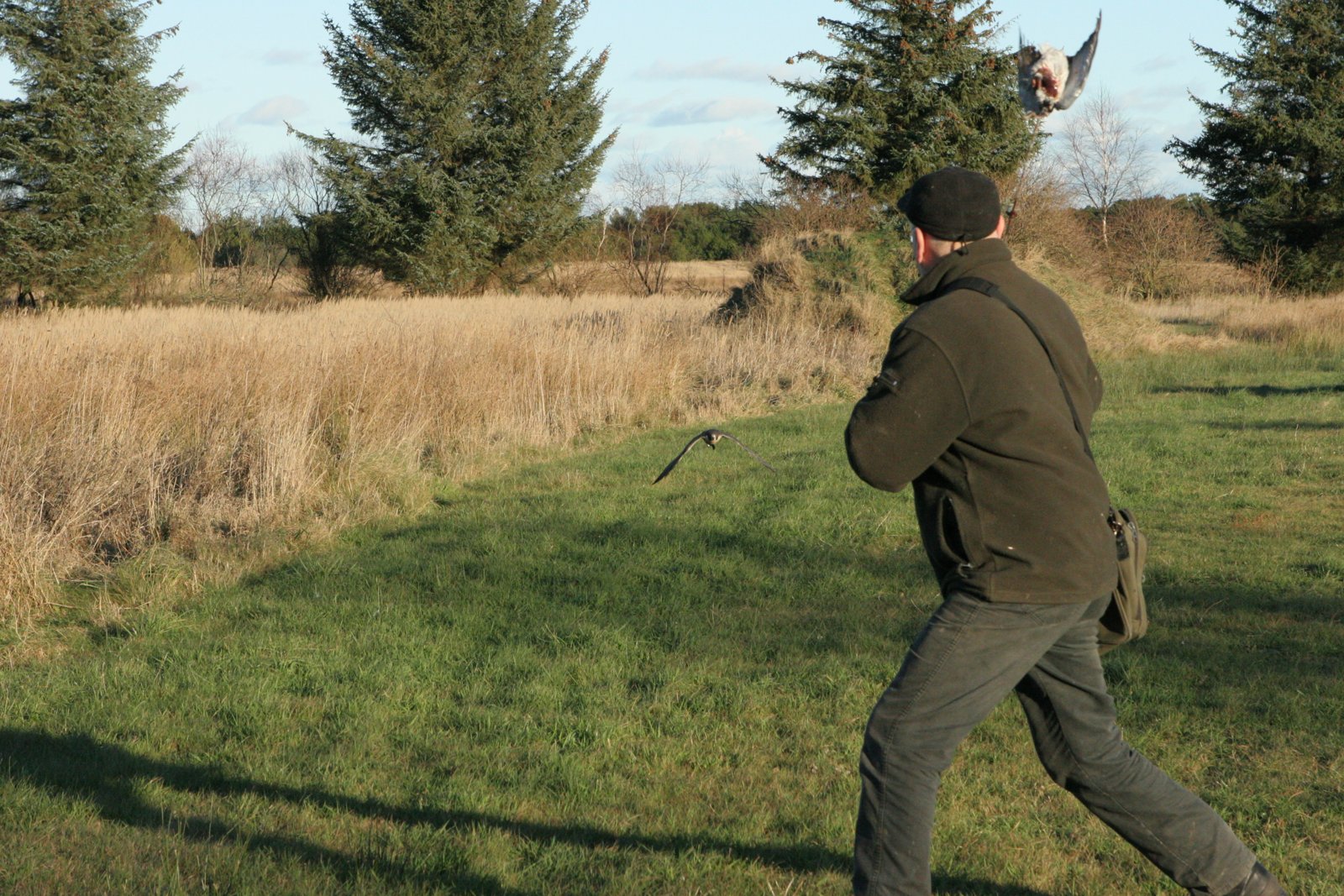
In the field: the falconer follows the bird across the land.
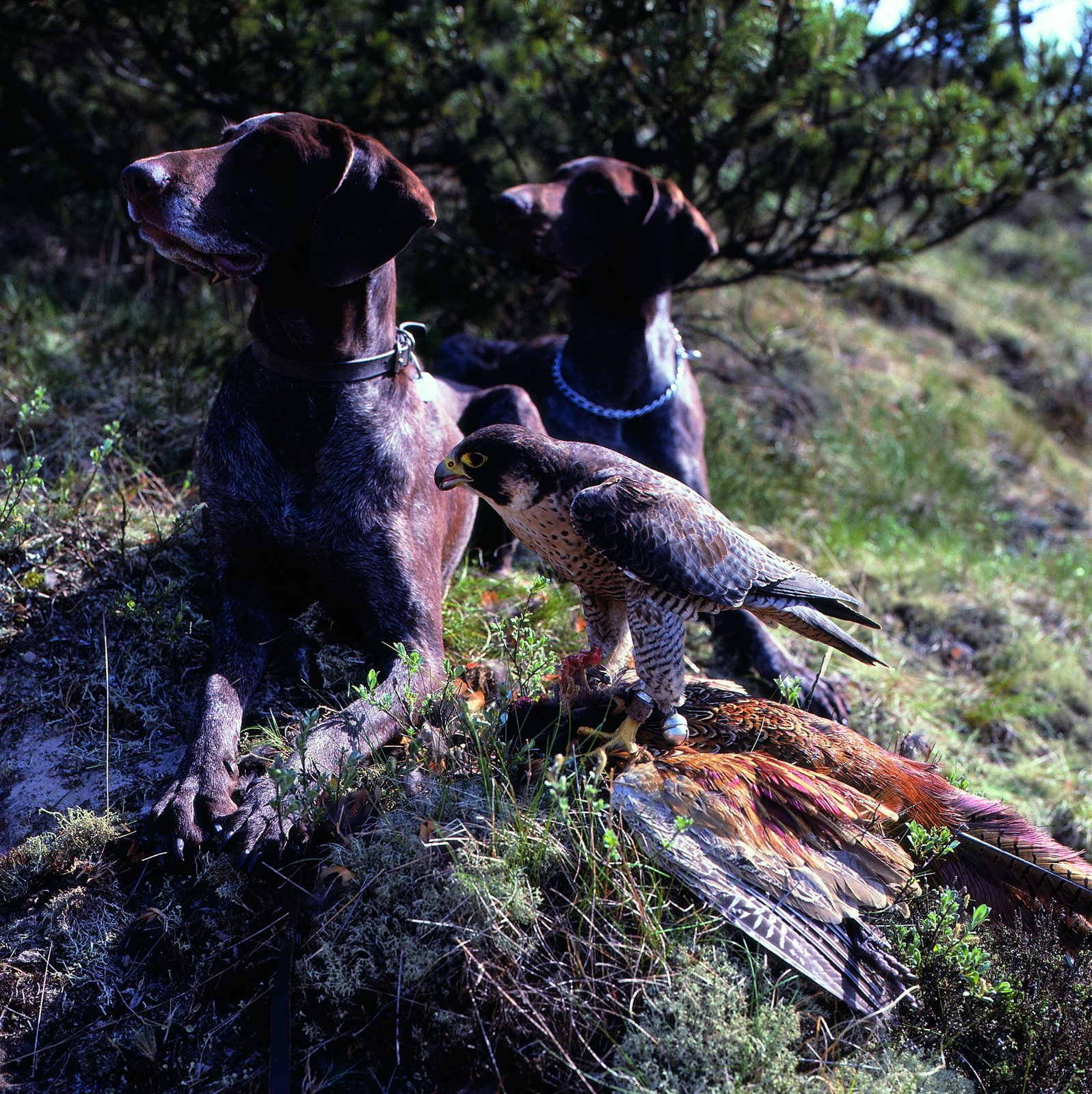
Peregrine and pointers – a classic hunting team.
Step 1
Preparation. The falconer weighs the bird. It needs to be at its "flying weight", the weight at which it would hunt in the wild. This differs from bird to bird, and an overweight bird is comparatively wild.54 The British Falconers' Club names weight and body condition as key welfare indicators.58 The falconer also checks the weather, especially the direction and strength of the wind,59 checks the equipment and fits the transmitter so the bird can be found again.545
Step 2
Into the field. Birds should only be flown free where the landowner has given permission.58 Falcons are flown over open country such as desert and moorland so the falconer can keep them in sight. Hawks are better suited to woodland and cover.54 The wind is used actively: in classic game hawking with falcons, the quarry is usually put up by walking downwind.59 A pointing dog, such as a pointer or setter, works the field systematically and freezes in front of the quarry without flushing it.55
Step 3
Flying the bird. When the dog is on point, the falcon's hood comes off. It climbs, often to more than 80 metres, and circles above falconer and dog. This is called "waiting on".5554 Hawks and buzzards instead fly straight from the fist or from a tree when the quarry shows itself.54
Step 4
The flight. The quarry is flushed, and the falcon stoops. A peregrine can exceed 200 km/h.55 Often the quarry escapes by dodging or reaching cover, and the flight is over.55 Throughout, the falconer guides the bird with signals and sounds, for example by walking in the direction it should follow or by whistling.54
Step 5
The kill. Birds of prey do not retrieve, so the falconer must get to the bird quickly.55 You approach calmly and carefully so as not to startle it ("making in").59 Falcons kill with a targeted bite to the neck.55 If the quarry is still alive, the falconer dispatches it quickly and humanely.56
Step 6
Calling the bird back. The falconer holds a piece of meat in the glove between the bird's beak and the quarry. The bird switches to the meat and steps up onto the glove while the quarry goes into the game bag ("trading off").54 After an unsuccessful flight, the bird is called back to the lure or to the fist.56 If it disappears from view, bells and a transmitter help find it.54
Step 7
After the hunt. The bird gets its reward. After crows it is often given a full crop so it stays keen on this difficult quarry.56 At home it needs clean water for drinking and bathing, good food and safe housing, and the falconer watches for signs of illness and injury.58 Edible game is usually eaten by the falconer.54
Around the world: five examples
- United Kingdom: In classic grouse hawking, the peregrine is flown over pointing dogs that show where the birds are lying.5459
- Arabian Peninsula: In houbara hawking, the falcon flies in direct pursuit, and the falconers follow in four-wheel-drive vehicles across the desert.54
- Mongolia and Kazakhstan: Golden eagles are flown at foxes, wolves and gazelles.54 The hunt takes place on horseback.9
- USA: Harris's hawks often hunt rabbits together with dogs. A young hawk should first catch a number of rabbits on its own, so it learns that the rabbit, not the dog, is the quarry.57
- Germany: Crows are often hunted from a car with a hawk or falcon so the bird has speed from the start.56 Ducks, pheasants and partridges are hunted with falcons "waiting on" over a pointing dog.55
Frank Wenzel experienced desert falconry himself. He was invited three times to the Saudi king's falcon hunts in the desert and wrote:65
"It was in all likelihood my book and my knowledge of the falcons that were the reasons why I was invited to take part in the king's falconry expeditions, a privilege that only a very few westerners have enjoyed."
— Frank Wenzel65
How to become a falconer, country by country
The rules vary a lot, but one thing is the same everywhere: you learn falconry from other falconers.1
USA: apprentice, general and master
The federal rules (50 CFR 21.82) set minimum standards that states may make stricter. Before you get an apprentice permit, you must pass an exam with at least 80% correct answers. An apprentice must be at least 12, have a written commitment from an experienced falconer as sponsor and may only keep one bird. After at least two years as an apprentice, you can become a General Falconer (at least 16, up to three birds), and after five more years a Master Falconer. Your facilities must pass an inspection before you get a bird.12
Germany: the Falknerprüfung
Under the Federal Hunting Act (§ 15), hunting with birds of prey requires a special falconer's hunting licence, the Falknerjagdschein. To get it you must pass both a hunting exam and a falconry exam covering the keeping, care and training of birds of prey, raptor protection and the hunt itself.14 The federal states set the details. In Bavaria, a restricted hunting exam without the shooting test is enough. Candidates must be at least 15 and have completed theoretical and practical training.15 You may keep no more than two birds in total of the species goshawk, sparrowhawk, golden eagle and peregrine.16
Austria: state exams
Hunting law is a matter for the individual federal states. In Burgenland, you may only hunt with birds of prey if this right is entered on your hunting card, which requires an exam before a commission.17 In Upper Austria, the falconer must carry a special certificate of competence when hunting.18 The Österreichischer Falknerbund recommends the hunting exam, a falconry course and the falconry exam, followed by an apprenticeship with an experienced falconer, because falconry cannot be learned from books alone.4
Spain: regional rules
Here the autonomous communities make the laws. In Andalusia, falconry requires a class C1 hunting licence, which you get after passing the hunter's exam. The bird must be registered, and you need permission from whoever holds the hunting rights. Minors must be accompanied by an adult falconer, and the authorities advise new falconers to contact a falconry association.7
United Kingdom: freedom with responsibility
The UK has no falconry exam. In England and Wales, however, certain species, including the peregrine, merlin, goshawk and golden eagle, must be registered and ringed or microchipped.19 In England you need a free licence from Natural England (A41) to kill certain wild bird species with a hawk.20 Since 2025, the starting point is that no licences are issued to take birds of prey from the wild for falconry, because suitable birds can be obtained from captive breeding.21 In The British Falconers' Club you are an associate member for at least three years before you can become a full member, and the regional groups are tasked with helping beginners.22
United Arab Emirates: tradition and a passport for the falcon
In 2002 the UAE introduced a "falcon passport", recognised by CITES as a certificate of ownership for falcons that frequently cross borders, mostly for hunting. One passport is issued per bird.23 Today the passport is valid for three years.24 The Abu Dhabi Falcon Hospital opened in 1999 and receives around 11,200 falcons a year.25 The tradition is passed on through, among others, the Mohamed bin Zayed Falconry and Desert Physiognomy School,26 and more than 250 young Emiratis, the youngest just five, took part in the Fazza Championship for Falconry in 2015.27
Countries at a glance
Simplified overview. Rules change and may vary within a country. Always check with the relevant authority.
| Country | Hunting licence/permit | Specific falconry exam | Mentor/apprenticeship | Minimum age (where sourced) |
|---|---|---|---|---|
| Denmark | Hunting licence + endorsement for hunting with birds of prey5 | Yes, written exam5 | Not legally required; clubs train new falconers11 | Hunting exam from the year you turn 1628 |
| Germany | Falknerjagdschein14 | Yes, Falknerprüfung + hunting exam14 | Documented practical training (Bavaria)15 | 15 for the exam (Bavaria)15 |
| Austria | Hunting card with falconry entry (Burgenland)17 | Yes, under state rules1718 | Strongly recommended4 | – |
| Spain (Andalusia) | Hunting licence class C17 | General hunter's exam7 | Minors accompanied by adult falconer7 | – |
| United Kingdom | No general falconry licence; A41 licence for certain wild bird quarry (England)20 | No | Through clubs, e.g. BFC22 | None in law; BFC normally admits from 1622 |
| USA | State falconry permit (+ hunting licence where needed)12 | Yes, at least 80% correct12 | Yes, at least 2 years as apprentice with sponsor12 | 12 (apprentice)12 |
| UAE | Falcon passport/registration of the bird2324 | – | Family, clubs and schools126 | – |
International law: UNESCO, the EU and CITES
UNESCO
Falconry was first inscribed on the list of the Intangible Cultural Heritage of Humanity in 2010, and the inscription was extended in 2012, 2016 and 2021. The current joint nomination covers 24 countries, including Germany, Austria, France, Spain, Ireland, Mongolia, Kazakhstan, Pakistan, Saudi Arabia and the UAE. Denmark is not among them.1
The EU Birds Directive (2009/147/EC) mentions falconry by name. Under Article 7(4), member states must ensure that hunting, including falconry, complies with the principles of wise use and ecologically balanced control. Under Article 9, states may, under strict conditions, allow the capture, keeping or other judicious use of certain birds in small numbers.29 According to the IAF, the organisation helped get falconry included in the directive.30
CITES is the convention on international trade in endangered species. In the EU, birds of prey are listed in Annex A or B of the CITES rules. For Annex A species, the Danish authorities require, for example, a CITES certificate as documentation when you apply to keep a bird.31 The peregrine is still on CITES Appendix I, which gives the strictest protection. In December 2025, the CITES parties voted against a proposal from Canada and the USA to move the species to Appendix II (61 in favour, 74 against).32 The IAF had supported the proposal.33
Denmark: what is allowed today?
Many people still believe otherwise, but falconry is no longer banned in Denmark.
A short history
Hunting with birds of prey and owls was banned in the 1967 revision of the hunting act, and in 1994 the ban became absolute, with no exemptions.34 On 7 December 2017 the Danish parliament passed bill L 81, which reintroduced falconry.35 Executive Order no. 1072 on hunting and pest control with birds of prey came into force on 1 September 2018.5 Frank Wenzel worked for decades to make falconry legal again in Denmark and contributed significantly to its legalisation.4851
The confusion may come from the fact that section 23(2) of the Danish Hunting Act still says that birds of prey and owls may not be used for hunting. But section 23(5) allows the minister to set rules for hunting with certain species of birds of prey, and that is exactly what the executive order does.365 The change was controversial. The Danish Animal Welfare Society (Dyrenes Beskyttelse), the Danish Mammal Society and BirdLife Denmark (DOF) opposed it.39
What the law requires today537
- A valid Danish hunting licence.
- A pass in the written falconry exam: 40 questions to be answered in no more than 30 minutes, with no more than 4 wrong answers. According to the executive order, the exam is held in spring and autumn, and the fee is about DKK 500.
- An endorsement on the hunting licence giving the right to hunt with birds of prey.
- Lawful keeping of the bird (see below).
Fees and exam dates can change, so always check the current details on the falconry exam with SGAV (in Danish).52
Only birds of prey from the falcon and hawk families may be used, not owls. Hybrids are not allowed either.5 The bird must be "suitable": its size and behaviour must match the quarry so that the quarry is killed as quickly and painlessly as possible.5 The executive order lists a number of quarry species, including crow, rook, magpie, gulls, dabbling ducks, tufted duck, common pochard, gamebirds, waders, pigeons, coot, hare and rabbit. However, they may only be hunted in their open season. The pochard, for example, is on the list but has no open season, so it may not be hunted.3752
During training and hunting the bird must carry a tracking device.5 Every year, by 31 March, the falconer must submit a special report, even if they have not been hunting. Otherwise the endorsement lapses.537 Using birds of prey for pest control requires an application via virk.dk.37 Foreign falconers can get an endorsement if they hold a Danish hunting licence, can document the bird's lawful origin under CITES rules and are allowed to practise falconry in their home country.5
Keeping birds of prey
All birds of prey and owls require a permit or exemption, whether or not you hunt. The species in Annex 1 of the executive order, which are generally the species that live wild in Denmark, may only be kept with an exemption in special cases and must be captive-bred for at least two generations. Other species require a permit and must also be captive-bred. All birds must wear a closed seamless ring, a feather sample is taken, and the authorities may carry out unannounced inspections.3138 Since 20 May 2023 the authorities have treated the Barbary falcon as a subspecies of the peregrine.31
The authority today is the Danish Agency for Green Land Conversion and Aquatic Environment (SGAV). The text of the executive order still names the Danish Environmental Protection Agency (Miljøstyrelsen).375
How many falconers are there?
The Danish Environmental Protection Agency evaluated the scheme in 2022. On 1 June 2022, 45 people held the endorsement, and 17 had used it for hunting or pest control. Over four seasons, 199 head of game were reported. The agency found no signs that the concerns raised before the change had materialised, and it judged that the two clubs, Dansk Falkejagt Klub and Dansk Falkoner Klub, do serious work training new falconers.11
Hunting seasons: a few examples
Falconers follow the normal hunting seasons, which vary between countries and regions. Always check the current rules. Examples:
Facts
- Denmark (general seasons from 1 July 2024): pheasant 1 October–31 January, hare and rabbit 1 November–31 January (for hare, several regions and islands have a shorter season or none) and crow 1 September–31 January.40
- Germany (federal rules): hare and pheasant 1 October–15 January. Rabbits may be hunted all year.41
- England and Wales: pheasant 1 October–1 February, grey partridge 1 September–1 February and red grouse 12 August–10 December.42
- USA: States may set an extended falconry season for migratory game birds between 1 September and 10 March. All seasons combined may not exceed 107 days per species, and the daily bag limit is three birds.43
Can anyone become a falconer?
The answer is yes, if the interest is strong enough. Falconry demands the same as any other hobby you give 100% to, like a skilled rider caring for a horse. The Österreichischer Falknerbund mentions discipline, patience, empathy and plenty of time. Training is based entirely on reward and trust, because a bird of prey does not understand punishment. The association calls being a falconer more than a hobby: it is a way of life that the whole family has to be able to live with.4
Frank Wenzel described his own fascination after a night with the white gyrfalcons at Disko Bay in Greenland in 1980:
"Only those who have experienced an Arctic night – in the company of the white falcons – are really able to appreciate this scene which exceeds your wildest imagination."
— Frank Wenzel63
Dansk Falkejagt Klub puts it like this: falconry means both sacrifice and joy. You must be able to care for a bird for its whole life, which is 15–20 years for most birds of prey.35 For many people, the fascination starts with a book such as Helen Macdonald's H is for Hawk, about training the goshawk Mabel after her father's death. The book won the Samuel Johnson Prize for non-fiction in 2014.44
Everyday life: care, time and responsibility
A hunting bird must be cared for every day, all year round. It needs food, water and a chance to bathe, and it must live in a mews that protects it from predators and weather. The falconer also needs scales to weigh the bird.12 Frank Wenzel kept Icelandic falcons for more than 40 years and wrote:
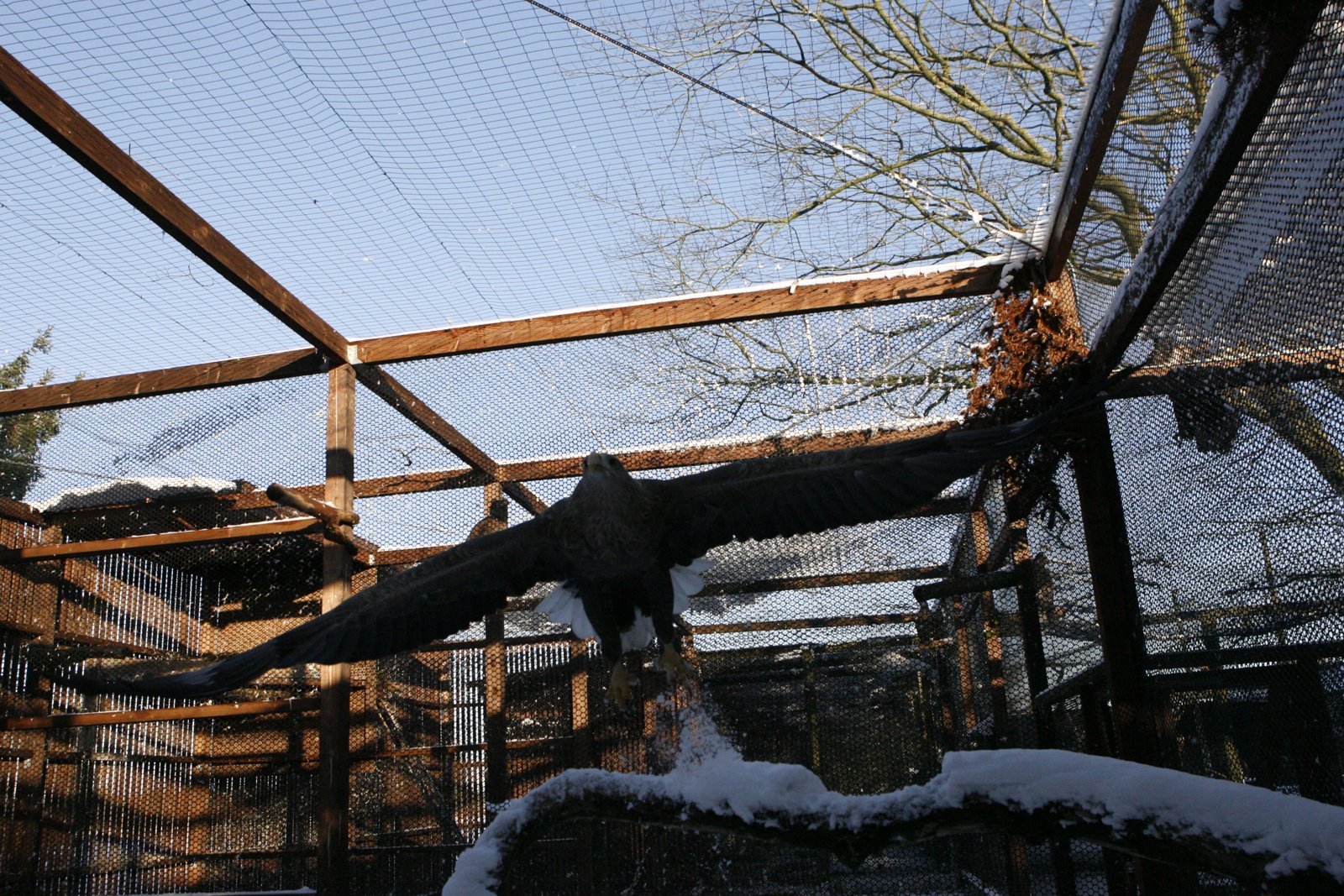
A spacious aviary is the bird's home all year round.
"Over the years I have learnt a lot about the flying techniques of the gyrfalcon and have seen thousands of flights and hunting situations that have given me invaluable insight."
— Frank Wenzel53
Then there is the paperwork: permits, marking, CITES documents and reports.531 And when you are ill or on holiday, someone else must be able to take over. The US rules, for example, allow another falconer to care for your birds for up to 120 days.12
How to get started as a visitor or beginner
- Watch falconers at work at a bird-of-prey park or a falconry display.
- Join a club, in Denmark for example Dansk Falkejagt Klub or Dansk Falkoner Klub.11 In the UK, the BFC offers supporting membership for people who do not yet have a bird.22
- Find a mentor before you get your own bird.412
- Take the formal steps. In Denmark: hunting licence, falconry exam, endorsement and a permit to keep the bird.538
Falconry words
Facts
- Longwing / shortwing / broadwing: the three classic groups of hunting birds: falcons, hawks and buzzards/eagles.6
- Jesses (Geschüh): leather straps on the bird's legs.12
- Lure: a dummy the bird is trained to fly to.12
- Creance: a long training line.12
- Mews / weathering area: the bird's indoor housing and its outdoor area.12
- Hacking: a period in which the bird temporarily flies free to get fit.12
- Imping: repairing a broken feather with a moulted one.12
- Påtegning (endorsement): the Danish entry on the hunting licence that grants the right to hunt with birds of prey.5
- Pest control (regulering): controlling wildlife that causes damage, for example with a bird of prey under permit.37
See falconry up close
At Eagle World (Ørnereservatet) on Skagensvej, between Tversted and Ålbæk in North Jutland, birds of prey have been at the centre since Frank and Irene Wenzel founded the site in 1976. In our displays, our falconers show the birds' skills both on foot and on horseback.48 It is a good place to start if you want to see what being a falconer takes and ask questions of people who do it every day. See times under Falconry displays and buy tickets in advance.
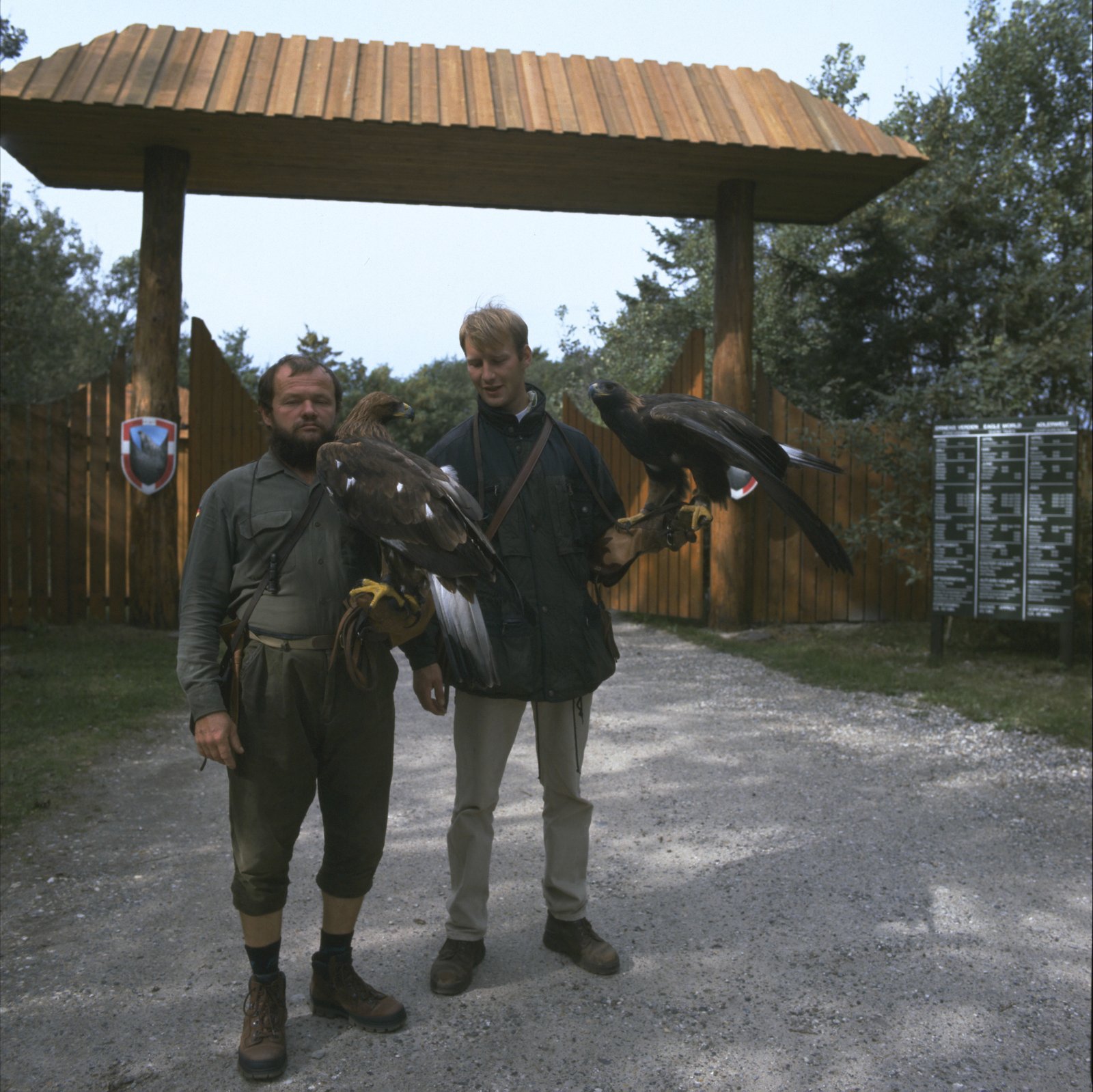
Falconers with golden eagles at the entrance to Eagle World.
"Along with just a handful of others, I was one of the pioneers 40 years ago who defined a new agenda for a future legitimisation of the fact that birds of prey and human beings not only have a strong bond from the past, but will continue to do so in future generations."
— Frank Wenzel64
On eagleworld.dk
- UNESCO and falconry
- Timeline
- Our species
- Falconer quiz and School materials
- Video archive and Library
- News from the world of eagles
- Frank Wenzel
- Gyrfalcons of the Kings (free e-book on Issuu): https://issuu.com/eagleworld/docs/gyrfalcons_of_the_kings; Danish edition Kongernes jagtfalke: https://issuu.com/eagleworld/docs/kongernes_jagtfalke
Read more
Books
- Frederick II: De arte venandi cum avibus (13th century). Manuscript Pal. lat. 1071 has been digitised by the Vatican Library.45 English translation: The Art of Falconry, trans. C. A. Wood and F. M. Fyfe (Stanford University Press, 1943), freely available on the Internet Archive.46
- Frank Wenzel: Kongernes jagtfalke / Gyrfalcons of the Kings (Ørnereservatet/Eagle World, 2010).47
- Helen Macdonald: H is for Hawk (2014).44
- Classic manuals recommended by the New York State Falconry Association: Phillip Glasier, Falconry and Hawking; Emma Ford, Falconry: Art and Practice; Nick Fox, Understanding the Bird of Prey; Frank L. Beebe & Harold M. Webster, North American Falconry and Hunting Hawks.6
Articles and radio
- DR: "Lynhurtige rovfugle bliver jægerens hjælper: I morgen er falkejagt lovlig" (31.08.2018, Danish).39
- Deutschlandfunk Kultur: "Jagen ohne Gewehr" (29.11.2014, German).8
- DW: "How a German vet came to run a falcon hospital in Abu Dhabi" (25.07.2017).10
- The Guardian: "Helen Macdonald's 'extraordinary' memoir wins Samuel Johnson prize" (04.11.2014).44
- BBC World Service, The Forum: "Falconry: The history of hunting with birds of prey" (17.06.2021).3
- The National (UAE): "Young Emiratis turn out for Fazza Championship for Falconry" (05.01.2015).27
- National Geographic: "Kazakh Eagle Hunter, Western Mongolia" (Photo of the Day, 2009).9
- FAZ: "Falknerei in Arabien: Nicht nur für Könige" (08.09.2012, German).49
- The New York Times: "How to Make It in America as a Professional Falconer" (24.04.2020).50
Notes
- UNESCO, Intangible Cultural Heritage: "Falconry, a living human heritage" (nomination file no. 01708; inscribed 2010, extended 2012, 2016, 2021). https://ich.unesco.org/en/RL/falconry-a-living-human-heritage-01708
- IUCN: member profile, International Association for Falconry and Conservation of Birds of Prey (IAF). https://iucn.org/our-union/members/iucn-members/international-association-falconry-and-conservation-birds-prey
- BBC World Service, The Forum: "Falconry: The history of hunting with birds of prey", 17.06.2021. https://www.bbc.com/audio/play/w3ct1rl8
- Österreichischer Falknerbund: "Wie werde ich Falkner?". https://www.falknerbund.com/falknerei/wie-werde-ich-falkner/
- Danish Executive Order no. 1072 of 27.08.2018 on hunting and pest control with birds of prey (Rovfuglejagtbekendtgørelsen), sections 1–7 and 13. https://www.retsinformation.dk/eli/lta/2018/1072
- New York State Falconry Association: "Suggested Reading". https://nysfa.org/becoming-a-falconer/suggested-reading/
- Junta de Andalucía: Orden de 22 de marzo de 2021, por la que se regula la práctica de la cetrería (BOJA no. 59, 2021), arts. 3, 4, 8 and 10. https://juntadeandalucia.es/boja/2021/59/4
- Deutschlandfunk Kultur: Patrick Hoffmann, "Jagen ohne Gewehr", 29.11.2014. https://www.deutschlandfunkkultur.de/greifvoegel-jagen-ohne-gewehr-100.html
- National Geographic: "Kazakh Eagle Hunter, Western Mongolia", Photo of the Day, 19.05.2009 (photo: David Edwards). https://www.nationalgeographic.com/photo-of-the-day/photo/kazakh-eagle-hunter-pod
- DW: Michael Marek, "How a German vet came to run a falcon hospital in Abu Dhabi", 25.07.2017. https://www.dw.com/en/how-a-german-vet-came-to-run-a-falcon-hospital-in-abu-dhabi/a-39826145
- Danish Environmental Protection Agency: "MST's evaluering af bekendtgørelse om rovfuglejagt" (02.03.2022) and the note "Falkejagt i tal" (03.03.2022), reproduced in the papers for the Danish Wildlife Management Council meeting of 26.09.2022. https://vildtforvaltningsraadet.dk/media/vnxjwzkv/dagsorden-og-moedematerialer-til-moede-i-vildtforvaltningsraadet-den-26-september-2022.pdf
- USA: 50 CFR § 21.82 "Falconry standards and falconry permitting" (eCFR). https://www.ecfr.gov/current/title-50/chapter-I/subchapter-B/part-21/subpart-C/section-21.82
- The Hawk Board: "Guidelines to demonstration givers". https://www.hawkboard.uk/guidance/guidelines-to-demonstration-givers
- German Federal Hunting Act (Bundesjagdgesetz, BJagdG) § 15(1) and (7). https://www.gesetze-im-internet.de/bjagdg/__15.html
- Bundesportal/Bavaria: "Falknerprüfung; Anmeldung" (updated 22.09.2025). https://verwaltung.bund.de/leistungsverzeichnis/DE/leistung/99067013007000/herausgeber/BY-16729/region/090000000000
- German Federal Game Protection Ordinance (Bundeswildschutzverordnung, BWildSchV) § 3. https://www.gesetze-im-internet.de/bwildschv/__3.html
- Burgenland Hunting Act 2017 (Burgenländisches Jagdgesetz) § 67 (RIS). https://www.ris.bka.gv.at/eli/lgbl/BU/2017/24/P67/LBG40024662
- Upper Austria Hunting Association (OÖ Landesjagdverband): "Falknerprüfung des OÖ Landesjagdverbandes". https://www.ooeljv.at/die-ooe-jaegerschaft/falknerei-in-obersterreich/falknerpruefung-des-ooe-landesjagdverbandes/
- GOV.UK: "Register a captive bird of prey". https://www.gov.uk/guidance/bird-registration
- GOV.UK/Natural England: "Wild birds: apply for a licence to kill wild birds for falconry (A41 and LR41)". https://www.gov.uk/government/publications/wild-birds-apply-for-a-licence-to-kill-wild-birds-for-falconry
- Natural England: "Outcome of Natural England's review of bird of prey 'wild take' licensing for falconry and aviculture", 06.03.2025. https://naturalengland.blog.gov.uk/2025/03/06/outcome-of-natural-englands-review-of-bird-of-prey-wild-take-licensing-for-falconry-and-aviculture/
- The British Falconers' Club: "Club Rules" (rules 4.2–4.3.1 and 21.2). https://britishfalconersclub.co.uk/club-rules/
- CITES: Notification to the Parties no. 2002/062, "United Arab Emirates – Falcon passport", 15.11.2002. https://cites.org/sites/default/files/eng/notif/2002/062.shtml
- UAE Ministry of Climate Change and Environment: "Request a falcon passport". https://www.moccae.gov.ae/en/services/falcon-passport
- Abu Dhabi Falcon Hospital: "About ADFH". https://www.falconhospital.com/adfh/about-adfh
- Emirates Falconers' Club: "Mohamed Bin Zayed Falconry and Desert Physiognomy School". https://efcuae.com/initiatives/mohamed-bin-zayed-falconry-and-desert-physiognomy-school/
- The National: Nadeem Hanif, "Young Emiratis turn out for Fazza Championship for Falconry", 05.01.2015. https://www.thenationalnews.com/uae/young-emiratis-turn-out-for-fazza-championship-for-falconry-1.118306
- SGAV: "Jagtprøven – skriftlig og praktisk prøve". https://sgavmst.dk/natur-og-jagt/jagttegn/jagtens-proever/jagtproeven
- Directive 2009/147/EC of the European Parliament and of the Council on the conservation of wild birds, Art. 7(4) and Art. 9 (OJ L 20, 26.01.2010). https://eur-lex.europa.eu/LexUriServ/LexUriServ.do?uri=OJ:L:2010:020:0007:0025:EN:PDF
- IAF: "Role of IAF" (history: founded 9 April 1968 in Düsseldorf; 1977 and the Birds Directive). https://iaf.org/role-of-iaf
- SGAV: "Hold af fugle i fangenskab". https://sgavmst.dk/natur-og-jagt/natur-og-biodiversitet/hold-af-fugle-i-fangenskab
- Government of Canada: "Outcomes of species proposals: 20th Conference of the Parties" (CITES CoP20, 2025). https://www.canada.ca/en/environment-climate-change/services/convention-international-trade-endangered-species/conference-of-parties/20-species-proposal-outcomes.html
- IAF: "CITES CoP: Proposal to Downlist the Peregrine Falcon Not Adopted", 05.12.2025. https://iaf.org/archives/1912
- Danish Forest and Nature Agency (working group with DOF, DN, Danmarks Jægerforbund and Dansk Falkejagt Klub): "Genindførsel af falkejagt i Danmark", section 3 (report, reproduced on Dansk Falkejagt Klub's website). https://danskfalkejagtklub.dk/onewebmedia/FALKERAPPORT.pdf
- Dansk Falkejagt Klub: "Vejledning for falkonerer", rev. 1.1, 2023. https://www.danskfalkejagtklub.dk/onewebmedia/Vejledning%20for%20falkonerer_Rev1.1.2023.pdf
- Danish Hunting and Wildlife Management Act (Jagt- og vildtforvaltningsloven), consolidated act no. 639 of 26.05.2023, section 23(2) and (5). https://www.retsinformation.dk/eli/lta/2023/639
- SGAV: "Jagt med rovfugl – falkejagt". https://sgavmst.dk/natur-og-jagt/om-at-gaa-paa-jagt/jagt-med-rovfugl
- Danish Executive Order no. 848 of 27.06.2016 on keeping birds in captivity, sections 3–5. https://www.retsinformation.dk/eli/lta/2016/848
- DR Østjylland: "Lynhurtige rovfugle bliver jægerens hjælper: I morgen er falkejagt lovlig", 31.08.2018. https://www.dr.dk/nyheder/regionale/oestjylland/lynhurtige-rovfugle-bliver-jaegerens-hjaelper-i-morgen-er-falkejagt
- SGAV: hunting season table, general seasons valid from 1 July 2024 (PDF). https://sgavmst.dk/media/zjnnkg1c/2025-sgav-jagttabel_-fra-juli-2024.pdf
- German Ordinance on Hunting Seasons (Verordnung über die Jagdzeiten, JagdzeitV) § 1. https://www.gesetze-im-internet.de/jagdzeitv_1977/__1.html
- Game & Wildlife Conservation Trust: "Shooting season dates". https://www.gwct.org.uk/game/advice/shooting-season-dates/
- USA: 50 CFR § 20.109 "Extended seasons, limits, and hours for taking migratory game birds by falconry" (eCFR, Part 20 Subpart K). https://www.ecfr.gov/current/title-50/chapter-I/subchapter-B/part-20/subpart-K
- The Guardian: Hannah Ellis-Petersen, "Helen Macdonald's 'extraordinary' memoir wins Samuel Johnson prize", 04.11.2014. https://www.theguardian.com/books/2014/nov/04/samuel-johnson-prize-helen-macdonald-h-is-for-hawk
- Biblioteca Apostolica Vaticana: Pal. lat. 1071 (Frederick II, De arte venandi cum avibus), digitised. https://digi.vatlib.it/mss/detail/Pal.lat.1071
- Frederick II: The Art of Falconry, trans. and ed. Casey A. Wood and F. Marjorie Fyfe (Stanford University Press, 1943), Internet Archive. https://archive.org/details/McGillLibrary-rbsc_art-falconry_casey-wood_SK321F87-18001
- Eagle World: "Gratis e-bog: Kongernes jagtfalke" (Frank Wenzel, Ørnereservatet 2010, 40 pp.). https://eagleworld.dk/artikler/gratis-e-bog-kongernes-jagtfalke – Issuu (EN): https://issuu.com/eagleworld/docs/gyrfalcons_of_the_kings – Issuu (DA): https://issuu.com/eagleworld/docs/kongernes_jagtfalke
- Eagle World (Ørnereservatet), home page (history and displays). https://eagleworld.dk/en
- FAZ: Rainer Hermann, "Falknerei in Arabien: Nicht nur für Könige", 08.09.2012. https://www.faz.net/aktuell/wirtschaft/menschen-wirtschaft/falknerei-in-arabien-nicht-nur-fuer-koenige-11881301.html
- The New York Times: "How to Make It in America as a Professional Falconer", 24.04.2020. https://www.nytimes.com/2020/04/24/style/falconry-los-angeles.html
- Eagle World (Ørnereservatet): "Falkejagten er atter fri" (article in Danish on the executive order that made falconry legal from 1.9.2018). https://eagleworld.dk/artikler/falkejagten-er-atter-fri
- SGAV: "Falkonerprøve" (syllabus, exam format and registration; in Danish). https://sgavmst.dk/natur-og-jagt/jagttegn/jagtens-proever/falkonerproeve
- Frank Wenzel: Gyrfalcons of the Kings (English edition of Kongernes jagtfalke, Ørnereservatet, 2010), p. 32, section "My Gyrfalcon". https://issuu.com/eagleworld/docs/gyrfalcons_of_the_kings – Danish original, p. 32: https://issuu.com/eagleworld/docs/kongernes_jagtfalke
- Encyclopaedia Britannica: Emma Ford, "Falconry" (sections on types of birds, equipment, and hunting and training techniques). https://www.britannica.com/sports/falconry
- Deutscher Falkenorden (DFO): "Beizjagd mit Falken" (in German). https://d-f-o.de/falknerei/beizvoegel/beizjagd-mit-falken/
- Jägerverein Bayreuth e.V.: "Krähenbejagung mit dem Beizvogel" (in German). http://www.jaegerverein-bayreuth.de/m/seite/230759/kr%C3%A4henbejagung.html
- Toby Bradshaw: "Harris' hawks and dogs" (University of Washington). https://faculty.washington.edu/toby/baywingdb/hhdogs.htm
- The British Falconers' Club: "Code of Welfare and Husbandry for Falconry" (May 2021), sections 1–4 and 7. https://britishfalconersclub.co.uk/falconry-welfare-code/
- E. B. Michell: The Art and Practice of Hawking (Methuen, 1900), chapters VI, VIII and XIII, Project Gutenberg. https://www.gutenberg.org/ebooks/48437
- Ekstra Bladet: Nikolaj Karlshøj, "Manden der lever med ørne", 28.03.2016 (in Danish). https://ekstrabladet.dk/nyheder/samfund/manden-der-lever-med-oerne/6009818
- Eagle World: "Frank Wenzel" (apprenticeship in Germany at 20) and "Timeline" (1962). https://eagleworld.dk/en/history/frank-wenzel – https://eagleworld.dk/en/history/timeline
- Mette Kirstine Goddiksen: "En ørn til at regne den ud" (interview with Frank Wenzel, in Danish), eagleworld.dk, dated 16.01.2019. Quote translated from Danish. https://eagleworld.dk/artikler/en-oern-til-at-regne-den-ud
- Frank Wenzel: Gyrfalcons of the Kings (Ørnereservatet, 2010), p. 8, "Capturing the essence of Greenland" (the author's experience, 20.09.1980, Disko Bay). https://issuu.com/eagleworld/docs/gyrfalcons_of_the_kings
- Frank Wenzel: Gyrfalcons of the Kings (Ørnereservatet, 2010), p. 33, "Four Iceland gyrfalcon chicks". https://issuu.com/eagleworld/docs/gyrfalcons_of_the_kings
- Frank Wenzel: Gyrfalcons of the Kings (Ørnereservatet, 2010), p. 35, "The desert king". https://issuu.com/eagleworld/docs/gyrfalcons_of_the_kings