


When a bird flies off – how we find it again
Every falconer knows the feeling: the bird climbs, the wind takes it, and suddenly it is gone behind the treetops. At Ørnereservatet we have flown birds of prey since 1976, and we have been there. Here we tell you how falconers have searched for their birds for 800 years, how we do it today – and what equipment researchers are working on right now.
Why does a bird fly off?
A bird of prey in falconry is not tied down. It flies freely and comes back because it has learned that it pays off: with the falconer there is food, calm and safety. But a bird is a living animal. A sudden fright, a pair of wild raptors defending their territory, a strong thermal or a bird that is a little too well fed can be enough for it to fly further away than usual.
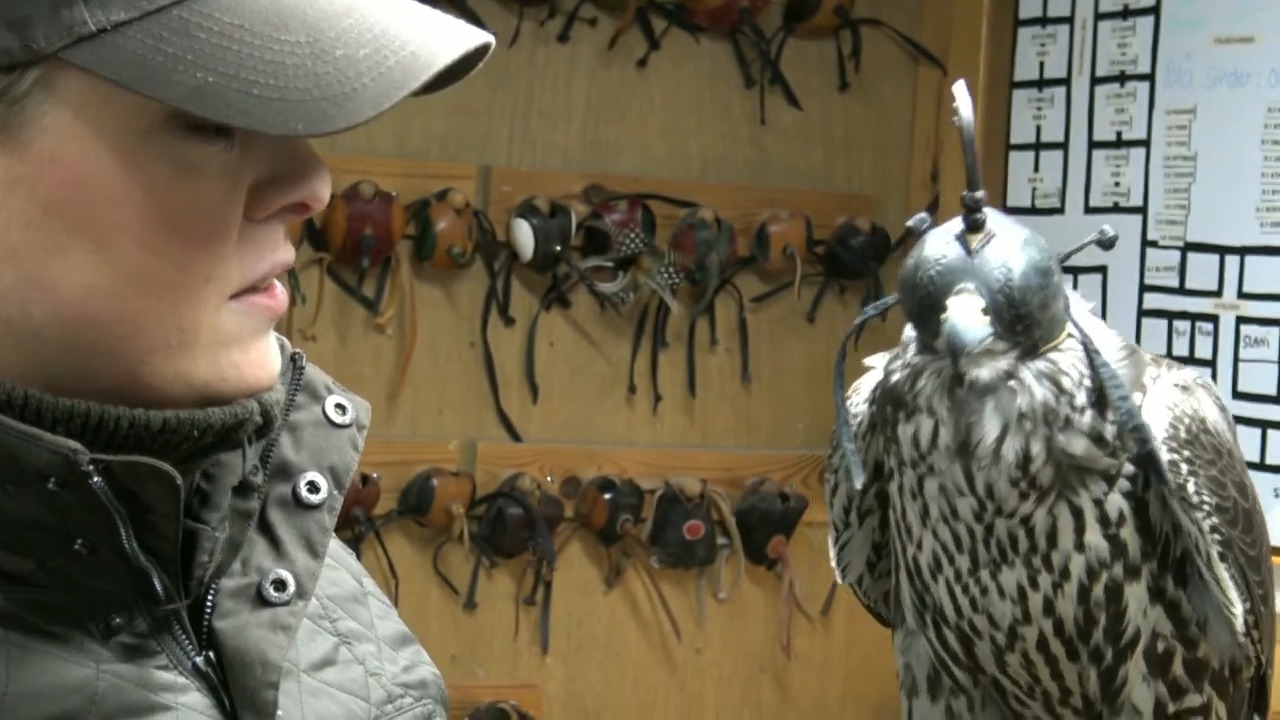
A falcon wearing a hood, with hoods hanging on the wall behind it. Still from Ørnereservatet's video
Phillip and the two young white-tailed eagles – summer 2026
On Thursday 27 August 2026, two young wild white-tailed eagles came in over the reserve during the afternoon programme with around 100 guests. When the peregrine falcon Phillip took to the air, they appeared again, and Phillip chose to leave the area. He settled out over Simons Skrivers Klit, and we followed his radio signal while the programme continued.
When the programme was over, the signal had grown weaker. It led towards Råbjerg Church and on into the forest and dune landscape, where the eagles chased him up again. The rest of the search took place on foot: a little way forward, stop, raise the antenna, listen. After about three and a half hours the signal suddenly became strong in the forest by Skiveren Camping, and there sat Phillip on a branch. He came down to the lure with a dead pigeon, and a kind couple with dachshunds in the car drove us back to the gate at around eight in the evening.
When the eagles find their own way home
The eagles often fly far, but they can also find their way home. In February 2014 the 18-year-old white-tailed eagle Kya was missing for a week. Among other things, we searched with a camera drone over Tolne, Jerup, Måstrup, Skiveren and Blæsbjerg, and many local people reported where they had seen him. On 18 February Kya was back home in the reserve. The year before he had also been gone for about a week and had returned on his own.
In March 2022 our white-tailed eagles got into a fight with migrating eagles, and the male Vikna went on a longer trip around Vendsyssel. We put out a call for him in the newspaper and on the radio, and a great many North Jutlanders got in touch. After a week we found him about 20 km from here, where he flew to the glove as if nothing had happened.
The story of Will
One of the stories we will never forget is about the saker falcon Will. He was only three months old when a heavy rainstorm broke out one day at the end of August during the demonstration. The audience ran for shelter and opened umbrellas, and Will was so startled that he flew. He came in over a pair of buzzards' territory, was attacked again and again and flew even further away.
Will was wearing a radio transmitter, and we made contact with him in Søparken in Frederikshavn. But just as he was about to be called in, loose dogs came by – and after three frights in a row he carried on out towards Hirsholmene. We posted an appeal and the transmitter's frequency on Facebook, and hundreds of people, including radio amateurs, helped follow his route. The last report came from the eastern part of Zealand, shortly before the transmitter's battery ran out. Will never came home.
The story reveals two things we take very seriously: how quickly a young falcon can cover great distances, and how crucial the battery and range of the equipment are. It also reveals that there is a large network of helpful people when it matters.
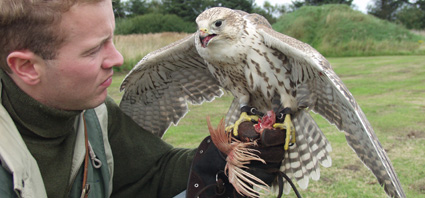
Saker falcon on the glove. Photo: Frank Wenzel
Bells, rings and the falconer's eyes – how it was done in the old days
For as long as there has been falconry, falconers have lost birds and searched for them. The Holy Roman Emperor Frederick II of Hohenstaufen described in his great work on falconry, De arte venandi cum avibus, from the 1240s, how the falcon is fitted with jesses and a bell on its leg. For centuries the bell was the falconer's most important search tool: when the bird sat hidden in a tree or on prey in tall grass, you could hear it when it shook itself or moved its head.
Besides the bell, falconers had their eyes and ears, patience – and the lure, which the falconer swings to call the bird in. Valuable falcons could also carry their owner's mark, so a bird that was found could be returned – an early attempt to solve the same problem we solve with electronics today.
In Denmark, hunting falcons have a very special history. Frank Wenzel tells it in the book Kongernes jagtfalke (The Kings' Hunting Falcons, 2010, in Danish), which can be read for free on Issuu.
Radio arrives – from the 1960s
The big leap came with radio telemetry. In 1963 the American biologists William Cochran and Rexford Lord described a small radio-tracking system for wild animals, and in 1969, according to the American manufacturer L.L. Electronics, telemetry was introduced to falconry by Bob Berry and Bill Cochran. The first falconry transmitters were shaped like bells and attached to the leg.
The principle is the same today: the transmitter sends out a small beep on a fixed frequency. With a receiver and a directional antenna, the falconer can find where the signal is strongest and follow it. Later it became common to mount the transmitter on the tail, and European falconers brought the equipment on to the Middle East.
GPS, apps and drones – how falconers search today
Today many falconers in the USA, England and the rest of the world combine two systems: a GPS transmitter that displays the bird's position, altitude and speed live on a phone, and a classic radio transmitter as a backup. The American manufacturer Marshall Radio itself recommends using two transmitters – GPS as the primary and a long-lasting "beeper" transmitter as backup – because the GPS uses more power. Their system transmits via UHF radio directly to a small receiver and an app, and therefore also works without mobile coverage.
During a longer search it is important to save battery: the GPS can be set to update less often, and if the bird roosts in a tree overnight, you can return at dawn before it flies again. It was precisely the battery that ran out for us with Will.
Drones are also used in some places to get an overview of the terrain, but they can frighten a bird that is already unsettled, and in Denmark they are covered by the Danish Civil Aviation and Railway Authority's drone rules.
In England there are also registers for lost and found birds of prey, where birds are registered with a ring or chip so that a found bird can be returned to its owner. Lost falcons and eagles can also be reported to the police and animal shelters.
How we do it at Ørnereservatet
We have used GPS without a SIM card for quite a few years now. We use Marshall's GPS system in the second-to-last version, which has longer battery life than the newest one: a transmitter weighing only 9 grams, where the receiver is an ordinary smartphone. Here you can follow the bird on a map and at the same time see its speed, altitude and temperature. In addition to the GPS, we also use ordinary radio telemetry from Marshall. It is not cheap equipment, but it is good, and when a bird is gone, that is what counts. A Field Marshall Digital Tracking Receiver UHF costs from approx. DKK 6,600 (USD 995), and a Turbo GPS Transmitter from approx. DKK 5,200 (USD 775). The prices are Marshall's list prices in October 2026, converted at the ECB rate of 26 October 2026 (USD 1 ≈ DKK 6.68) and excluding VAT, customs and shipping. In the video GPS på rovfugle og udstyr under træning (GPS on birds of prey and equipment during training, 2019, in Danish) we present the equipment and fly the gyrfalcon Slani.
Unfortunately, the transmitters do not always last that long. An eagle may decide to bite them, and a bird that bathes with the transmitter on again and again also wears it down. There are various options, but experience teaches that you also have to look at the purely practical side and perhaps make changes yourself – for example by protecting the transmitters themselves. We have learned that the hard way.
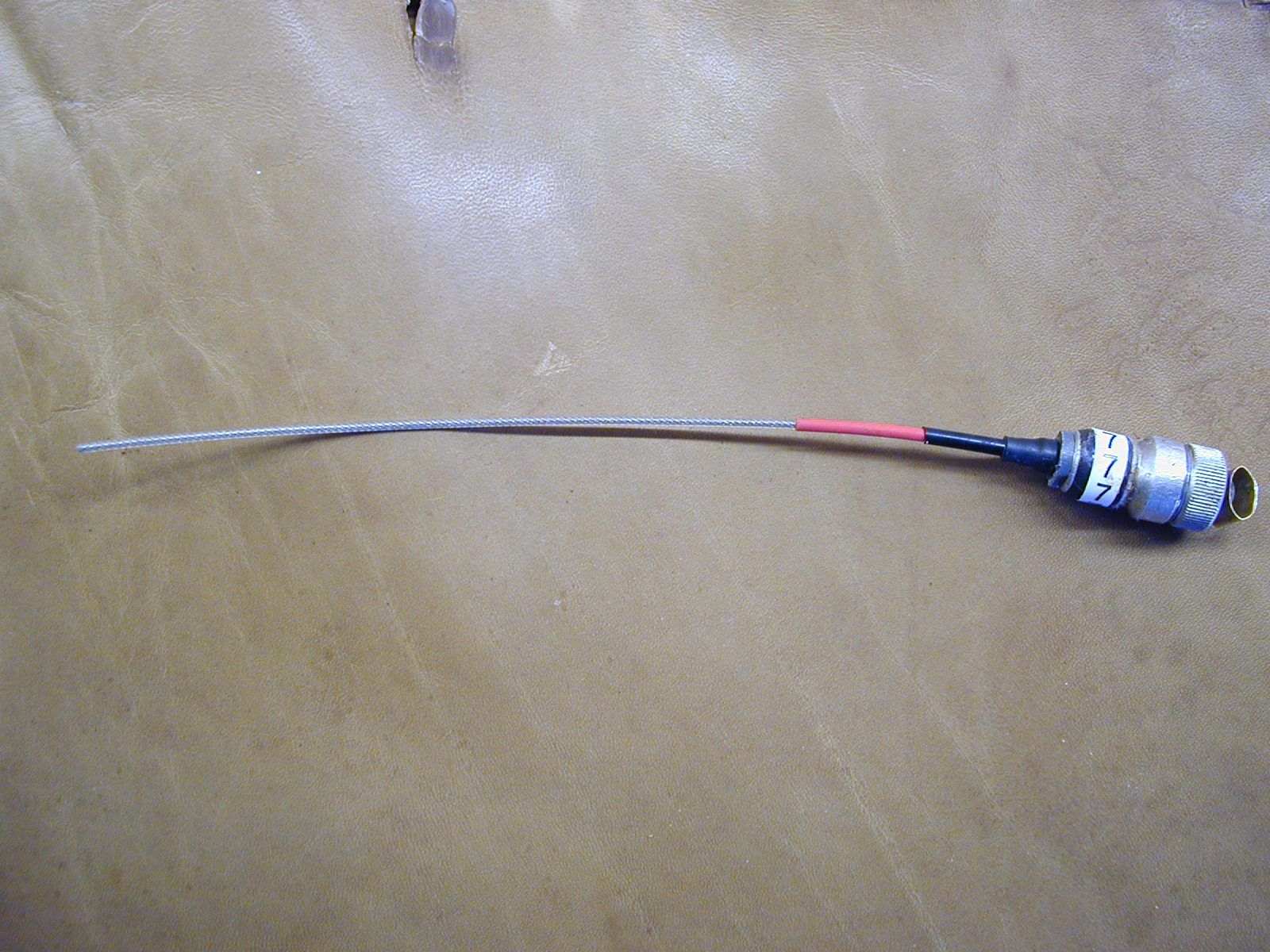
The older radio transmitter with long battery life. Photo: Peter Frank Wenzel
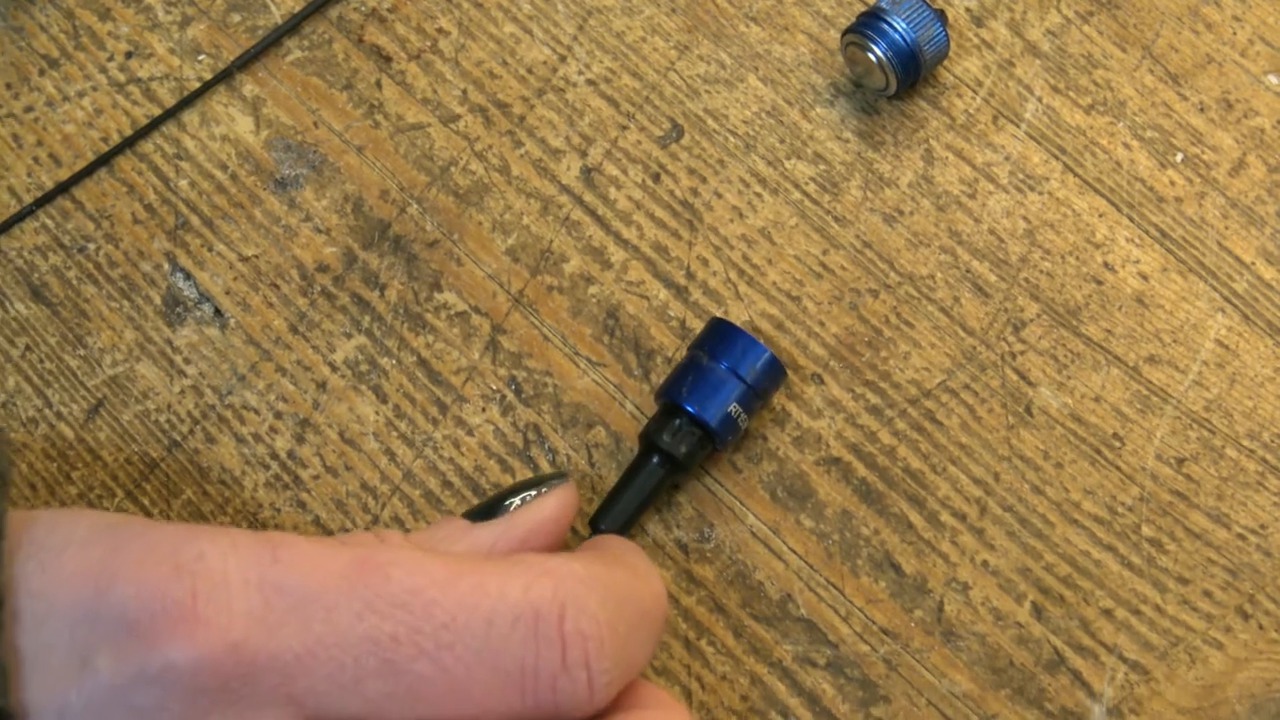
The blue GPS transmitter is technologically better but has shorter battery life. Still from Ørnereservatet's video
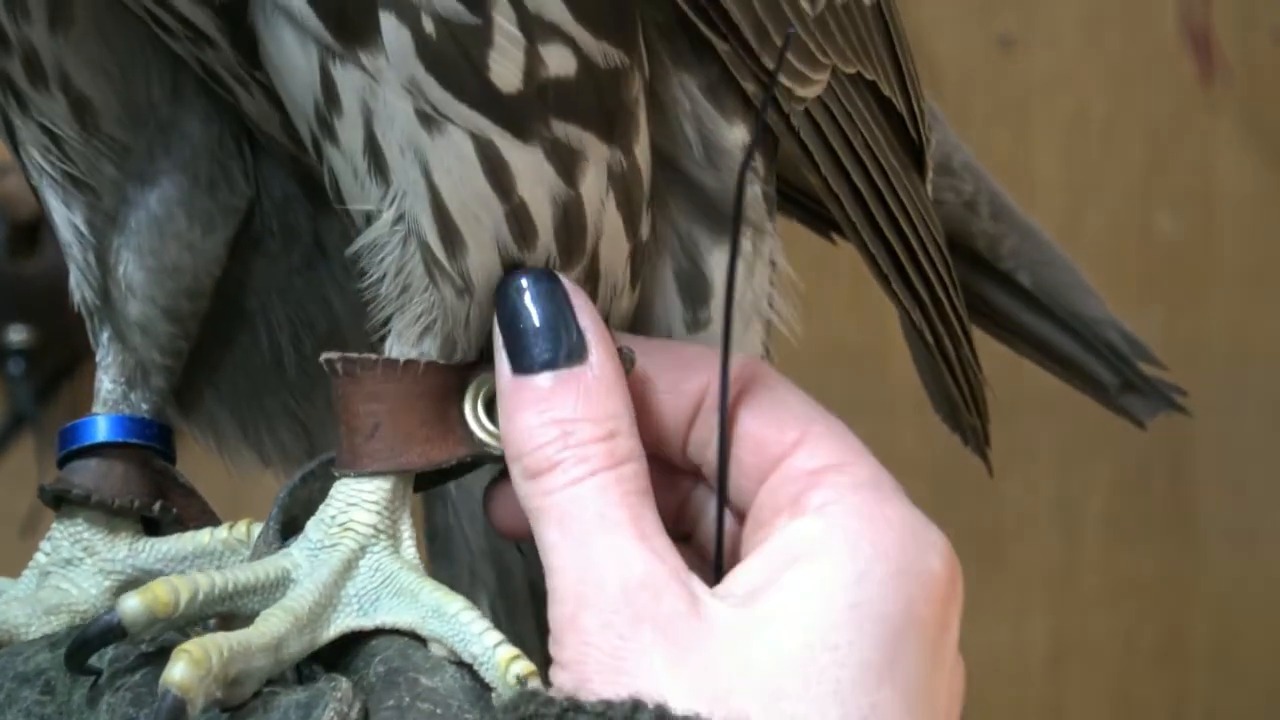
The transmitter is fitted on the bird. Still from Ørnereservatet's video
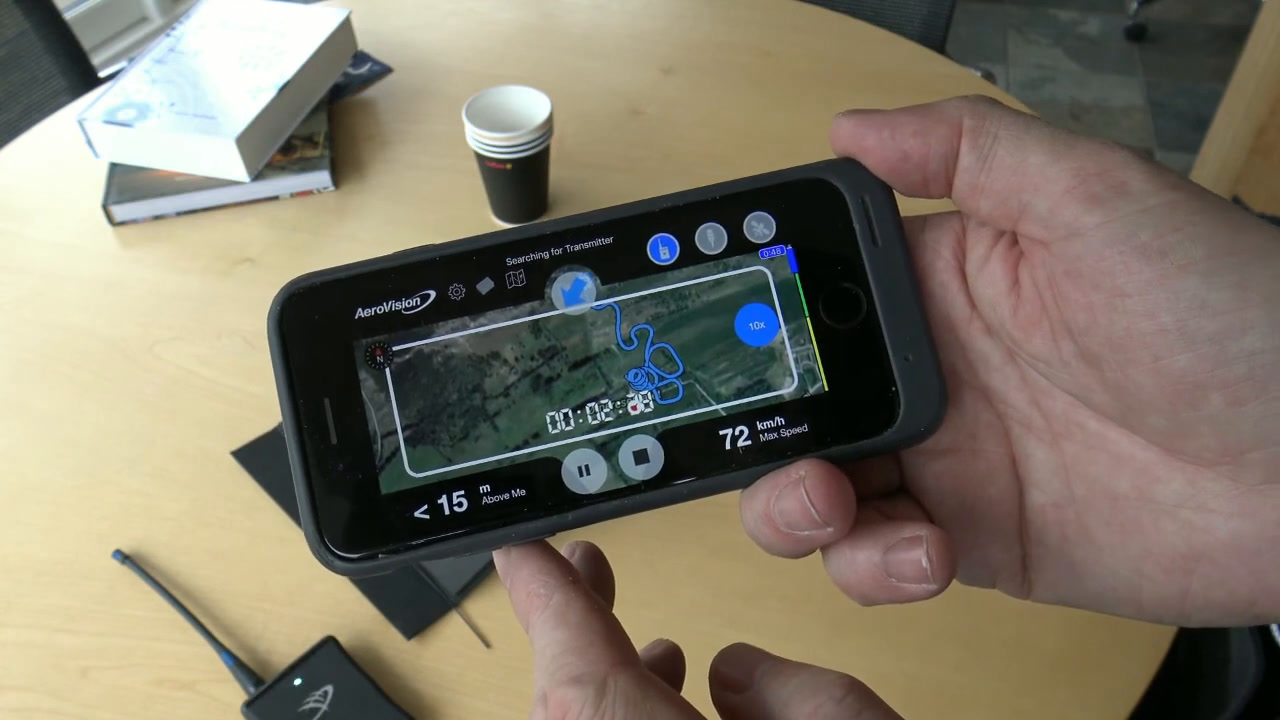
The phone displays the bird's position on the map, with the receiver next to it. Still from Ørnereservatet's video
The equipment only works when it is on the bird, though. When the white-tailed eagle Arnulf went missing in May 2016, he had no radio transmitter on, because our eagles had picked up the bad habit of biting the antenna. Arnulf came home again. Telemetry – a radio or GPS transmitter – is by the way mandatory in Denmark during training, hunting and wildlife management.
All our birds are also microchipped. The chip cannot tell where the bird is, but it makes it possible to identify it reliably if it is found.
What is on the way
Research in animal tracking is moving very fast. The Max Planck Institute of Animal Behavior is working with transmitters of only 1–3 grams that measure position, temperature, air pressure and activity and send data via low-power networks. One of them, a solar-powered transmitter with a supercapacitor, has been developed for kestrels and needs only a few minutes in direct sunlight to charge.
At the same time, the global ICARUS system has returned to space. A first receiver was launched in November 2025, and in May 2026 ICARUS' own satellite, RAVEN, followed. The plan is a network of at least five satellites that can provide up to six updates a day from animals with small transmitters – anywhere on the globe. Data is collected in the international database Movebank.
This is research equipment, not falconry equipment. But experience says that what researchers use today often finds its way to falconers tomorrow: smaller, lighter transmitters with solar cells, longer battery life and coverage that does not depend on mobile masts. Had Will had such a transmitter, we might have known where he ended up.
If you see one of our birds
If you see a bird of prey with jesses on its legs or a small antenna on its tail, it is probably a falconry bird. Keep your distance, do not chase it up, and call us on +45 98 93 20 31 – also in winter.
The reserve is closed for the winter, and we open again at Easter 2027.
Read also (in Danish)
Da havørnene kom forbi · Hundredevis ville hjælpe Will hjem · Sakerfalk (Falco cherrug) · Gratis e-bog: Kongernes jagtfalke
Sources
- Ørnereservatet: Da havørnene kom forbi (article of 28 August 2026)
- Ørnereservatet på YouTube: GPS på rovfugle og udstyr under træning (3 November 2019)
- TV2 Nord: Havørnen Kya er fundet (18 February 2014)
- Nordjyske: Drone sat ind i jagten på forsvundet ørn (17 February 2014)
- NordsøPosten: Peter Frank Wenzel ser tilbage på et spændende år i Ørnereservatet (22 December 2022)
- TV2 Nord: Ørn savnes: Hvor er du, Arnulf? (6 May 2016)
- Ørnereservatet: Falkejagten er atter fri
- Marshall Radio Telemetry: Field Marshall Digital Tracking Receiver UHF (list price checked 27 October 2026)
- Marshall Radio Telemetry: Turbo GPS Transmitter (list price checked 27 October 2026)
- European Central Bank: Euro foreign exchange reference rates (26 October 2026: EUR 1 = USD 1.1188 = DKK 7.4747)
- Ørnereservatet: Hundredevis ville hjælpe Will hjem (article of 16 January 2019)
- Frank Wenzel: Kongernes jagtfalke (2010), Issuu
- Frederick II of Hohenstaufen: De arte venandi cum avibus, English ed. Casey A. Wood & F. Marjorie Fyfe, The Art of Falconry (Internet Archive)
- Cochran, W.W. & Lord, R.D. (1963): A Radio-Tracking System for Wild Animals. Journal of Wildlife Management 27(1)
- L.L. Electronics: Observations on Falconry Transmitter Tailmounting (2015)
- Marshall Radio: Extended Tracking with the GPS System and Marshall GPS Pro System
- Max Planck Institute of Animal Behavior: Tracking Technology (ICARUS-tags)
- Max-Planck-Gesellschaft: Icarus returns to space (2025) and ICARUS launches second system into orbit (2026)
- Movebank – database for animal tracking