


Marco Polo and the Falcons of Kublai Khan
Spring, more than seven hundred years ago. On the plains of northern China, an emperor rides out to hunt, in a chamber lined with gold and carried by four elephants. A young Venetian wrote it all down. His name was Marco Polo. In a new film we tell the story.
By Peter Frank Wenzel, Ørnereservatet / Eagle World
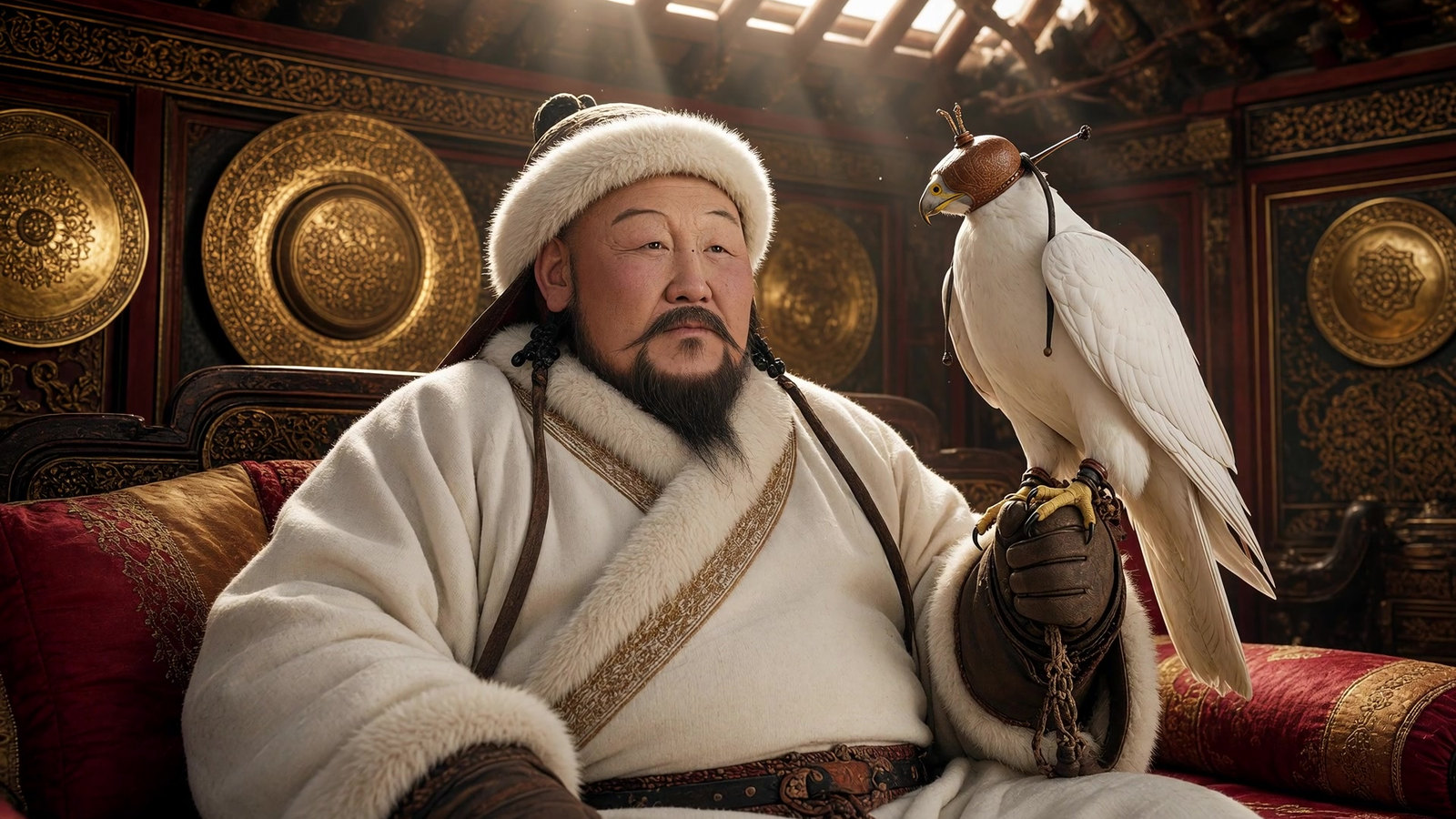
Kublai Khan with one of his gerfalcons, in the hunting chamber. AI reconstruction.
A Venetian bound for the east
In 1271 the Venetian merchants Niccolò Polo and his brother Maffeo set out from Venice. This time they took Niccolò’s son, Marco, about seventeen years old. By sea to Acre, then overland through Persia, over the high Pamirs and along the desert oases. The journey took more than three years. Around 1275 they stood before Kublai Khan.
Polo’s book records the moment. Niccolò presents his son: “Sire, ’tis my son and your liegeman.” And the Emperor replies: “Welcome is he too.” (Prologue, ch. XIV, in Henry Yule’s translation.)
Marco learned the languages and customs of the Mongols, and several scripts. Kublai began sending him on missions across the empire, and Marco came back with stories of everything he had seen. According to the book, that was exactly what the Khan wanted to hear. Polo says he stayed in Kublai’s service some seventeen years. He describes the palaces, the paper money, the post roads. And again and again, the hunt.
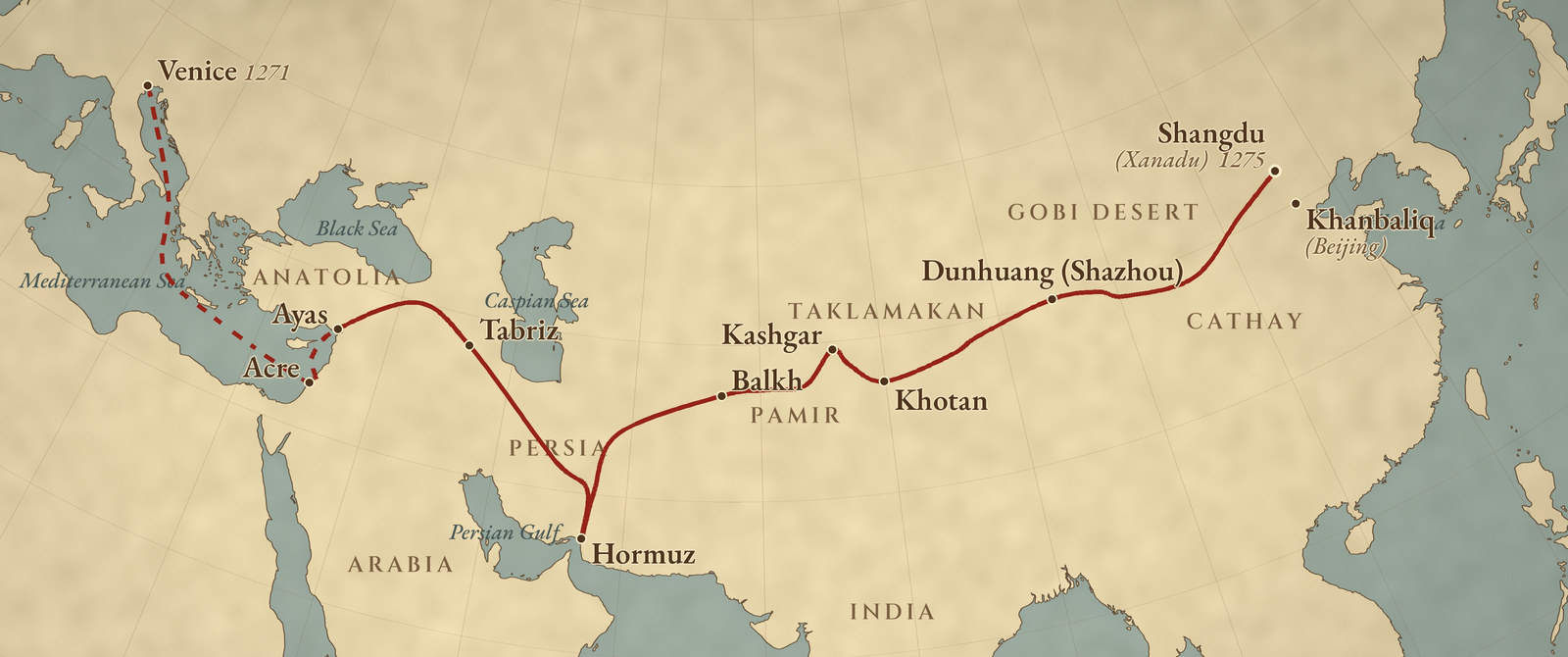
Marco’s journey from Venice to Kublai Khan, 1271 to 1275. Illustration.
Genghis Khan, Kublai and the Silk Road
The story begins before Marco. In 1206 Genghis Khan united the rival tribes of the Mongolian steppe, and his mounted armies built the largest land empire the world had yet seen. For the Mongols, hunting was more than a pastime. In great ring hunts, thousands of riders circled the game, moving together like an army. Hawks, falcons and eagles were treasured, and passed as gifts between rulers.
Genghis died in 1227. He and Marco never met. It was the grandson, Kublai, a son of Tolui, who was chosen as Great Khan in 1260. Kublai completed the conquest of China and founded the Yuan dynasty. He built a summer capital on the grasslands, Shangdu, the Xanadu of legend, and a great new capital where Beijing stands today. The Mongols called it Khanbaliq, the city of the Khan.
Under Mongol rule, the old trade routes between China and the Mediterranean, the network we now call the Silk Road, carried goods and travellers. Around 1260, Niccolò and Maffeo had already set out east with a store of jewels to trade. War blocked their road home, so they kept going, until they reached Kublai himself. The Khan questioned them about the Christians and the Pope, and sent them back as his envoys, carrying a tablet of gold that gave them horses and escorts across his empire. Only then did they take Marco with them on the long journey back.
The Khan’s year, and the great spring hunt
Polo lays out the Khan’s year. The winter months in the capital. From the first of March to the middle of May, the great hunting expedition toward the sea. Then summer in cool Shangdu, where Kublai kept more than two hundred gerfalcons in his mews, and went every week to see his birds.
The scale is hard to imagine. Polo writes that the Khan “takes with him full 10,000 falconers, and some 500 gerfalcons besides peregrines, sakers, and other hawks in great numbers” (Book II, ch. XX). Another ten thousand men, posted in pairs, kept watch on the sky. Each had a whistle and a hood, to call a hawk back to the hand. Two brothers, Baian and Mingan, each led ten thousand huntsmen, one company in red and one in blue, with great mastiffs. Polo also writes of eagles flown at wolves, foxes and deer.
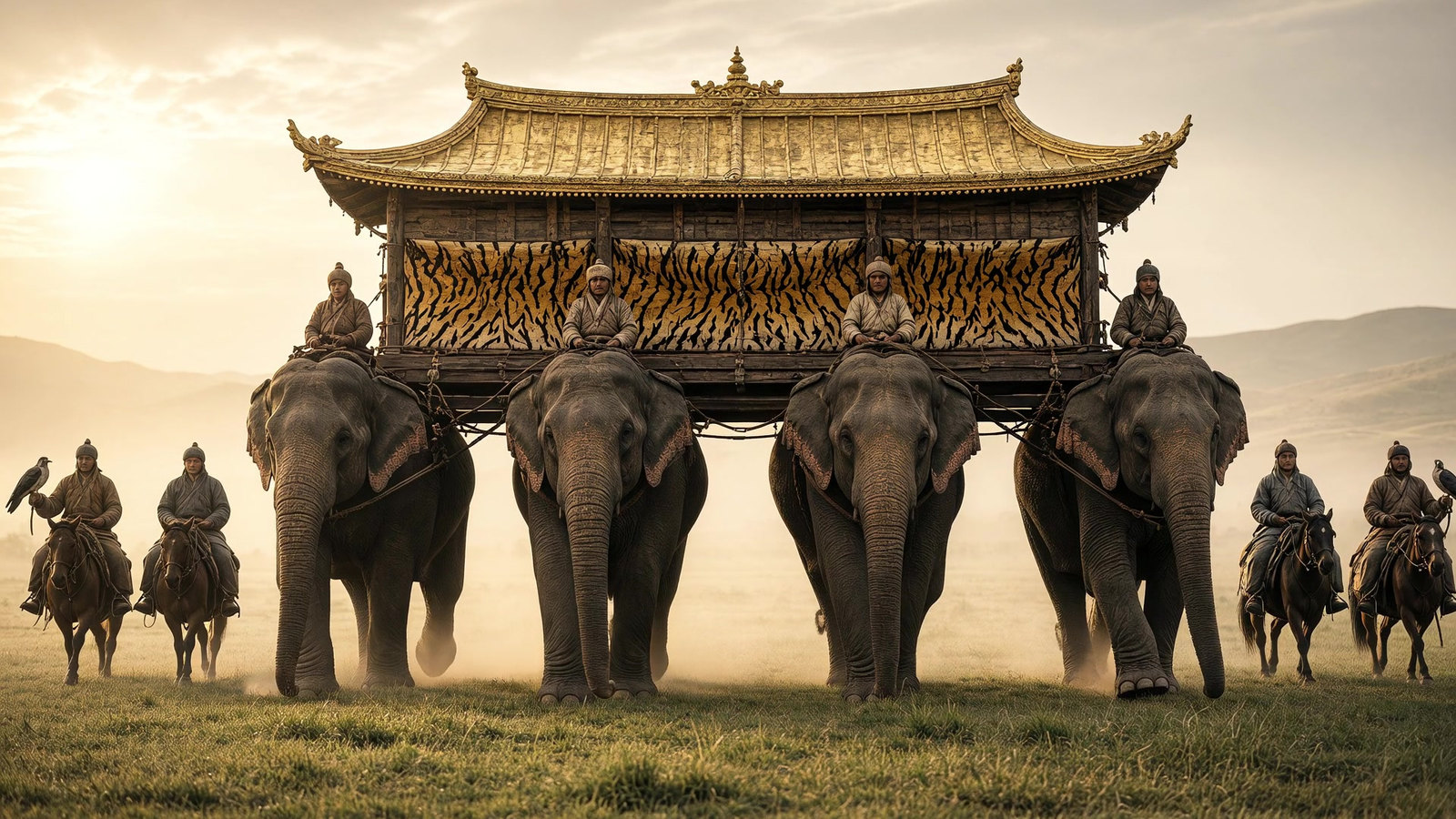
Kublai Khan’s hunting chamber, carried by four elephants. AI reconstruction.
Every hawk wore a small label on its leg, with the names of its owner and its keeper. A bird found without its keeper was brought to an officer called the Bularguchi, the keeper of lost property. His banner flew from the highest point of the camp. Horses, swords, hawks: whatever was lost, he held until the owner came for it.
The Khan himself suffered from gout. So he travelled in a wooden chamber carried by four elephants, lined inside with beaten gold and covered outside with lion skins. Beside him he kept a dozen of his finest gerfalcons. Then a baron riding alongside would call out: “Sire! Look out for Cranes!” (Book II, ch. XX). The roof was thrown open, the Khan chose a gerfalcon and cast it, and often the strike came within his view.
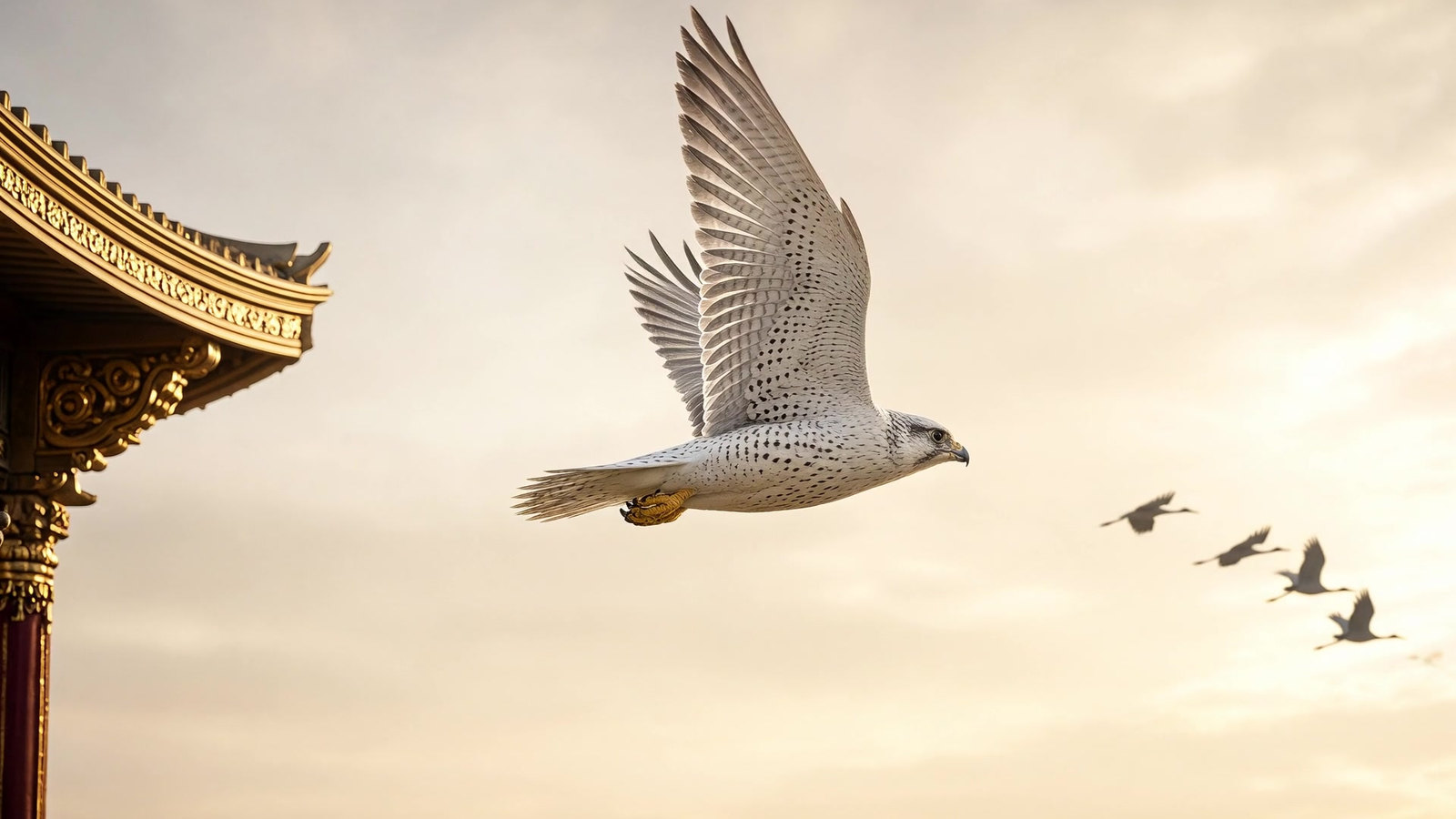
A gerfalcon leaves the chamber roof, toward the cranes. AI reconstruction.
A city of tents by the water
At a place Polo calls Cachar Modun, and no one today knows exactly where it lay, a city of tents was waiting. A full ten thousand of them, Polo writes. The Khan’s great tent could hold a thousand people. Outside it was covered with striped lion skins. Inside it was lined with ermine and sable, “the finest and most costly furs in existence” (Book II, ch. XX). From here the court went out each day to fly their hawks at cranes and swans, among the lakes and reed beds.
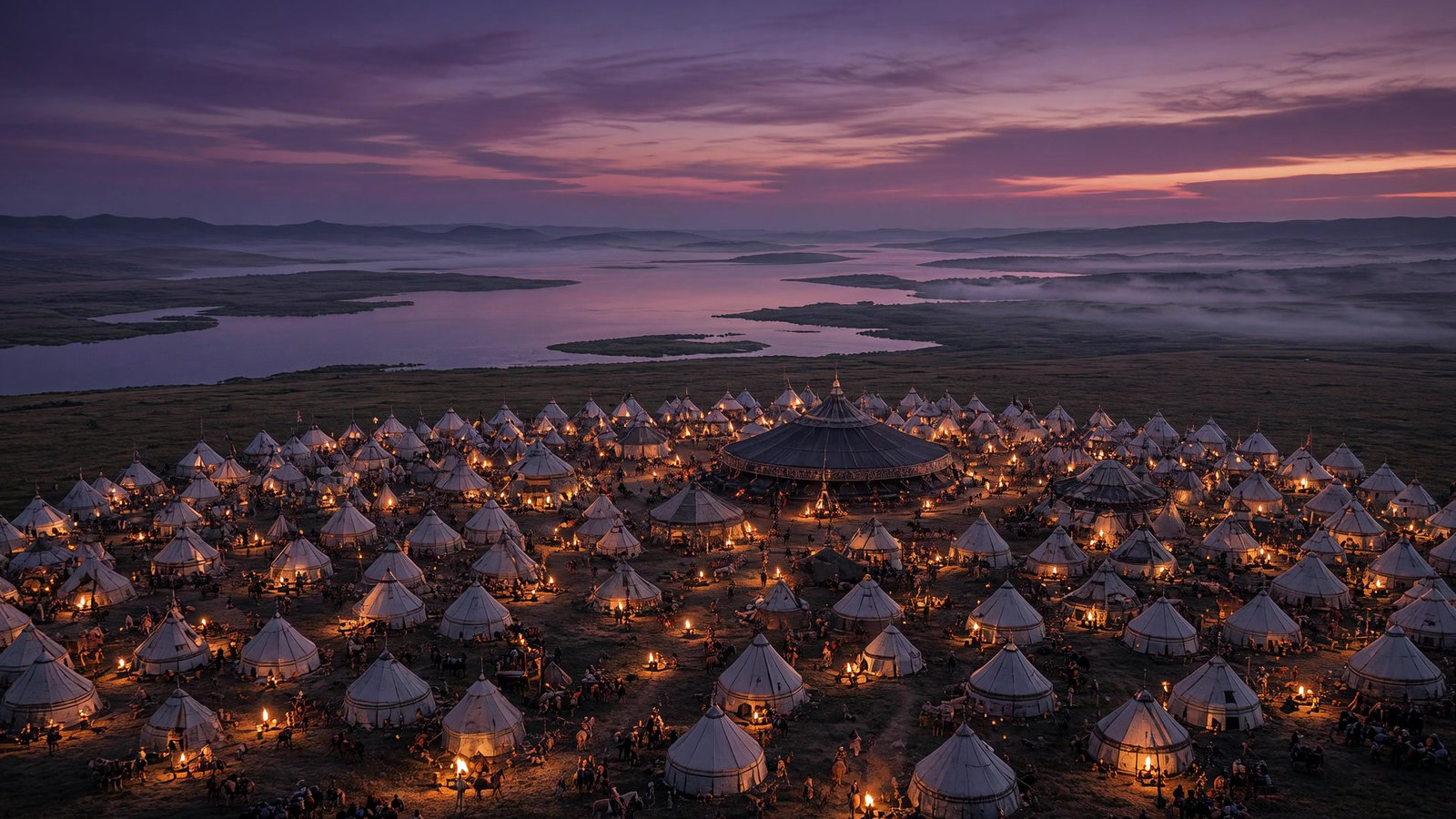
The hunting camp Polo calls Cachar Modun. AI reconstruction.
A book written in a prison
Did Marco ride beside the Khan on these hunts? His book never quite says so. Some historians have asked whether he reached China at all, since he never mentions tea or the Great Wall. Yet his book gets small details right, from the Mongol word for the keeper of lost property to the Khan’s gout, which is also recorded in Korean chronicles. Most scholars today believe he knew this court well.
Around 1291 the Polos finally left, escorting a Mongol bride by sea to Persia. They reached Venice in 1295, almost twenty-five years after they set out. A few years later, Venice was at war with Genoa, and Marco ended up in a Genoese prison. There he met Rustichello of Pisa, a writer of romances. In 1298, Marco told his story, and Rustichello wrote it down.
Kublai Khan died in 1294. Marco Polo died in Venice in 1324. But their story lived on, copied by hand across Europe, and read two centuries later by Christopher Columbus.
Here at Ørnereservatet
At the heart of the story is still that spring morning. The roof of a golden chamber opens, a gerfalcon rises into the sky, and a Venetian watches, and remembers.
Here at Ørnereservatet, Eagle World in Denmark, we tell the stories of birds of prey and the people who flew them. The film is in English. Scenes from the thirteenth century are AI reconstructions, clearly marked, and the maps are illustrations. The borders of the Mongol Empire on the maps in the film are approximate.
Sources for every factual claim are listed below. You are always welcome here at Ørnereservatet.
Watch the film on YouTube: Marco Polo and the Falcons of Kublai Khan
Sources
The Book of Ser Marco Polo, translated by Sir Henry Yule, 3rd edition revised by Henri Cordier, 1903. Vol. 1: https://www.gutenberg.org/ebooks/10636
Vol. 2: https://www.gutenberg.org/ebooks/12410
Quotes from Yule: Prologue, ch. XIV; Book I, ch. LXI; Book II, ch. XX. Other details of the journey, the court and the hunt: Prologue, ch. I to VIII and X to XVIII; Book I, ch. LXI; Book II, ch. XVIII to XXI.
Britannica, Marco Polo (Fosco Maraini): https://www.britannica.com/biography/Marco-Polo
Britannica, Kublai Khan (Charles R. Bawden): https://www.britannica.com/biography/Kublai-Khan
UNESCO, Site of Xanadu (World Heritage, 2012): https://whc.unesco.org/en/list/1389/
Frances Wood, Did Marco Polo Go to China?, 1995.
Hans Ulrich Vogel, Marco Polo Was in China, Brill, 2013.
Thomas T. Allsen, The Royal Hunt in Eurasian History, University of Pennsylvania Press, 2006. The Mongol ring hunts are also described by Ata-Malik Juvaini, cited in Allsen.
The name Silk Road is modern. It was coined by Ferdinand von Richthofen in 1877.
The Khan’s gout in Korean chronicles: Yule and Cordier, note to Book II, ch. XX.
Christopher Columbus’s annotated copy of the Latin edition is held at the Biblioteca Colombina, Seville.
Maps in the film: historical-basemaps by André Ourednik (approximate borders): https://github.com/aourednik/historical-basemaps
Coastlines: Natural Earth: https://www.naturalearthdata.com
eagleworld.dk