


The Philippine scops owl – the forest’s little night watchman
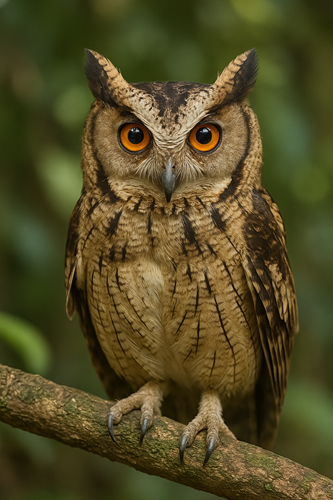
When darkness falls over the tropical islands of the Philippines, one of the country’s most distinctive – yet often overlooked – birds wakes up. The Philippine scops owl (Otus megalotis) is not big – only about the size of a blackbird – but its silhouette, with the characteristic “ear tufts” and the intense orange gaze, has made it a hallmark of the Philippine forests. It bears its Latin name with good reason: megalotis means “big ears” and refers to the feather tufts that can be raised like horns, giving the bird an almost theatrical expression.
Although it could easily blend in with the leaves of the forest, it carries a story that reaches far into evolution, the ecosystem and human cultural history.
The invisible hunter of the forest
The scops owl lives in lowland rainforest, forest edges and even in areas shaped by people. Observations show that it is found not only in untouched rainforest but also in mosaic landscapes with farmland, bamboo groves and coconut palms. This makes it one of the more adaptable birds of prey in the archipelago (Sanchez 2012).
At night it hunts from a lookout – a branch, a fence or even a rooftop. It listens, moves silently on its soft wings and strikes its prey in a surprise attack. Its prey is wide-ranging: insects such as cicadas, grasshoppers and beetles, but also mice, small birds, bats and frogs (Holt et al. 2020).
Researchers have described how the owl tears up its prey with its beak and often swallows it whole. At times this strategy can end dramatically – chicks trying to swallow insects that are too large can, in the worst case, choke (Sanchez 2012). Yet this very efficient hunting technique is one of the reasons the scops owl plays such an important role in the ecosystem: it keeps populations of small animals down and acts as a natural balancer.
Calls in the night
It is not only the sight but above all the sound of the scops owl that makes an impression. The male’s territorial call is described as a rhythmic series: oik-oik-oik-ook. The deeper final note can be heard repeated through the night in the breeding season (Holt et al. 2020). For local villagers this call has had a very special meaning. In several regions an owl calling close to a house foretells illness or death – a belief that has cost many owls their lives over the years (Sanchez 2012).
For biologists, however, the call is a key trait: it distinguishes the various subspecies and has helped determine how the scops owls on the many islands of the Philippines should be classified.
Try it yourself: Can you say oik-oik-oik-ook? Call the scops owl in “Kald på uglen” (Call the owl) →
Life in tree hollows
As the breeding season approaches, the scops owls pair up. The female usually lays only 1–2 eggs in a hollow in an old tree, an old woodpecker hole or – more unusually – among roots close to the ground. She incubates for almost four weeks while the male provides the food. When the chicks hatch, they are small white balls of down, completely dependent on their parents.
After 4–5 weeks the chicks leave the nest but stay in the area, where they gradually learn to hunt for themselves. Both parents take part in the care, and researchers have observed families in which the chicks were fed long after they had left the nest (Sanchez 2012).
Islands and isolation
The Philippines consist of more than 7,000 islands, and the scops owl is found on several of the largest – Luzon, Samar, Leyte, Mindanao, Negros and Bohol. Each island has its own subspecies with small differences in size, plumage and voice (del Hoyo & Collar 2014).
Genetic analyses show that the lowland owls – including Otus megalotis – form a separate group from the montane (highland) owls, such as the Luzon and Mindoro scops owls. Isolation on the islands has given rise to rapid evolutionary development, and several subspecies are today regarded as species in their own right (Miranda et al. 1999).
With a length of 20–25 cm and a weight of 200–310 grams, the Philippine scops owl is one of the largest Otus owls in the Philippines. Its plumage comes in both a brownish and a more reddish phase, and its feathered legs – “like little muffs” – give it a particularly compact appearance (König & Weick 2008).
Threats today
Although the species is assessed globally as “Least Concern” (BirdLife International 2016), it is far from free of threats. The biggest is the destruction of lowland rainforest – for commercial logging, agriculture and urbanisation. The forests on islands such as Negros and Bohol have been reduced to small fragments, and here the owl is probably under considerable pressure.
In addition, there are examples of hunting and trapping – either because the birds are used in illegal trade or because local traditions associate owls with misfortune. At the same time, more frequent typhoons and climate change mean that its habitats may become even more fragile in the future.
Conservation and hope
There is hope, too. In the Philippines, the Center for Philippine Raptors works with rescue, research and breeding of owls, and has had success with captive breeding (Sanchez 2012). In Europe the species is part of EAZA’s breeding cooperation as a “model species” – a species that teaches us how to keep and breed it, so that the experience can be used to save even more threatened relatives (EAZA 2023).
Several of the national parks of the Philippines still hold populations of the scops owl, including the Sierra Madre on Luzon and Bulusan Volcano Natural Park. But in reality the future of the species depends on whether the forests are preserved, and on whether people’s attitude towards owls changes from superstition to respect.
Why we tell Papaya’s story
The Philippine scops owl may not be a giant like the white-tailed eagle or a mythical giant like the harpy eagle. But its story holds everything that makes the bird world fascinating: evolution across an archipelago, ecological importance, vulnerability to human actions – and not least the close, intimate side of bird life, where a small pair in a tree raises their downy chicks in the dark of night.
Here at Eagle World we have set out to give this hidden bird a voice. With Papaya – our Philippine scops owl – visitors can get close to a bird that otherwise lives in darkness and is almost never seen in daylight. Through education, knowledge and live encounters we create fascination and respect for a species that could easily be forgotten.
For us it is clear: only through education can we make sure that species like Papaya and her wild relatives still have a future. And we have chosen to take on that responsibility – to tell the stories of the small, the large and the overlooked birds that still fly through the world’s forests.
References
-
BirdLife International (2016). Otus megalotis. The IUCN Red List of Threatened Species.
-
Del Hoyo, J. & Collar, N. J. (2014). HBW and BirdLife International Illustrated Checklist of the Birds of the World.
-
Holt, D. W., et al. (2020). Philippine Scops-Owl (Otus megalotis), in Birds of the World. Cornell Lab of Ornithology.
-
König, C. & Weick, F. (2008). Owls of the World.
-
Miranda, H. C., et al. (1999). Phylogeny and biogeography of Philippine owls (Otus spp.). Biological Journal of the Linnean Society.
-
Sanchez, J. (2012). Breeding biology of the Philippine Scops-Owl (Otus megalotis). Our Nature 10(1).
-
EAZA (2023). EAZA Small Owl EEP Annual Report.
This article is from 16 August 2025
By Peter Frank Wenzelx