


Through the Golden Eagle's Eye
A new film from Ørnereservatet / Eagle World takes you up over the heath, the forest and the ponds and tries to convey how the world may look to a golden eagle from morning to evening.
In the film below you can follow the eagle from morning to evening over the landscape around Eagle World.
Why we made the film
We stand close to our golden eagles every day. We watch them sit still for hours, turn their heads toward something we have not even noticed, and then suddenly take off. We have long wondered: what is it she actually sees? And why does she choose that path?
With the film, we want you to experience how the world might look through a golden eagle's eyes. It is built on research and on Eagle World's own experience with the eagles. The footage is our own calm drone flights over the landscape around the reserve, filmed in the morning, at midday and in the evening. Over the pictures we place small "thoughts": what the eagle notices, how she judges it, and what she chooses to do.
Between the drone flights you see our own golden eagles: our own film footage, archive photos from the reserve, and a clip of the golden eagle Rhina on her nest from March 2026.
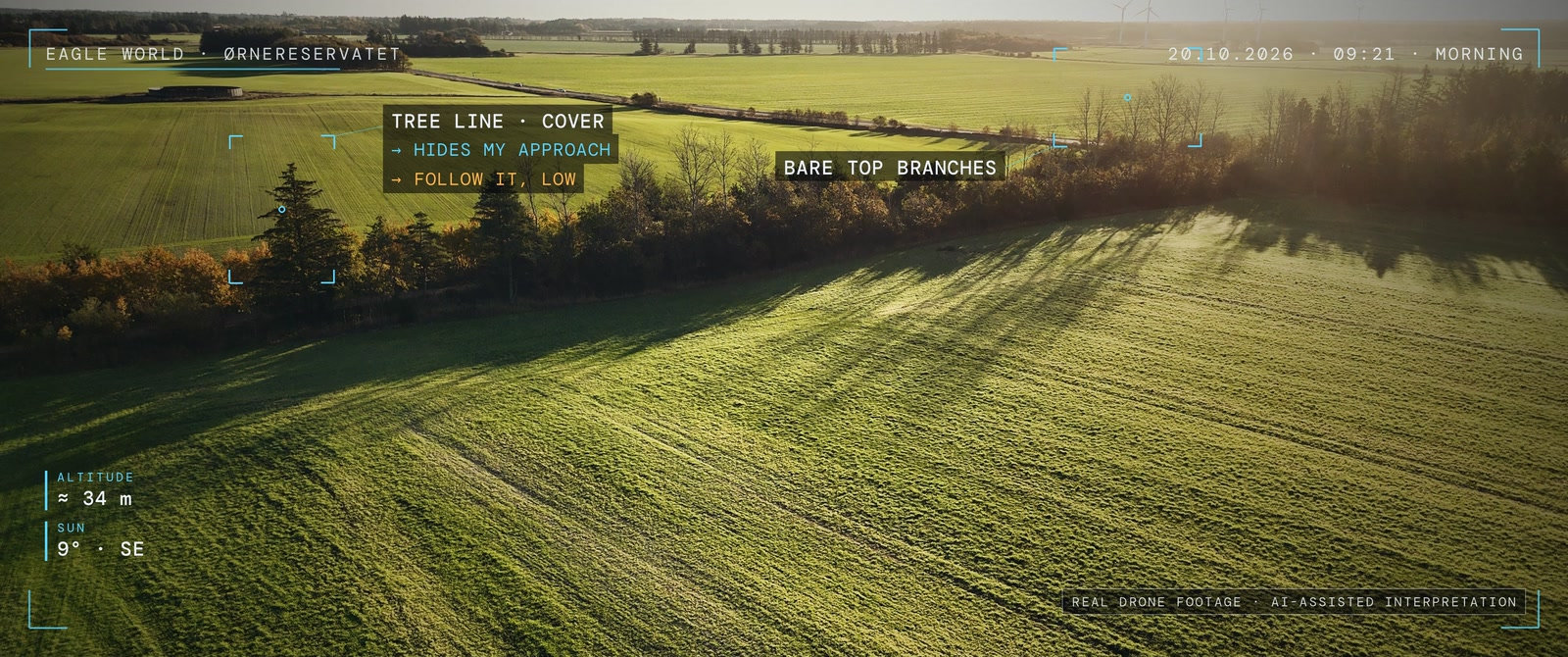 Morning over field and shelterbelt, 20 October 2026, with the eagle's thoughts overlaid. Still: Eagle World.
An eye built for distance
Eagles see more sharply than we do. In the Australian wedge-tailed eagle, a close relative of the golden eagle, visual acuity has been measured at about twice that of a human [1]. One reason is that birds of prey have two "sharp points" in each eye, the so-called foveae [2]. The deeper one looks out to the side. That is why an eagle often turns its head and looks with one eye when it studies something far away [3]. The other is used when the prey is close [2].
Above the eye sits a bony ridge that shades it from the sun, and the visual field has a blind area above the head, which also helps against glare [2][4]. But sharpness has a cost: as the light falls, so does the detail [1][2]. An eagle is a daytime animal.
You may have heard that birds of prey can see the urine trails of mice in UV light. The research suggests that this is unlikely [5].
Read more about their vision: Raptor eyes – what new research reveals about the sharpest vision in the world →
Reading the terrain
An eagle does not just fly. She reads the landscape. A line of trees gives cover, so she can approach unseen. A dead, bare branch is a good lookout, with a clear view and an easy departure. Open field means she must watch for movement. She also watches other birds: if crows or ravens gather and call, there may be food on the ground, and golden eagles often follow those signals [10].
In the film we have tried to tie every "thought" to something that is actually in the picture. A tree line, a dead tree, frost on the heath, low sun.
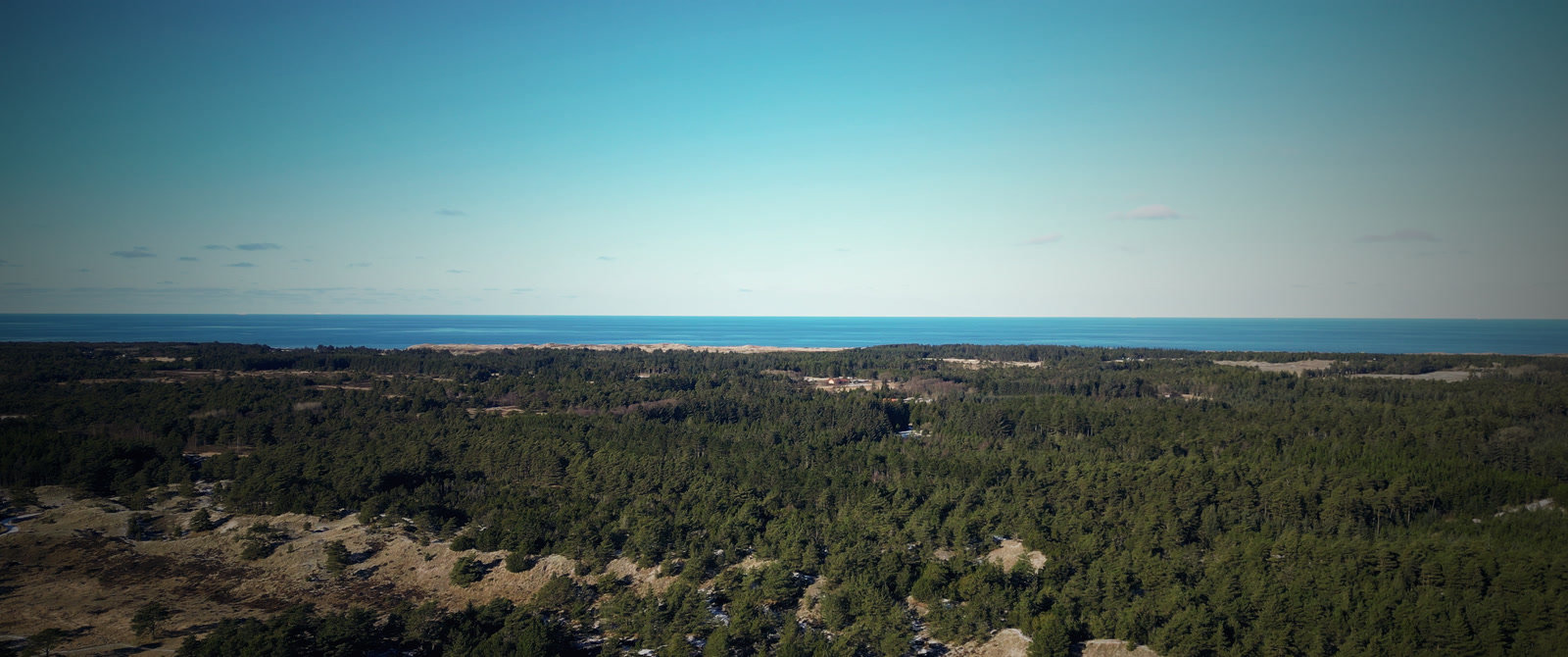 Midday, high over plantation and dune, with the coast on the horizon. 10 January 2025. Still: Eagle World.
Thermals and wind: height for free
The golden eagle is an energy saver. When the sun warms the ground, warm air rises in columns — thermals — and the eagle can circle upward almost without a wingbeat [7][8]. Over flat land, golden eagles often fly highest, on thermals, while over slopes and hills they use the updraft the wind creates along the terrain [6][7]. Thermals form best in still weather, while slope lift needs wind [7].
So the eagle's day follows the sun. In the morning the ground is cold, and she glides low. In the middle of the day there is lift, and she can climb high. At sunset the thermals fade again [8]. In young golden eagles, the longest flights come right in the middle of the day, when the thermals are strongest [9].
See today's wind and thermals over the reserve in Today's Flight Weather →
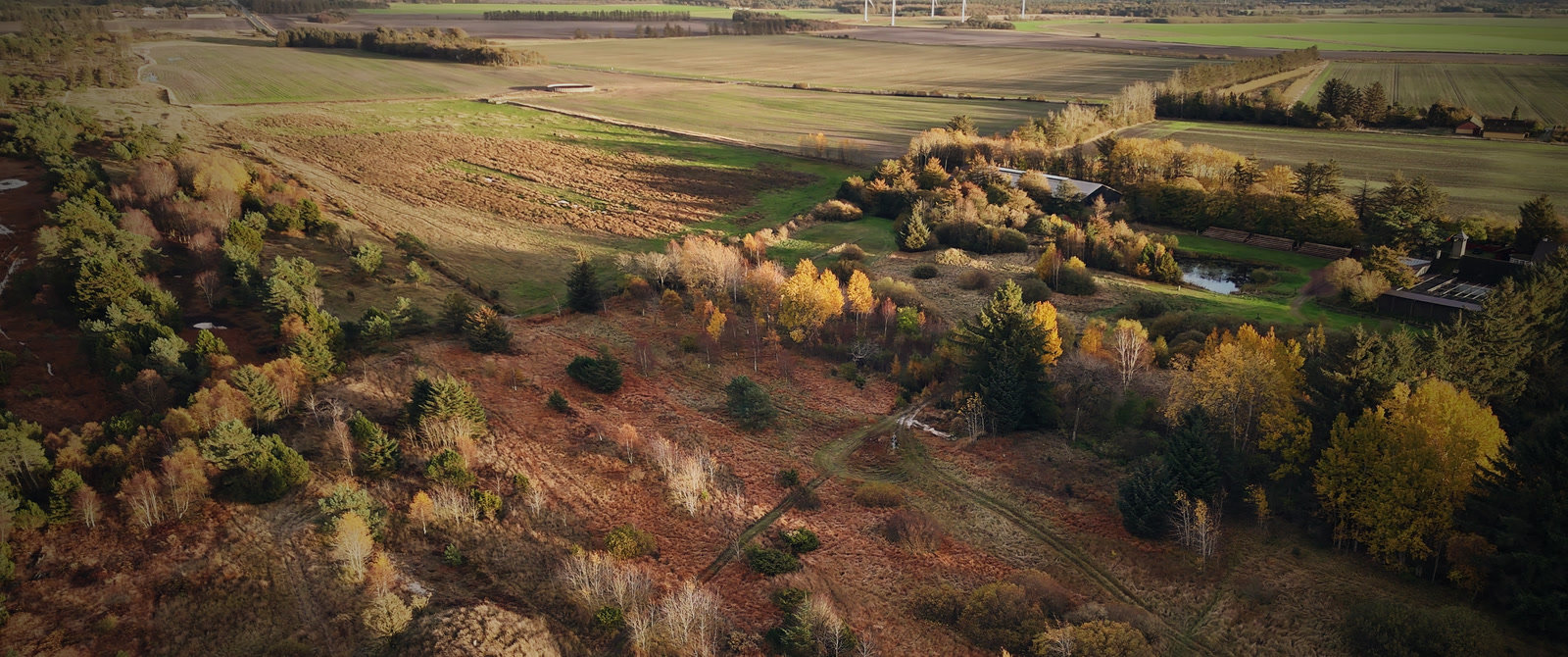 Evening light over the heath, 24 October 2025. Still: Eagle World.
Hunting: patience is strategy
Golden eagles hunt in three ways: high in a soar, from a perch, or in low contour flight close to the ground, using every rise and bush as cover [10]. On sunny, windy days they soar more. On grey, still days they hunt more often from a branch [10]. The attack often comes from the windward side [10].
And most attempts fail. In one field study, only about one in five hunting attempts succeeded [11]. So when an eagle sits still, it is not laziness. It is strategy.
Territory, neighbours and rest
A golden eagle has its own ground. In an American study, a pair's territory covered more than 3,000 hectares [12]. At the borders the eagles fly an undulating "roller-coaster" display, a signal to the neighbours that this ground is occupied [12]. So unfamiliar eagles are noticed and judged: friend, rival or mate.
At the same time, a golden eagle spends most of the day sitting. In the same study, the males were in the air only about a fifth of the daylight hours [12]. Does she enjoy it? Science cannot answer that. But if you have seen an eagle settle in the evening sun, with loose feathers and half-closed eyes, you have seen something that looks like rest.
The partner on the ground
At Ørnereservatet the eagles have a partner on the ground: the falconer. Not a master, but a partner. Trust is built flight by flight, and the glove means a safe landing. That part is based on our own experience, not on a study.
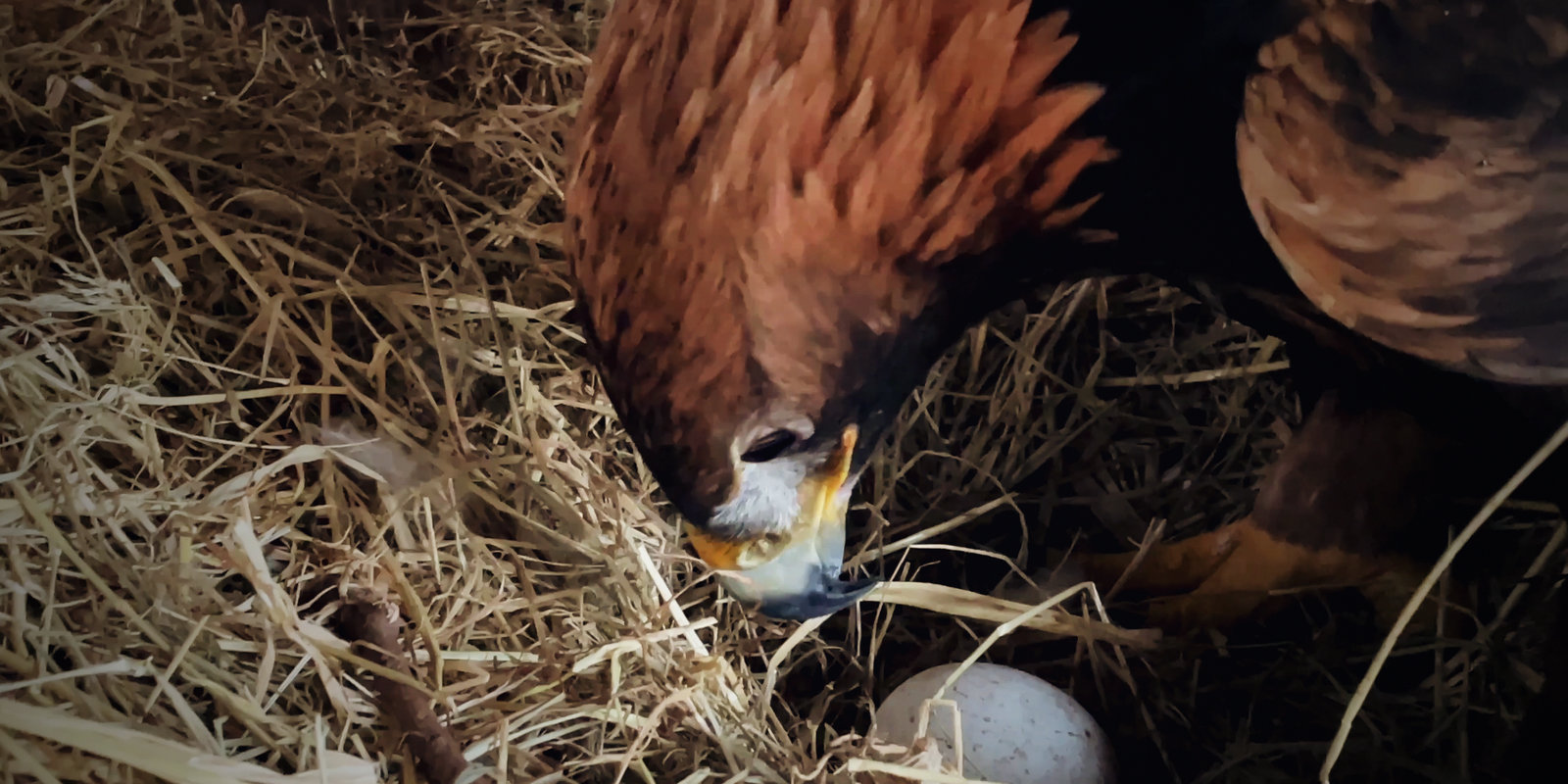 The golden eagle Rhina on her nest, March 2026. Still: Eagle World.
Why AI is so fantastic for exactly this
We want to say it plainly: without artificial intelligence we could not have made this film in this way. AI has helped us to:
- go through hundreds of drone recordings from our own drives and find the calmest, most eagle-like flights, using the drone's own height and speed data;
- look at the pictures and describe what is actually in the terrain: tree lines, dead trees, ponds, the height of the sun;
- gather and compare research on the eagle's eye, thermals, hunting and territory, with sources we can check;
- put it all together into a visualisation of how an eagle may perceive the world;
- add an English narrator's voice to the film. The voice is synthetic (AI-generated).
It is a tool that lets us share research in a completely new way, and we are excited about the possibilities.
But we also want to be honest: the footage is real. The overlays and "thoughts" are an AI-assisted interpretation built on science, not the eagle's actual thoughts. Nobody can read an eagle's mind. We can only come a little closer.
Sources
- Reymond, L. (1985). Vision Research 25:1477–1491. doi:10.1016/0042-6989(85)90226-3 (wedge-tailed eagle).
- Potier, S. et al. (2020). Diversity 12:400. doi:10.3390/d12100400
- Tucker, V.A. (2000). Journal of Experimental Biology 203:3745–3754. doi:10.1242/jeb.203.24.3745
- Potier, S. et al. (2018). Journal of Experimental Biology 221:jeb177295. doi:10.1242/jeb.177295
- Lind, O., Mitkus, M., Olsson, P. & Kelber, A. (2013). Journal of Experimental Biology 216:1819. doi:10.1242/jeb.082834
- Katzner, T.E. et al. (2012). Journal of Applied Ecology 49:1178–1186. doi:10.1111/j.1365-2664.2012.02185.x
- Duerr, A.E. et al. (2012). PLoS ONE 7:e35548. doi:10.1371/journal.pone.0035548
- Eisaguirre, J.M. et al. (2019). Frontiers in Ecology and Evolution 7:317. doi:10.3389/fevo.2019.00317
- Soutullo, A., Urios, V. & Ferrer, M. (2006). Journal of Ornithology. doi:10.1007/s10336-005-0020-x
- Kochert, M.N., Steenhof, K., McIntyre, C.L. & Craig, E.H. (2002). Golden Eagle (Aquila chrysaetos). Birds of North America. doi:10.2173/bna.684
- Collopy, M.W. (1983). The Auk 100(3). digitalcommons.usf.edu/auk/vol100/iss3/33
- Collopy, M.W. & Edwards, T.C. (1989). Journal of Field Ornithology 60(1). digitalcommons.usf.edu/jfo/vol60/iss1/8