


The Senses of Birds of Prey
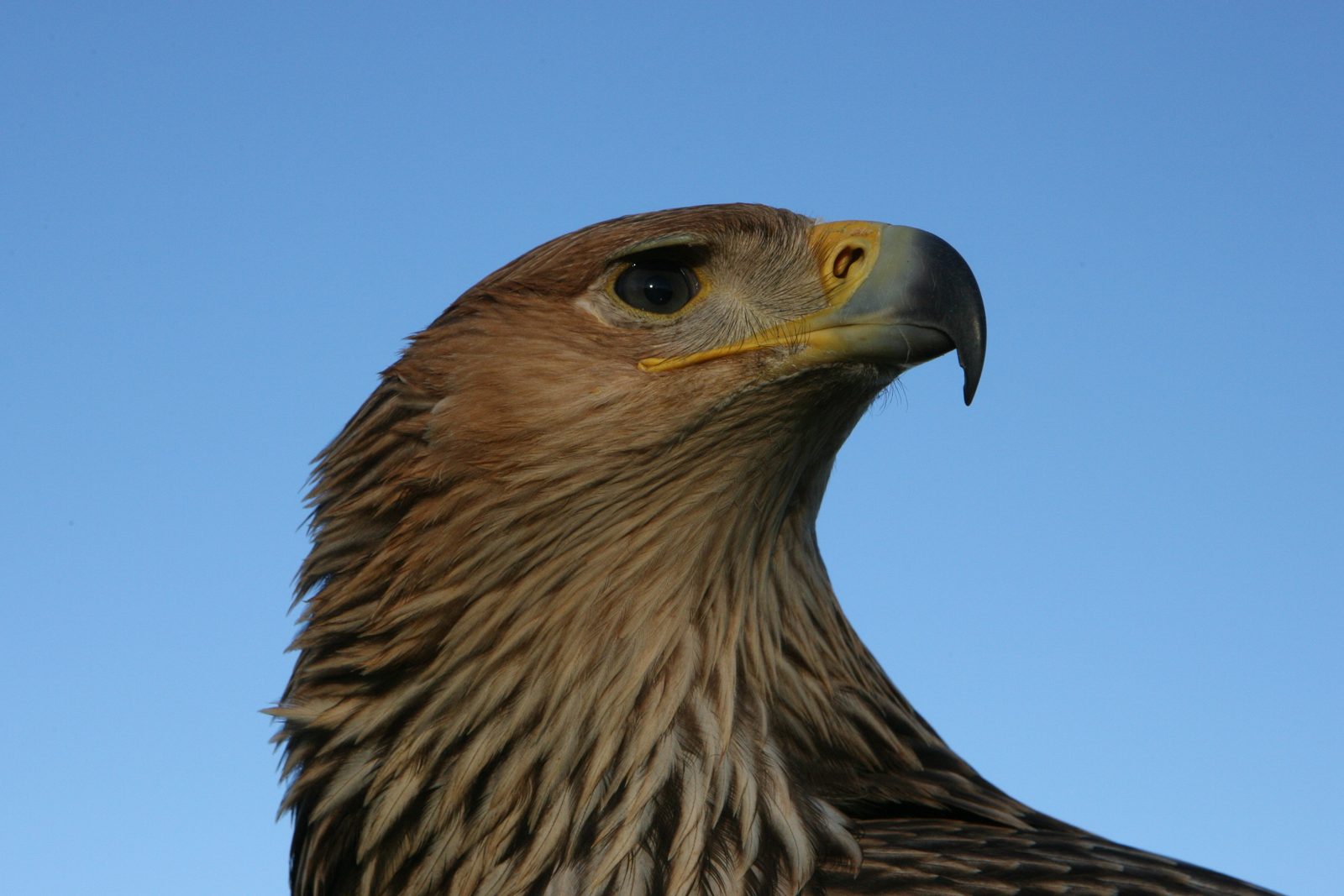 Eastern imperial eagle in profile.
Birds of prey such as eagles, falcons, vultures and owls are known for their impressive hunting skills. But it is their senses that make them some of the most effective hunters in nature. The eagle sees more sharply than any other animal we know of. The owl can catch a mouse it cannot see. And some vultures find their food by smell. In this article we look at what science knows today, and at what we have seen for ourselves during many years with the birds of prey at Eagle World.
A life among birds of prey
Frank Wenzel laid the foundation for the reserve at Lake Arresø in 1970, and in 1976 the family moved to North Jutland, where Eagle World came into being. Frank has studied and lived with birds of prey, both in the wild and at the reserve, for a lifetime. Peter Frank Wenzel, Frank's youngest son, took over Eagle World in the summer of 2015, and a new generation of the family is on its way.
This means that we see the birds every single day: in training, during the flying displays and in everyday life. In the text below, research findings and our own observations from the reserve are therefore kept apart.
The eagle's eye: the sharpest vision in the world
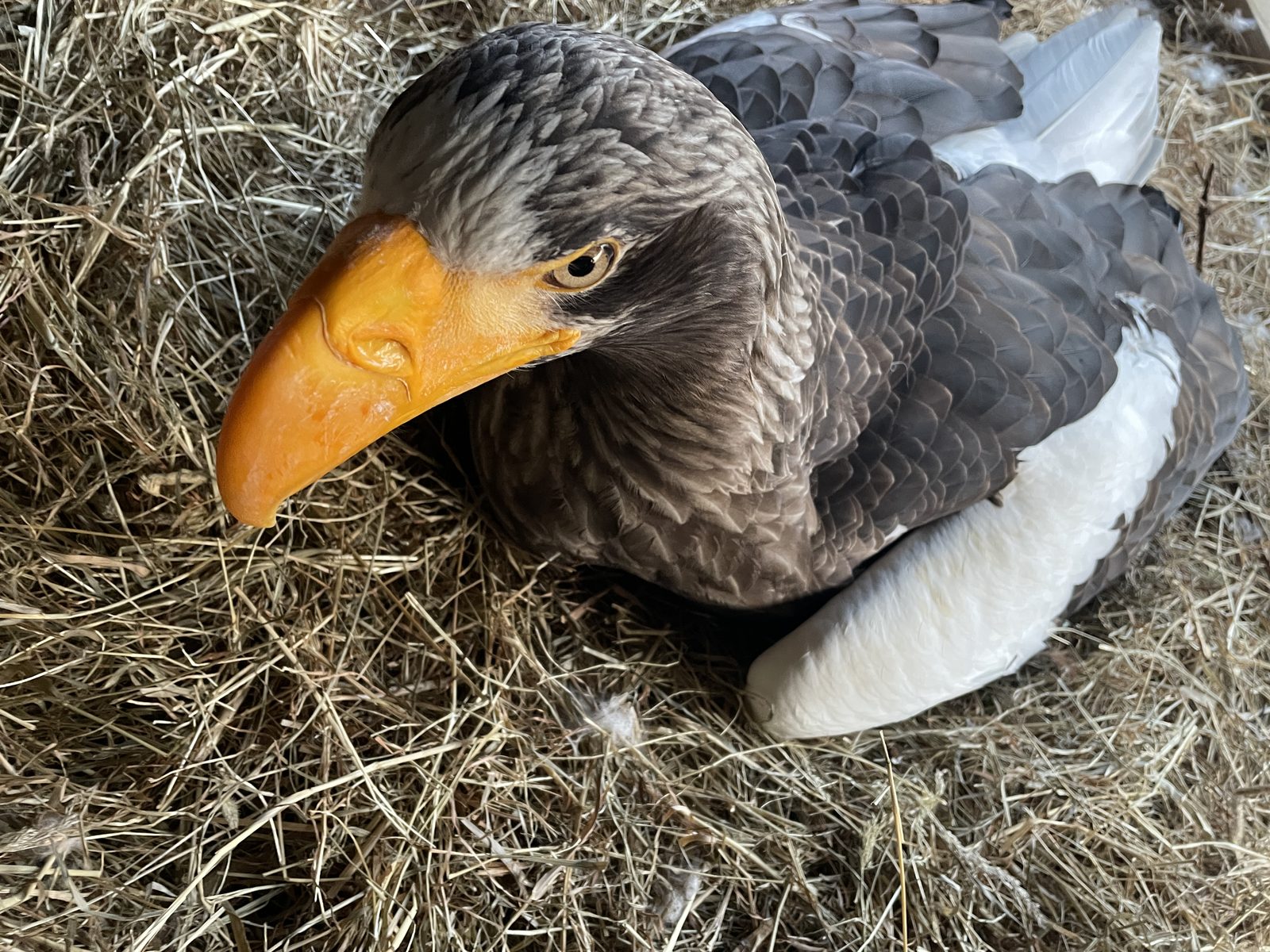 Steller's sea eagle in the nest. Photo: Peter Frank Wenzel.
The wedge-tailed eagle of Australia has the sharpest vision ever measured in any animal. In experiments it could distinguish up to around 140 fine lines per degree of its visual field. A person with good eyesight typically manages about half that. A large eagle therefore sees roughly twice as sharply as we do. Claims that eagles see four to eight times more sharply than humans do not hold up, according to the researchers behind a major review of raptor vision from Lund University (2018).
The secret lies in the retina. In the eagle's fovea, the small area of sharpest vision, there are more than 450,000 cone cells per square millimetre, packed as tightly as physics allows. Birds of prey also have two foveae in each eye: a deep one that looks about 40–45 degrees out to the side, and a shallower one that looks forward. A 2024 study of 94 bird species shows that sharp vision is found above all in large birds with large eyes that need to spot food far away, just like birds of prey and scavengers.
The eagle's vision in numbers
- About twice as sharp as a human's
- Up to around 140 fine lines per degree of the visual field (wedge-tailed eagle)
- More than 450,000 cone cells per mm² in the fovea
- Two foveae in each eye: one looking sideways, one looking forward
The falcon in the stoop
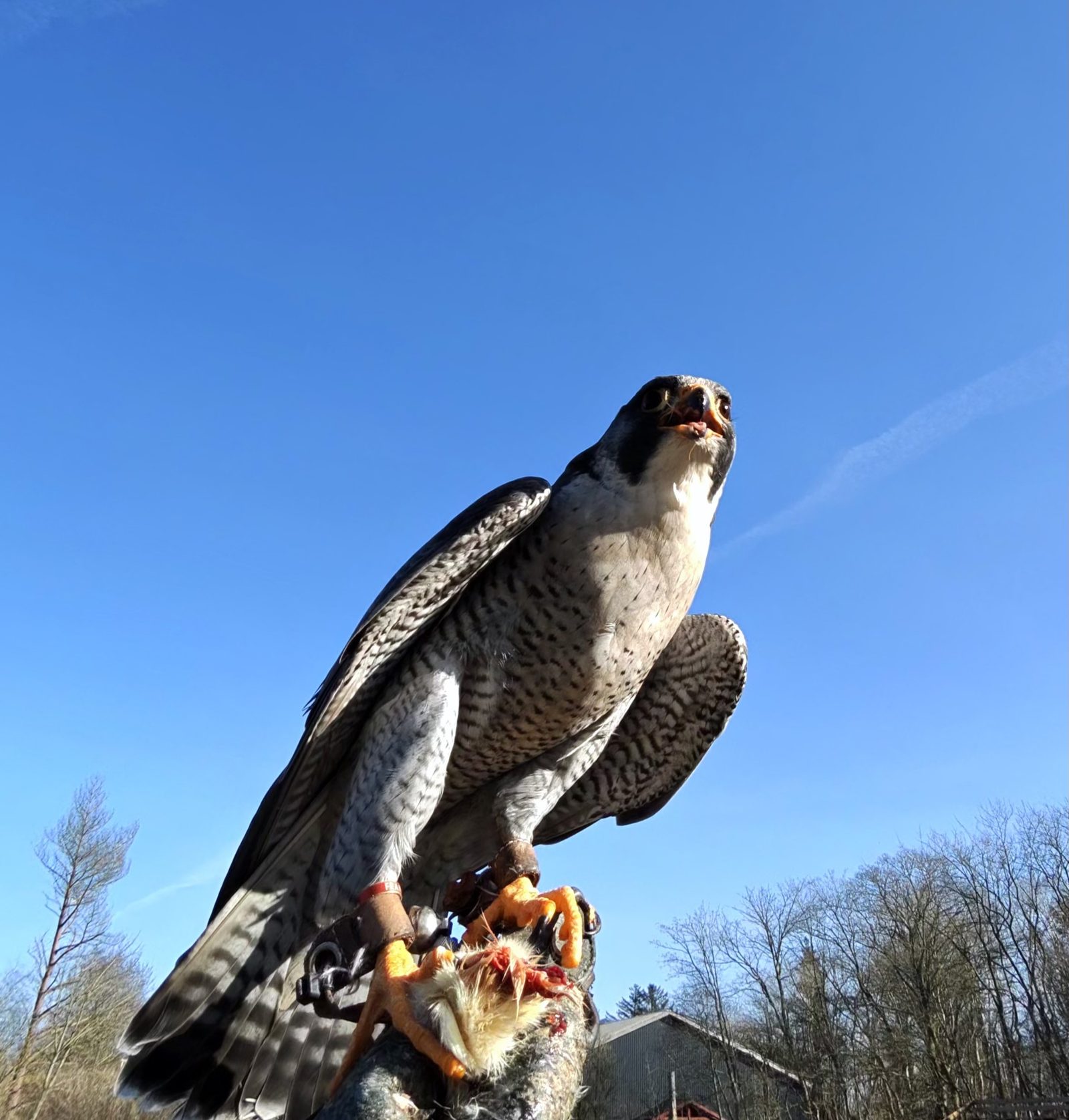 Peregrine falcon on the glove. Photo: Peter Frank Wenzel.
The peregrine falcon is famous for its dives, known as stoops. Its top speed is usually given as around 320 km/h, and in a series of experiments in 1999 the falcon Frightful was clocked at 389 km/h when diving from an aircraft at high altitude.
But how do you keep your eye on the prey at that speed? As early as 2000, the American researcher Vance Tucker showed that the peregrine keeps its head straight and instead flies in a curve, so that the deep fovea, which looks obliquely to the side, points at the prey the whole time. Turning its head would create too much drag. In 2017, researchers from the University of Oxford fitted peregrines with GPS and small cameras and found that they steer the final attack by the same rule as a homing missile. A later computer study (2018) showed that the high speed gives the falcon the forces it needs to follow the sudden turns of its prey.
Falcons also see fast. An experiment from Lund University (2020) found that peregrines can tell a flickering light from a steady one up to at least 129 times per second. Humans typically reach 50–60. The Harris's hawk, which hunts slower prey, came in at around 81.
Ultraviolet light: a myth debunked
We have previously written that birds of prey can see UV-reflecting trails left by their prey. The idea comes from a Finnish study from 1995, in which kestrels appeared to be attracted to the urine trails of voles. In 2013, however, researchers from Lund University measured how much UV light actually passes through the eyes of the kestrel, common buzzard, sparrowhawk and red kite, and what urine looks like in UV light. They concluded that the urine does not light up but instead absorbs UV light, and that the trail is unlikely to be a useful signal. So that explanation no longer holds. The kestrel finds the vole with its sharp eyes and its patience.
The kestrel's steady head
When a kestrel hovers over a roadside verge, its head stays almost perfectly still while its wings and tail do the work. As early as 1983, Dutch researchers showed that the eyes are held fixed in relation to the ground. A wind tunnel study from RMIT University and the University of Bristol (2024) measured that the head moves less than 5 millimetres while the bird hangs in the wind. It is the sense of balance and very fine control of wings and tail that give an image without any shake.
Frank Wenzel described it himself in "Rovfugle i Europa" (Birds of Prey in Europe): "The kestrel's flight is, incidentally, very characteristic, especially when it hovers, which it often does, i.e. when the falcon holds itself still in the air with vibrating wings over a particular spot." (Rovfugle i Europa, 1978, Issuu page 35)
The owl's ears: a map of sound in the brain
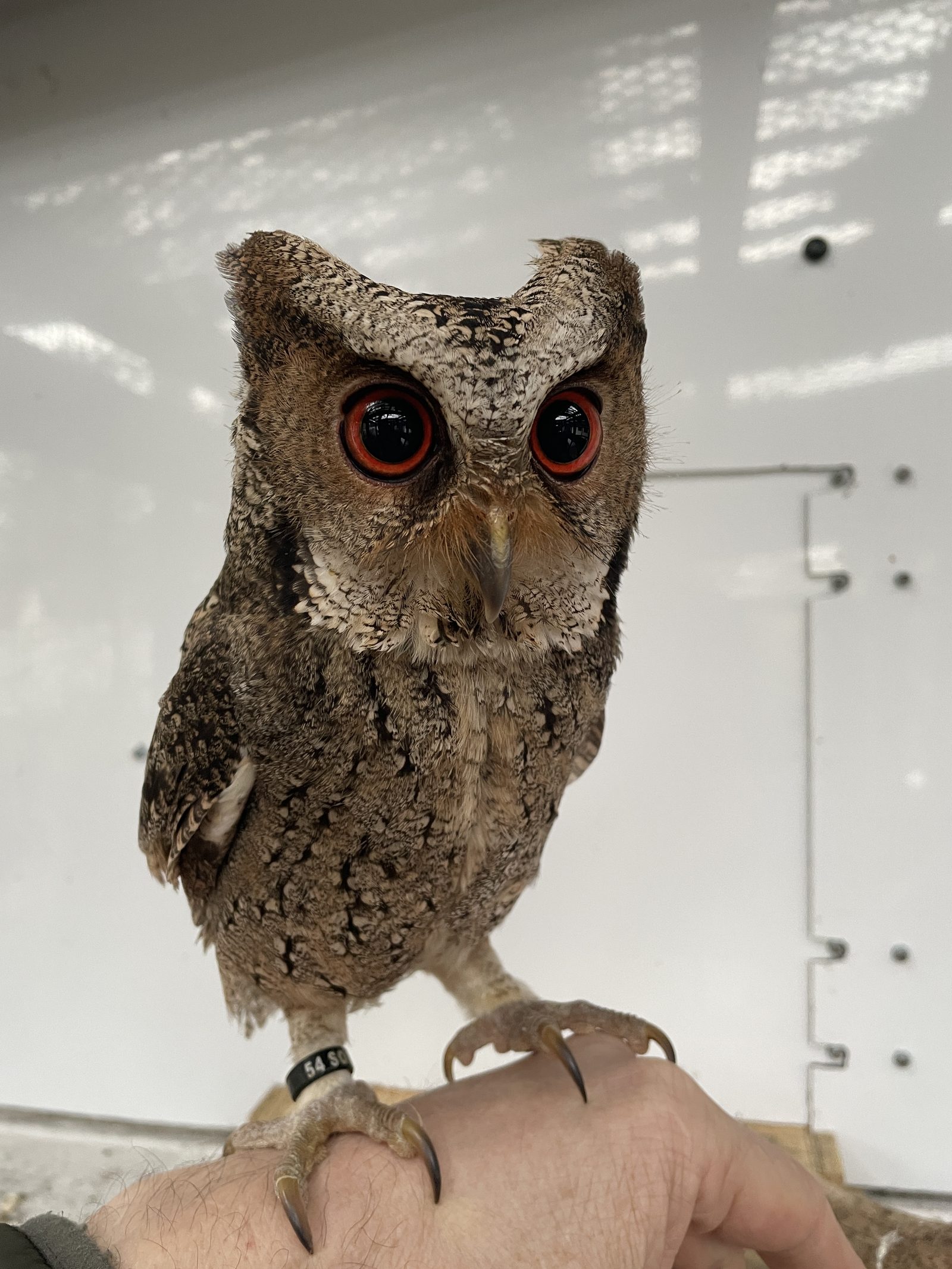 Papaya, Philippine scops owl. Photo: Peter Frank Wenzel.
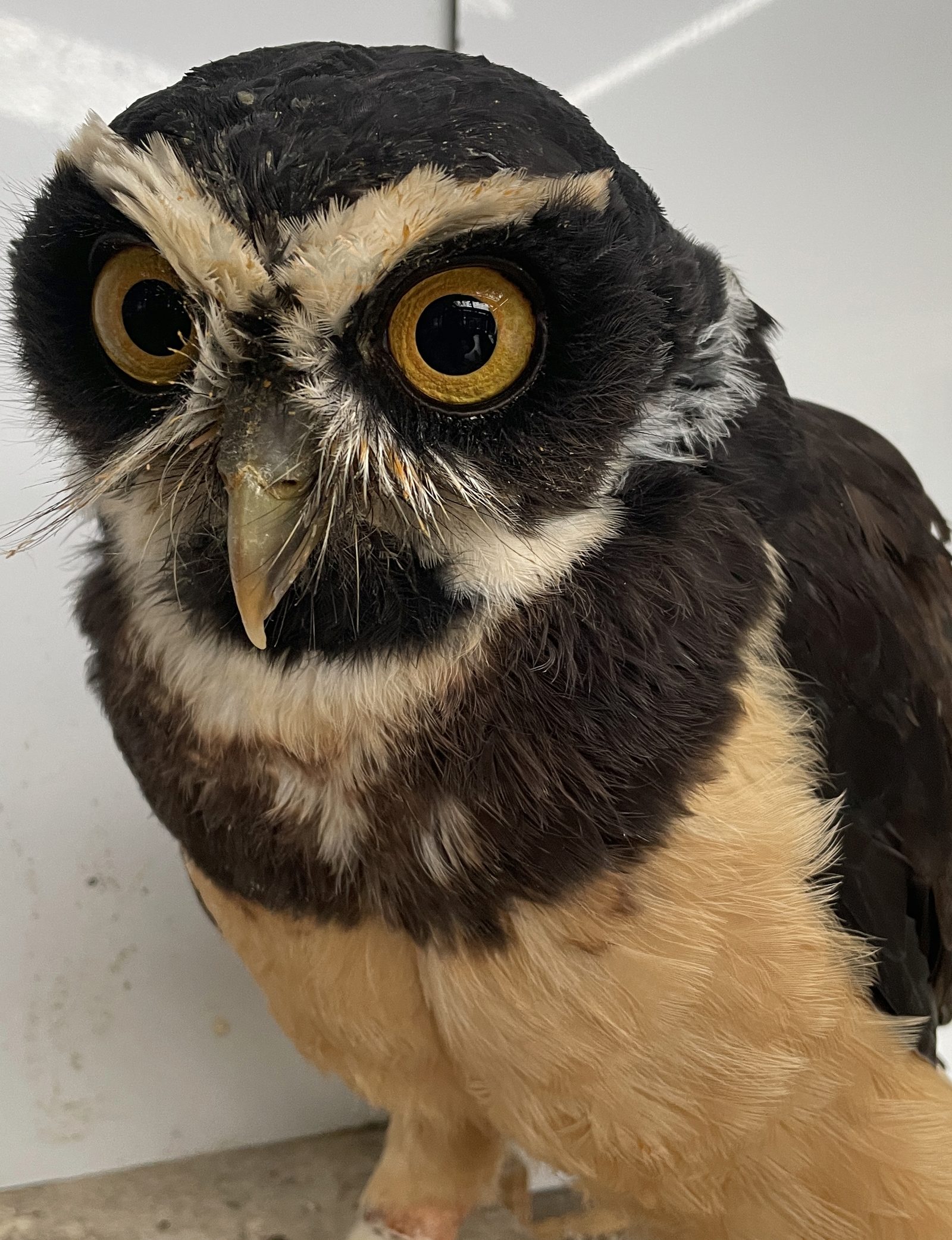 Delta, spectacled owl. Photo: Peter Frank Wenzel.
Owls are the specialists of the night. The classic experiment dates from 1971: a barn owl was able to catch a mouse in total darkness using sound alone. The owl's facial disc works like a parabolic dish that channels sound to the ears, and in the barn owl the two ear openings sit at different heights. As a result, sound reaches the two ears slightly differently, and the owl can work out both direction and height. In 1978, researchers at Caltech found that the owl's brain contains an actual map of where sounds are located in space, with each nerve cell corresponding to a particular point.
A surprising finding from the University of Oldenburg (2017): the barn owl's hearing does not deteriorate with age. An owl tested at 2 years old and again at 17 and 23 heard practically as well. Birds can regenerate the hair cells in the inner ear.
The owl's flight is also almost silent. The flight feathers have a comb-like leading edge and a fringed trailing edge, and the plumage is as soft as velvet, which dampens the rush of air and the rustle of feathers. And if the owl wants to look around, it can turn its head about 270 degrees. In 2013, researchers at Johns Hopkins University showed how special blood vessels keep the brain supplied with blood.
Owl hearing at a glance
- 1971: a barn owl caught a mouse in total darkness using sound alone
- The facial disc channels sound to the ears like a parabolic dish
- The barn owl's ear openings sit at different heights, so it can judge both direction and height
- The brain contains a map of where sounds are located in space (Caltech, 1978)
Among the residents of Eagle World are the Philippine scops owl Papaya and the spectacled owl Delta. Incidentally, the small "horns" on Papaya's head are not ears but feather tufts; Delta the spectacled owl has none. The real ears are hidden under the feathers on the sides of the head.
Vultures: a nose and a blind spot
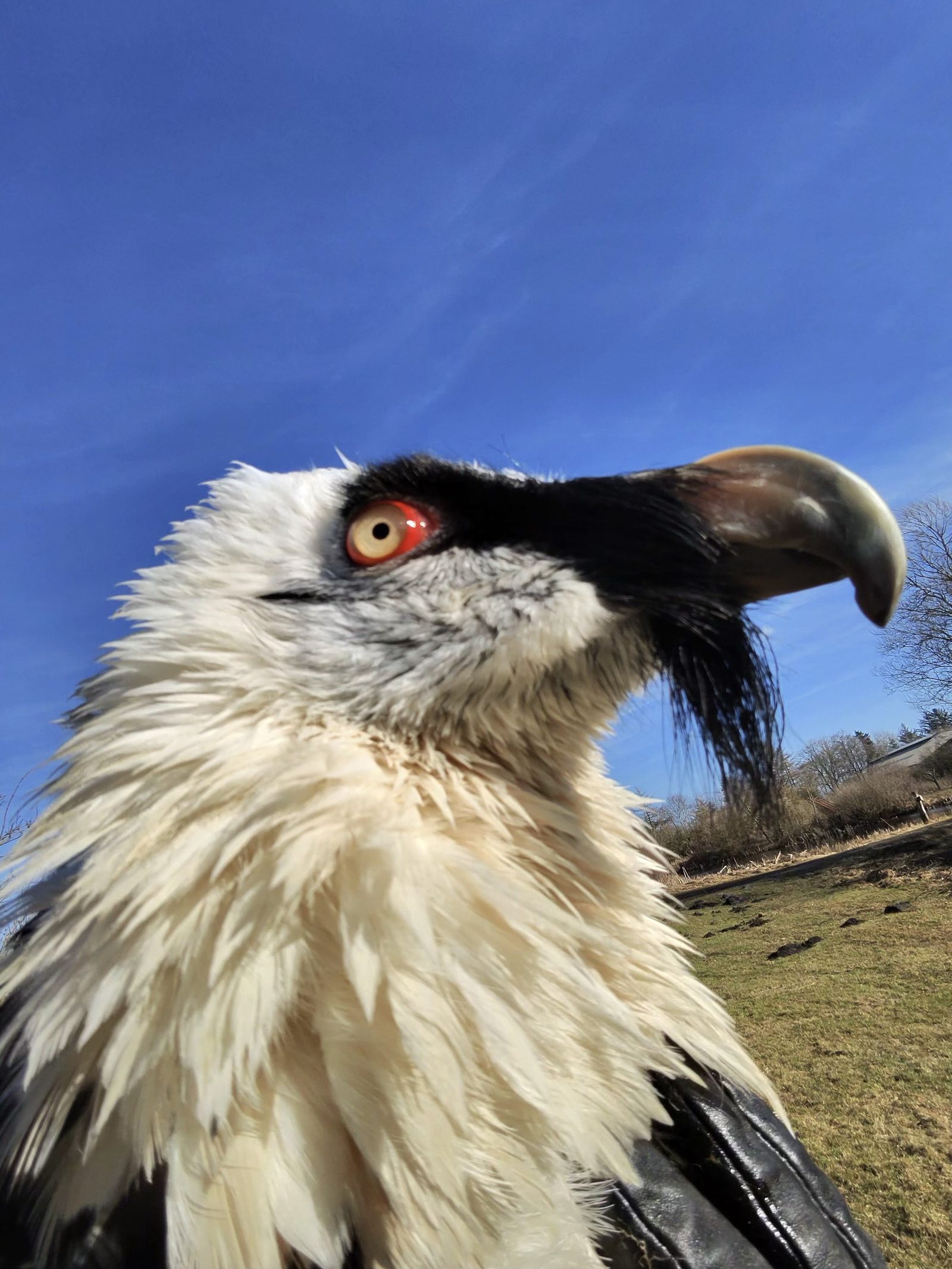 Bearded vulture up close. The bearded vulture finds food by sight, not by smell. Photo: Peter Frank Wenzel.
For a long time it was believed that birds could barely smell. The turkey vulture of the Americas proves otherwise. As early as the 1930s, engineers in California discovered that turkey vultures gathered over leaking gas pipes when a foul-smelling substance was added to the gas. An anatomical study from 2017 showed that the turkey vulture's olfactory bulbs are four times larger than the black vulture's and contain twice as many nerve cells of an important type.
Old World vultures, such as the griffon vulture, rely first and foremost on sight. A study from the University of Birmingham (2012) showed that griffon vultures looking down for food in flight have a blind spot straight ahead. This makes them vulnerable to wind turbines.
Touch and balance
The feet and beaks of birds of prey are not only weapons but also sense organs. Birds have so-called Herbst corpuscles, tiny touch receptors in the skin, the legs and at the base of the feathers, which pick up vibration and pressure. At the feathers they are thought to tell the bird how the air is acting on its plumage in flight. The sense of balance in the inner ear works together with vision when a falcon hangs motionless in the wind or an eagle lands precisely on the glove.
Observations from Eagle World
Seen here at Eagle World
In "Stormen i vingerne" (Storm in the Wings), Frank tells the story of the white-tailed eagle Gorm, who one day came flying in with the falconer's glove that Frank had left at home. Gorm had flown a kilometre home, got through a gate and taken the glove from behind a door. Frank said: "It's quite incredible! It's not like with dogs, where you train them to fetch things. Gorm worked it all out himself: he hasn't been trained to do it, which makes it really interesting" (Stormen i vingerne, told by Frank Wenzel, written by Mette Kirstine Goddiksen, Issuu page 87).
Frank also noted differences in the eyes of different species. "Rovfugle i Europa" says: "The sparrowhawk's eye is relatively larger and more prominent than the goshawk's." (Rovfugle i Europa, 1978, Issuu page 94). And in "Stormen i vingerne": "Young goshawk with yellow eyes. With age they turn red." (Issuu page 52)
What to look for at the flying display
Notice how the falcon turns its head in small jerks rather than moving its eyes. The eyes of birds of prey are so large that they can hardly move in their sockets. Watch, too, how an owl turns its head towards a sound long before it sees what is making it. And when an eagle circles high overhead, it is perfectly able to follow the falconer down on the field.
New knowledge, new questions
Even after many years with birds of prey, we keep learning, because research keeps providing new answers. Some things have turned out to be more down-to-earth than we thought: the eagle sees about twice as sharply as a human, not four or five times, and the kestrel's supposed ability to see vole urine trails in UV light has been disproved. Other things are far more impressive than anyone had imagined, such as the falcon's lightning-fast vision and missile-like steering in the stoop, or the owl's inner map of sound. And sometimes, as when the white-tailed eagle Gorm worked out for himself how to fetch Frank's forgotten glove, we can only wonder how the birds really think and experience the world.
How does a bird of prey think?
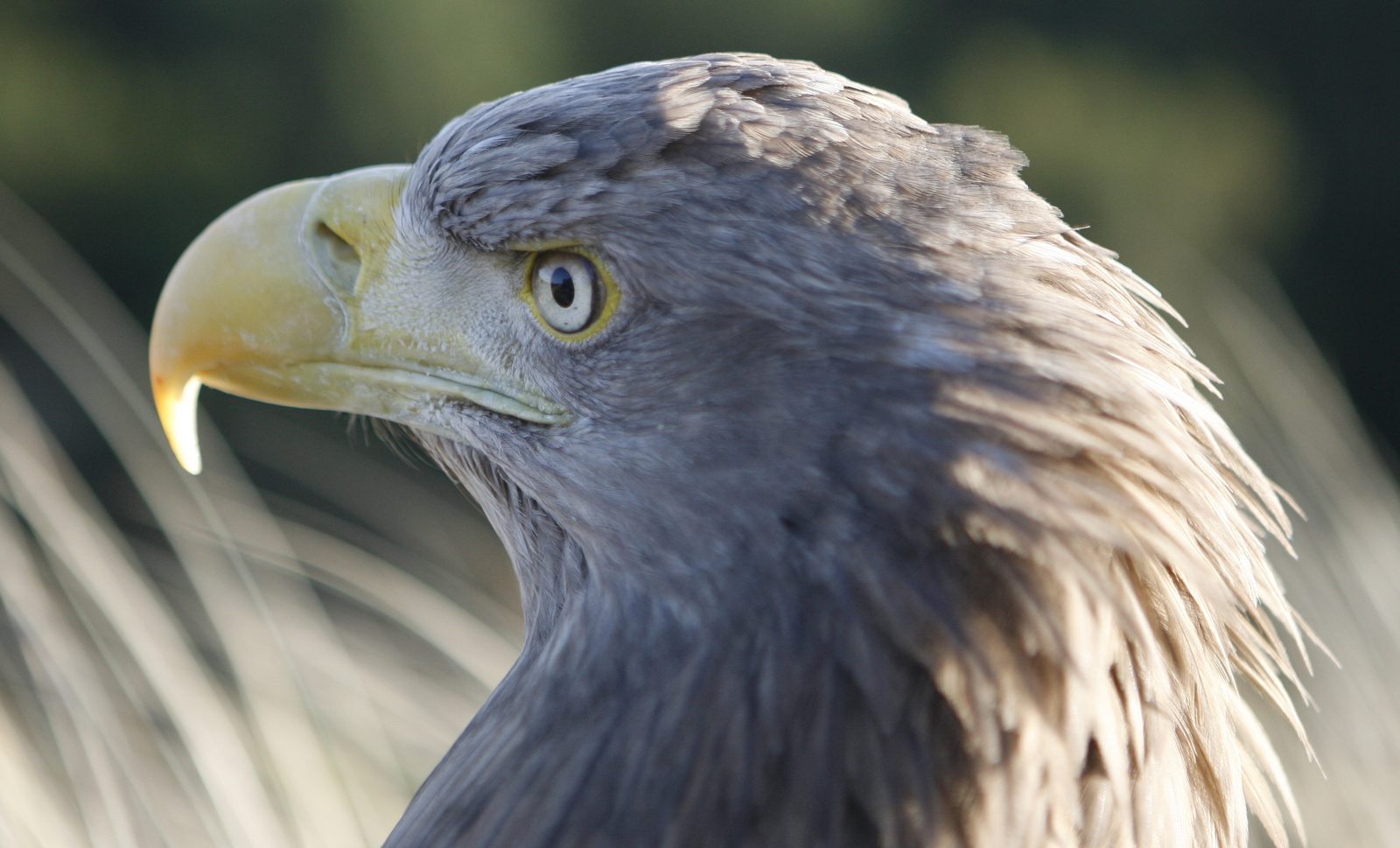 White-tailed eagle.
Here at Eagle World we see again and again that the birds have thought processes that genuinely surprise us. Gorm, who worked out for himself how to fetch Frank's forgotten glove, is a good example. And we are not the only ones wondering. In recent years, research into bird brains has turned old ideas about "bird brains" upside down. In 2016, researchers from Charles University in Prague counted the nerve cells in the brains of 28 bird species and found that songbirds and parrots on average have twice as many nerve cells as a monkey brain of the same weight. The bird brain is small, but densely packed.
Birds of prey surprise us too. In northern Australia, Aboriginal rangers and other observers have long told of "firehawks": black kites, whistling kites and brown falcons that pick up burning sticks and drop them in unburnt grass, so that the fire spreads and flushes out prey. The accounts were compiled in a 2017 study by the geographer Mark Bonta and colleagues. It is based on eyewitness reports and local knowledge, and experiments are under way. On the Falkland Islands, researchers from the University of Veterinary Medicine Vienna tested wild striated caracaras, relatives of the falcons, with a box containing eight different tasks. The birds solved them as quickly and flexibly as tool-using cockatoos (2024), and a year later they still remembered how to do it (2024).
And crows go even further. At the University of Tübingen, Andreas Nieder and colleagues showed in 2020 that nerve cells in the crow's forebrain respond not only to what the crow sees, but to what it believes it has seen. The researchers regard this as a sign of a form of conscious experience, even without the cerebral cortex that we mammals have.
Do birds dream?
Like us, birds have REM sleep, the sleep phase in which we humans dream the most. As early as 2000, researchers from the University of Chicago showed that sleeping zebra finches "replay" the same neural patterns as when they sing during the day. In 2023, researchers from the Max Planck Institute for Biological Intelligence and Ruhr University Bochum looked into the brains of sleeping pigeons with an MRI scanner: during REM sleep, areas for vision and movement in flight were active. Perhaps the pigeons dream of flying, but whether birds dream the same way we do, we cannot know.
Here at Eagle World, after many years of everyday life with them, we are now fairly sure that they do.
Research has, on the other hand, shown that frigatebirds can sleep in the air, sometimes with only one half of the brain at a time. Max Planck researchers demonstrated this in 2016 by measuring brain activity in birds flying over the ocean for up to ten days.
Did you know?
- An owl's "ear tufts" are not ears but feathers. The ears are hidden under the feathers on the sides of the head.
- The barn owl's hearing does not get worse with age, because birds can regenerate the hair cells in the inner ear (University of Oldenburg, 2017).
- Peregrine falcons perceive at least 129 flashes of light per second, more than twice as many as humans (Lund University, 2020).
- Gas companies in California have used turkey vultures to find leaking gas pipes.
- The idea that kestrels can see vole urine trails in UV light has been disproved (Lund University, 2013).
Sources
Reymond, L. (1985). Spatial visual acuity of the eagle Aquila audax: a behavioural, optical and anatomical investigation. Vision Research 25. Australian National University.
Mitkus, M., Potier, S., Martin, G.R., Duriez, O. & Kelber, A. (2018). Raptor vision / Visual adaptations of diurnal and nocturnal raptors. Seminars in Cell & Developmental Biology. Lund University et al.
Caves, E.M., Fernández-Juricic, E. & Kelley, L.A. (2024). Ecological and morphological correlates of visual acuity in birds. Journal of Experimental Biology 227. UC Santa Barbara, Purdue University, University of Exeter.
Potier, S., Lieuvin, M., Pfaff, M. & Kelber, A. (2020). How fast can raptors see? Journal of Experimental Biology 223. Lund University.
Tucker, V.A. (2000). The deep fovea, sideways vision and spiral flight paths in raptors; Curved flight paths and sideways vision in peregrine falcons. Journal of Experimental Biology 203. Duke University.
Brighton, C.H., Thomas, A.L.R. & Taylor, G.K. (2017). Terminal attack trajectories of peregrine falcons are described by the proportional navigation guidance law of missiles. PNAS 114. University of Oxford.
Mills, R., Hildenbrandt, H., Taylor, G.K. & Hemelrijk, C.K. (2018). Physics-based simulations of aerial attacks by peregrine falcons reveal that stooping at high speed maximizes catch success against agile prey. PLOS Computational Biology. University of Groningen and University of Oxford.
Guinness World Records: Fastest bird (diving); Smithsonian Air & Space: Falling with the Falcon (on Frightful, 1999).
Viitala, J., Korpimäki, E., Palokangas, P. & Koivula, M. (1995). Attraction of kestrels to vole scent marks visible in ultraviolet light. Nature 373. University of Turku.
Lind, O., Mitkus, M., Olsson, P. & Kelber, A. (2013). Ultraviolet sensitivity and colour vision in raptor foraging. Journal of Experimental Biology 216. Lund University.
Videler, J.J., Weihs, D. & Daan, S. (1983). Intermittent gliding in the hunting flight of the kestrel. Journal of Experimental Biology 102. University of Groningen.
Martinez Groves-Raines, M., Yi, G., Penn, M., Watkins, S., Windsor, S. & Mohamed, A. (2024). Steady as they hover: kinematics of kestrel wing and tail morphing during hovering flights. Journal of Experimental Biology 227(15): jeb247305. RMIT University and University of Bristol.
Payne, R.S. (1971). Acoustic location of prey by barn owls. Journal of Experimental Biology 54. Cornell University.
Knudsen, E.I. & Konishi, M. (1978). A neural map of auditory space in the owl. Science 200. California Institute of Technology.
Krumm, B., Klump, G., Köppl, C. & Langemann, U. (2017). Barn owls have ageless ears. Proceedings of the Royal Society B 284. Universität Oldenburg.
de Kok-Mercado, F. et al. (2013). Adaptations of the owl's cervical and cephalic arteries in relation to extreme neck rotation. Johns Hopkins University (press release 31.1.2013).
Stager, K.E. (1964). The role of olfaction in food location by the turkey vulture. Los Angeles County Museum Contributions in Science 81.
Grigg, N.P. et al. (2017). Anatomical evidence for scent guided foraging in the turkey vulture. Scientific Reports 7.
Martin, G.R., Portugal, S.J. & Murn, C.P. (2012). Visual fields, foraging and collision vulnerability in Gyps vultures. Ibis 154. University of Birmingham.
Ziolkowski, L.H., Gracheva, E.O. & Bagriantsev, S.N. (2022). Tactile sensation in birds: physiological insights from avian mechanoreceptors. Current Opinion in Neurobiology 74. Yale University School of Medicine. (PMC9167745)
Olkowicz, S., Kocourek, M., Lučan, R.K., Porteš, M., Fitch, W.T., Herculano-Houzel, S. & Němec, P. (2016). Birds have primate-like numbers of neurons in the forebrain. PNAS 113(26). Charles University, Prague.
Bonta, M., Gosford, R., Eussen, D., Ferguson, N., Loveless, E. & Witwer, M. (2017). Intentional fire-spreading by "firehawk" raptors in Northern Australia. Journal of Ethnobiology 37(4). Pennsylvania State University et al.
Harrington, K.J., Folkertsma, R., Auersperg, A.M.I., Biondi, L. & Lambert, M.L. (2024). Innovative problem solving by wild falcons. Current Biology 34(1). Veterinärmedizinische Universität Wien.
Harrington, K.J. et al. (2024). Long-term memory in wild falcons. Current Biology. Veterinärmedizinische Universität Wien.
Nieder, A., Wagener, L. & Rinnert, P. (2020). A neural correlate of sensory consciousness in a corvid bird. Science 369(6511). Universität Tübingen.
Dave, A.S. & Margoliash, D. (2000). Song replay during sleep and computational rules for sensorimotor vocal learning. Science 290(5492). University of Chicago.
Ungurean, G., Behroozi, M., Böger, L., Helluy, X., Libourel, P.-A., Güntürkün, O. & Rattenborg, N.C. (2023). Wide-spread brain activation and reduced CSF flow during avian REM sleep. Nature Communications 14. Max Planck Institute for Biological Intelligence and Ruhr-Universität Bochum.
Rattenborg, N.C., Voirin, B., Cruz, S.M., Tisdale, R., Dell'Omo, G., Lipp, H.-P., Wikelski, M. & Vyssotski, A.L. (2016). Evidence that birds sleep in mid-flight. Nature Communications 7. Max Planck Institute for Ornithology.
Wenzel, F. (1978). Rovfugle i Europa. Self-published.
Stormen i vingerne. Told by Frank Wenzel, written by Mette Kirstine Goddiksen. Eagle World.
Eagle World: eagleworld.dk/historie and eagleworld.dk/artikler/rovfuglenes-oejne-naturens-mest-avancerede-synsorganer (in Danish).