


Long-wings and broad-wings – two ways of flying
When a peregrine falcon and a white-tailed eagle take off from the same field, it looks as if they are built differently. And they are. For centuries falconers have divided birds of prey into two groups by their wings – and that decides how we train them and how you experience them in the demonstration.
An old division
The old falconry books distinguished – for example the French author Thuanus, who is mentioned in the English edition of Frederick II's work – between the long-winged "hawks of the lure", trained to the lure, and the short-winged "hawks of the fist", which fly from the hand. The division is still used. The long-wings are the falcons: peregrine, gyrfalcon and saker falcon. The broad-wings are eagles, buzzards and vultures, which have broad wings with "fingers" – the separated tips of the primary feathers.
The long-wing: speed and the stoop
The falcon's wing is long, narrow and pointed. It is made for speed and for hunting in open airspace. In a stoop the peregrine falcon can reach more than 320 km/h. Researchers from Germany trained peregrine falcons to dive down along a 60-metre-high dam and built a full-size model of the falcon for wind-tunnel tests. Among other things, they found that small feathers on the body rise exactly where the airflow is about to separate from the body – a kind of built-in control of the air.
In falconry, long-wings are typically trained to fly high above the falconer and come in to the lure, which is swung on a line. The falcon learns to trust that there is a reward to be had from the falconer, and the weather – especially wind and rain – decides how much flying can be done that day.
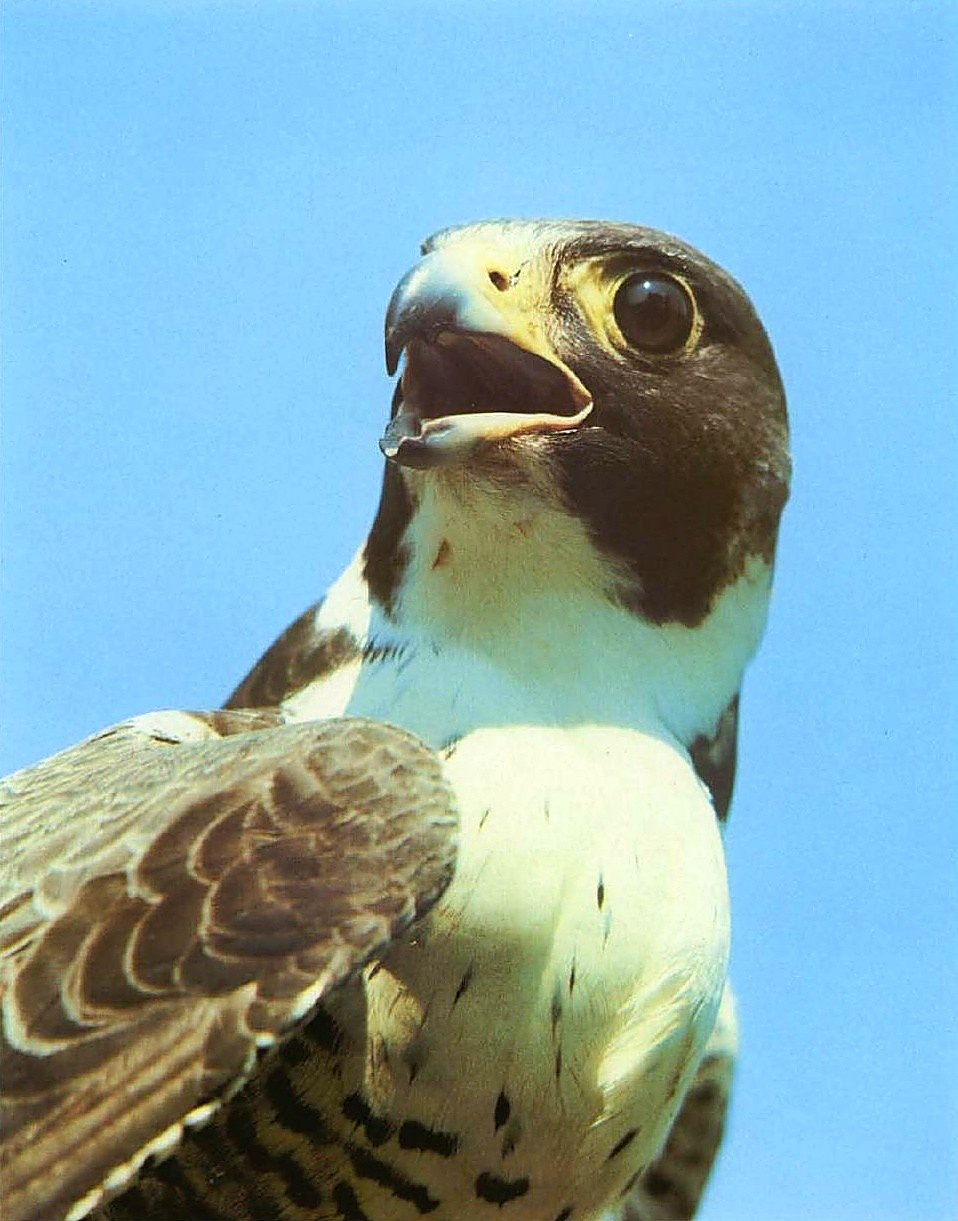
Peregrine falcon. Historical picture from the book "Rovfugle i Europa" (Birds of Prey in Europe, 1978). Photo: Frank Wenzel
The broad-wing: thermals and patience
The eagle's broad wings have a large area in relation to its weight. That makes it good at soaring on updrafts and thermals and at carrying heavy prey, but it is not built for the falcon's speed. The greatest soarer of them all is the Andean condor, which has the largest wing area of any living bird – like our Molina.
That is why we work differently with the eagles. Broad-wings are typically trained to fly shorter stretches, for example from a post or a high point to the falconer's glove, and they make use of updrafts and wind rather than high speed.
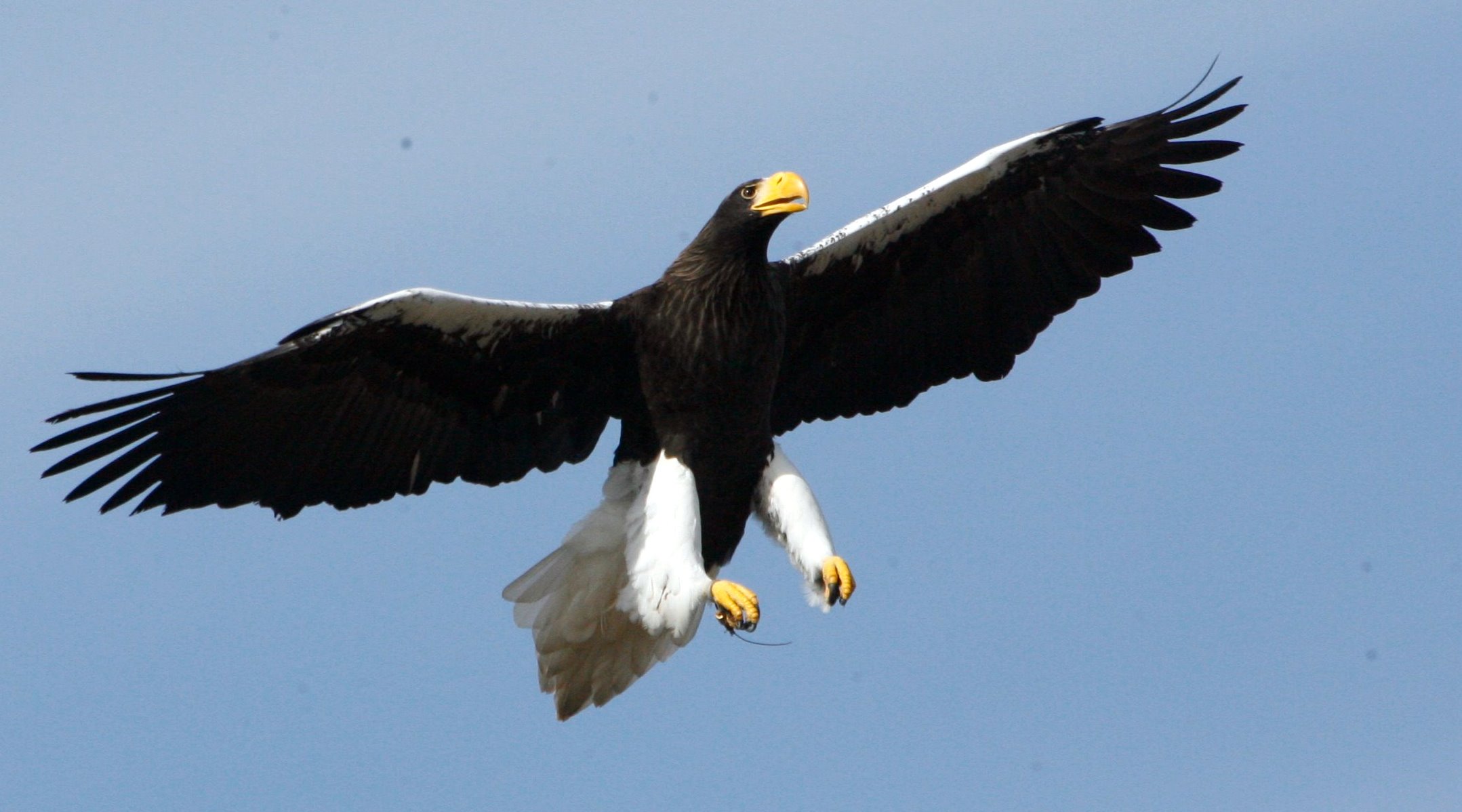
Steller's sea eagle. Photo: Frank Wenzel
The bird first – not the book
How much equipment a bird should have, and which, does not only depend on whether it is a long-wing or a broad-wing. It depends a great deal on the bird's temperament, on its cooperation with the falconer, on where it is to fly and what it is to do – and not least on what matters to the bird itself and what it feels most comfortable with. We place great emphasis on that here at the reserve. The textbook may say "this and that", and that is good too. But experience has taught us that you also have to use your head and look at the individual bird. Of course, you can only do that once many years of experience have brought you to expert level.
What you see in the demonstration
When you stand by the flying ground, you can see the difference for yourself: the falcon beats its wings quickly and briefly and comes in at speed, while the eagle glides with a few deep beats and uses the wind. With us live white-tailed eagles, golden eagles, Steller's sea eagles and a black eagle – and among the falcons gyrfalcons, saker falcons and peregrine falcons. The reserve is closed for the winter and opens again at Easter 2027.
If you want to know more about the history of falconry in Denmark, you can read Frank Wenzel's book Kongernes jagtfalke (The Kings' Hunting Falcons, 2010, in Danish) for free as an e-book.
Read also (in Danish)
Aerodynamik og flyvning · Styrtdyk – flyv som verdens hurtigste dyr · Termikflyvning – svæv som en andeskondor
Sources
- Ponitz, B. et al. (2014): Diving-Flight Aerodynamics of a Peregrine Falcon (Falco peregrinus). PLoS ONE 9(2): e86506
- Frederick II of Hohenstaufen: De arte venandi cum avibus, English ed. Casey A. Wood & F. Marjorie Fyfe, The Art of Falconry (the introduction's mention of "long-winged hawks-of-the-lure" and "short-winged hawks-of-the-fist")
- Wikipedia: Andean condor (wing area)
- Frank Wenzel: Kongernes jagtfalke (2010), Issuu