


Eggs – life's little masterpiece
An egg looks simple. But behind the shell lies a complete little life-support system: food, water, air and protection, packed so cleverly that the embryo can develop for weeks without receiving anything from outside – only warmth. Here at Ørnereservatet, eggs have been part of everyday life for a great many years, and we still feel the same joy and excitement every time an egg hatches.
In this article we look at eggs from several angles: our own birds of prey, the great dinosaurs, new research from around the world – and why an eagle's egg does not look like an owl's egg.
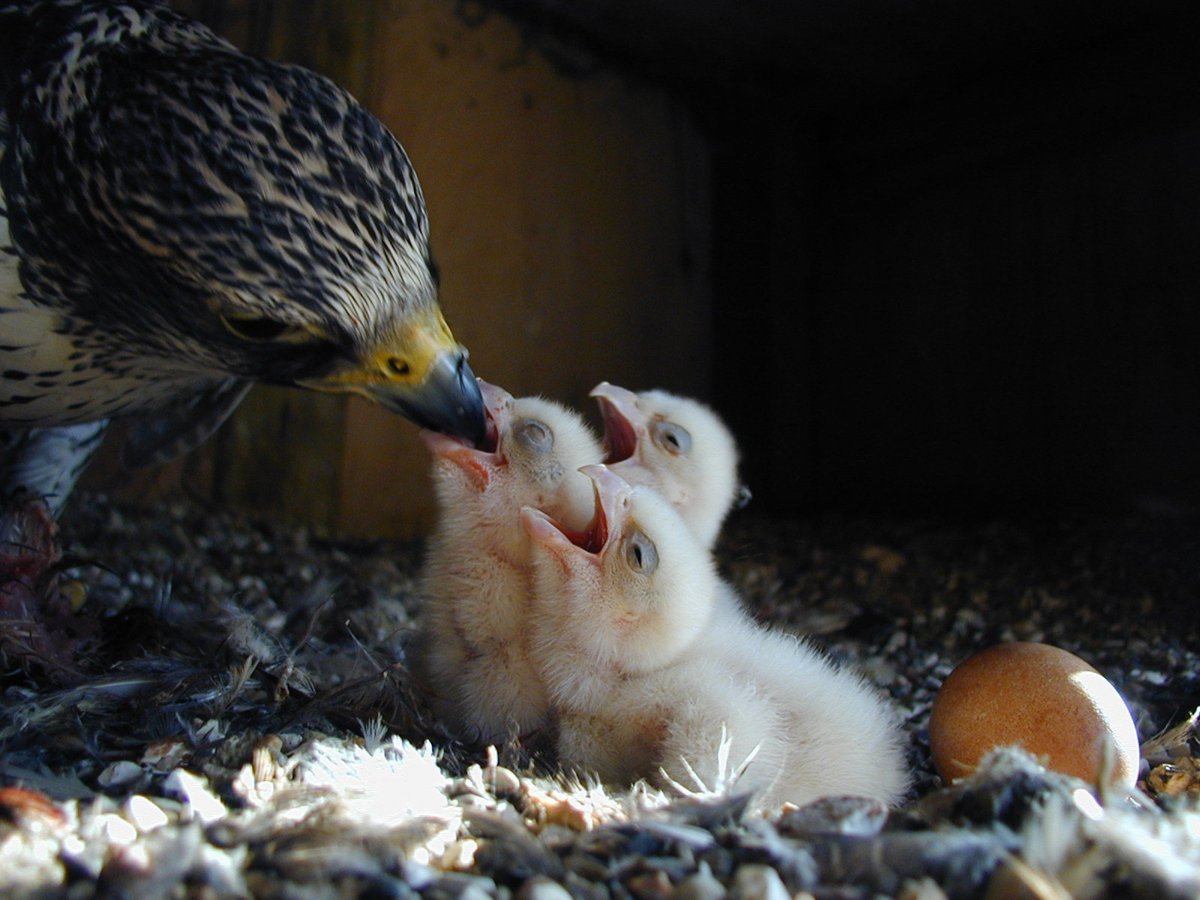
A gyrfalcon mother feeds her chicks – beside them lies an egg that has not yet hatched. Photo: Frank Wenzel
Our own eggs
Breeding birds of prey has been part of this place from the very beginning. As early as the 1950s, Frank Wenzel was devoted to breeding, and in the 1970s it was above all peregrine falcons – later gyrfalcons, golden eagles and white-tailed eagles, all bred here by us. Ørnereservatet was started in 1976 and officially got its name in 1980, and the purpose was and still is the same: to share knowledge about birds of prey.
Before every breeding season we prepare the eagles' nests with fresh branches of pine and spruce and a little straw at the bottom. Birds that are not breeding also get an inviting nest – because the nest is the eagle's bedroom and safe base.
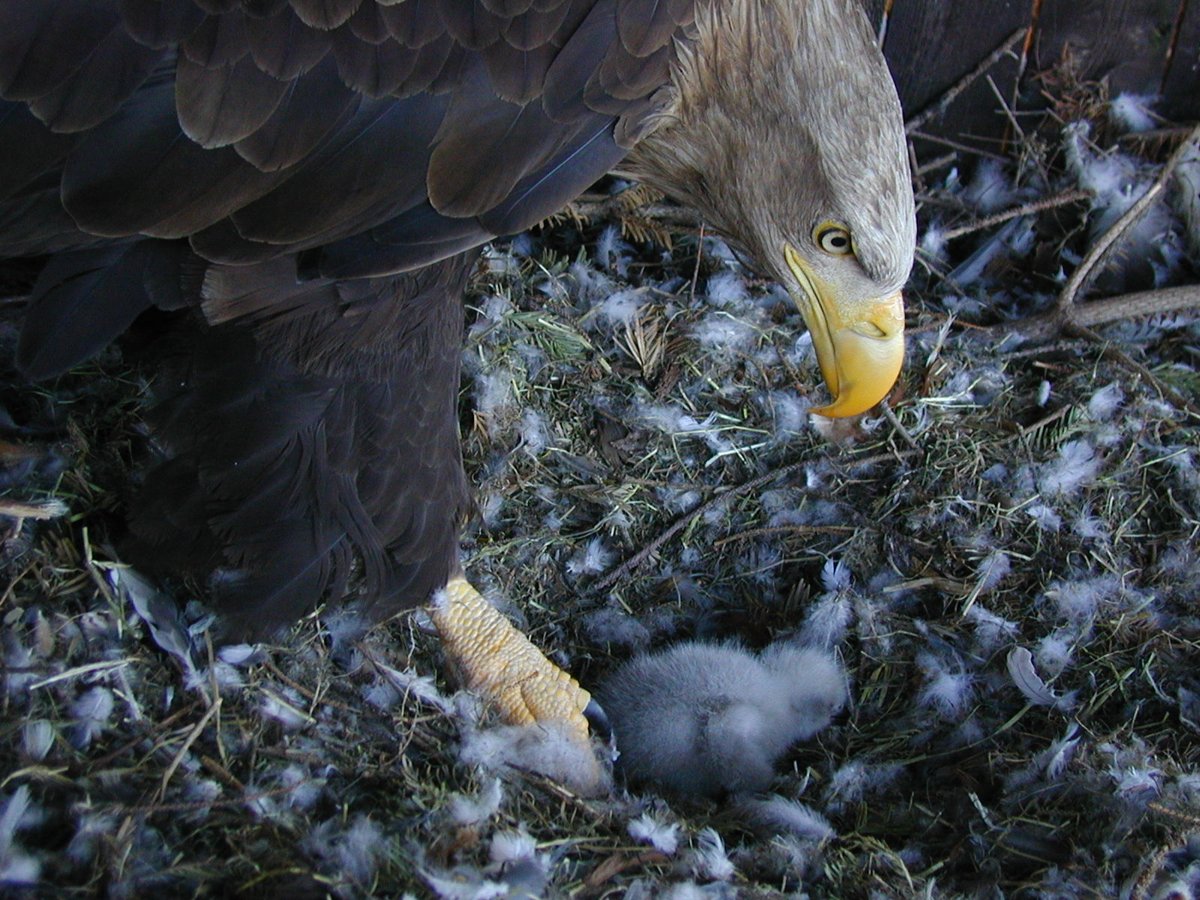
Freja – a white-tailed eagle bred here by us, hatched 18.05.2001 – seen as a newly hatched chick in the nest with her mother, 22.05.2001. Photo: Frank Wenzel
The eggs of birds of prey
Birds of prey lay fewer eggs than many other birds, and the large species lay the fewest. The golden eagle lays 1–3 eggs, the white-tailed eagle usually 1–3 (most often 2), and the condor just a single egg – and usually breeds at most every other year. Falcons lay more: peregrine, gyrfalcon and saker typically 3–5 eggs.
Many birds of prey start incubating as soon as the first egg is laid. That is why the chicks hatch a few days apart, and the eldest is often the largest. In the bearded vulture only one chick survives: the eggs are laid 5–7 days apart, and the elder chick does not let the younger one live.
How long do they incubate?
The incubation period is the time from when incubation begins until the chick hatches. The figures here are the ranges given by the sources – an individual bird may differ a little.
| Species | Incubation | Number of eggs | Typical nest site |
| White-tailed eagle | approx. 34–46 days (most often approx. 38) | 1–3 (most often 2) | Large stick nests in trees or on cliffs; in Norway and Iceland also on the ground |
| Golden eagle | 41–45 days | 1–3 | Cliff ledges, also trees |
| Steller's sea eagle | approx. 38–45 days | 1–3 (most often 2) | Tops of large trees near coasts and rivers; cliffs |
| Gyrfalcon | approx. 34–36 days | 3–5 | Cliff ledges, often in old raven nests |
| Saker falcon | approx. 30 days | 3–5 | Other birds' old nests in trees, on cliffs, on pylons |
| Peregrine falcon | approx. 29–34 days | 2–5 | A scrape in gravel on cliff ledges – and tall buildings |
| Andean condor | 54–58 days | 1 | Bare cliff ledge or shallow cave – no nest |
| Bearded vulture | approx. 55–60 days | 1–2 (rarely 3) | Caves and ledges in high mountains |
| Eurasian eagle-owl | – | 1–4 | Cliff ledges, crevices and cave entrances; old nests of other large birds; sometimes on the ground |
| Snowy owl | 31–33 days | 3–11 | A small hollow on a dry rise in the tundra |
| Barn owl | approx. 29–34 days | 2–9 | Dark cavities in trees, barns and nest boxes |
Fact box: eggs of birds of prey
- The white-tailed eagle incubates for approx. 34–46 days, most often approx. 38. Both parents incubate, but the female does at least 70 % (Raptor Research and Monitoring 2014).
- The condor lays just one egg, directly on the rock without a nest, and incubates it for almost two months (The Peregrine Fund).
- The gyrfalcon lays 3–5 eggs on a cliff ledge or in an old raven nest (The Peregrine Fund).
- The barn owl builds no nest; the eggs lie on old pellets (The Barn Owl Trust).
Parents on the nest
In most birds of prey the female does most of the incubating, while the male hunts and brings food. In the peregrine falcon the male helps, but the female does most of the incubation. In the snowy owl the female incubates alone, and the male brings food. In the white-tailed eagle, the condor and the bearded vulture both parents take turns.
Falcons do not build their own nests. They scrape a small hollow on a cliff ledge or take over an old nest from, for example, ravens. Eagles, on the other hand, build large nests of branches, which they use and add to year after year. The golden eagle often lines its nest with greenery – sometimes aromatic leaves, perhaps to keep insects away. The barn owl builds no nest at all, but lays its eggs on a layer of old pellets.
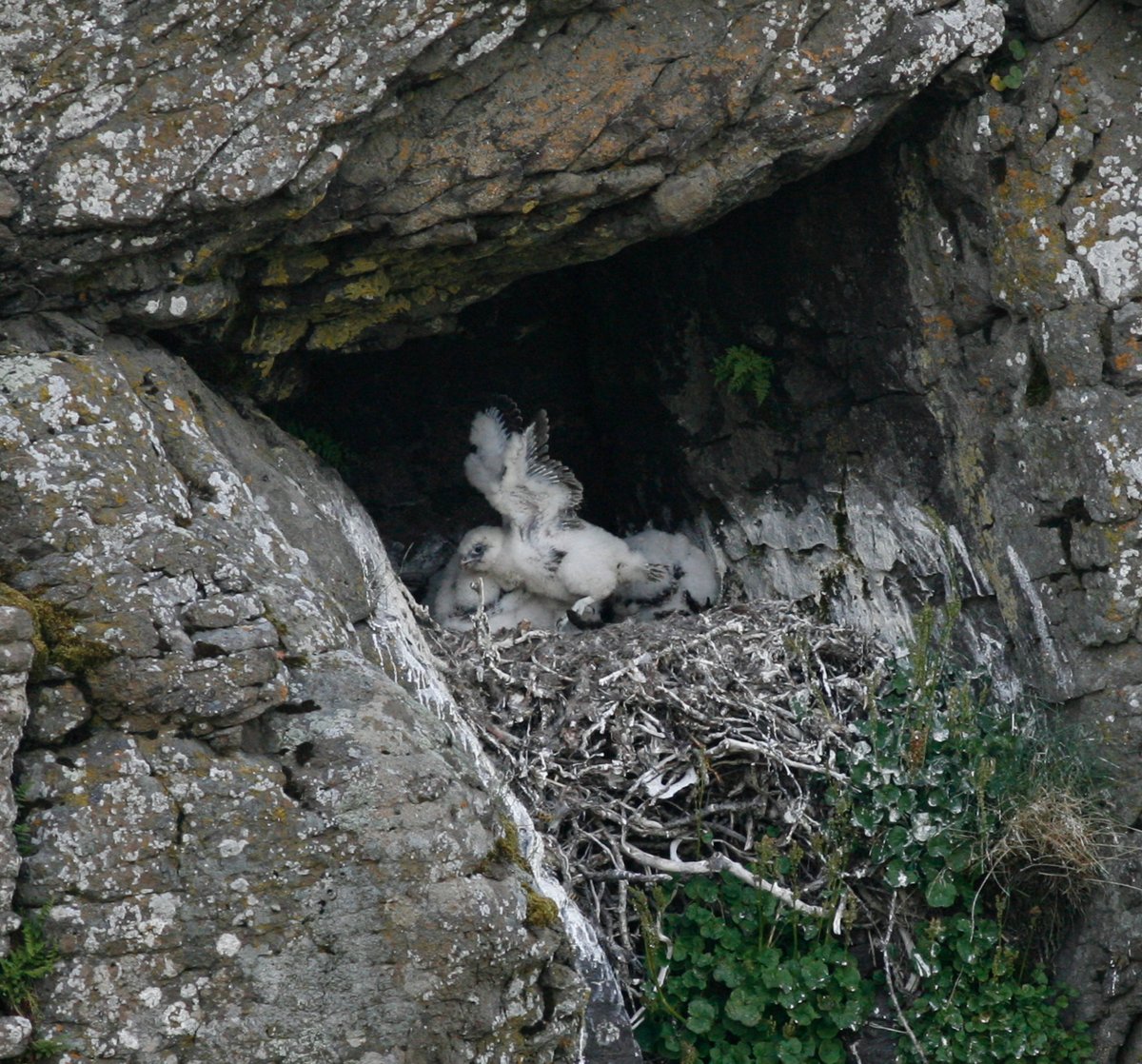
Gyrfalcon chicks in a nest under a rock overhang in Iceland. Photo: Frank Wenzel
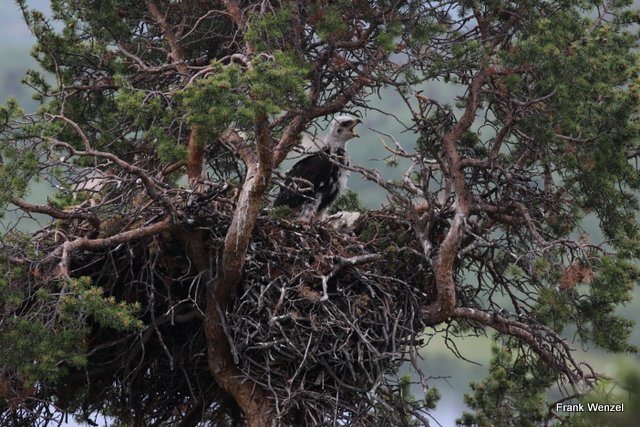
A golden eagle nest in a tree. Photo: Frank Wenzel
Dinosaur eggs
Birds are the living descendants of dinosaurs – and eggs are one of the clearest links. Fossils from Mongolia show an oviraptor-like dinosaur lying on its eggs exactly like a brooding bird (Norell et al., Nature 1995). A fossil embryo known as "Baby Yingliang" lies curled up inside its egg in a position reminiscent of a bird chick just before hatching (Xing et al., iScience 2022).
Research from 2020 suggests that the very earliest dinosaur eggs were soft and leathery like many turtle eggs, and that the hard calcified shell arose later – several times (Norell et al., Nature 2020). The same year a large, soft-shelled fossil egg from Antarctica was described (Legendre et al., Nature 2020). And coloured, speckled eggs – familiar from many birds – already existed in dinosaurs (Wiemann et al., Nature 2018).
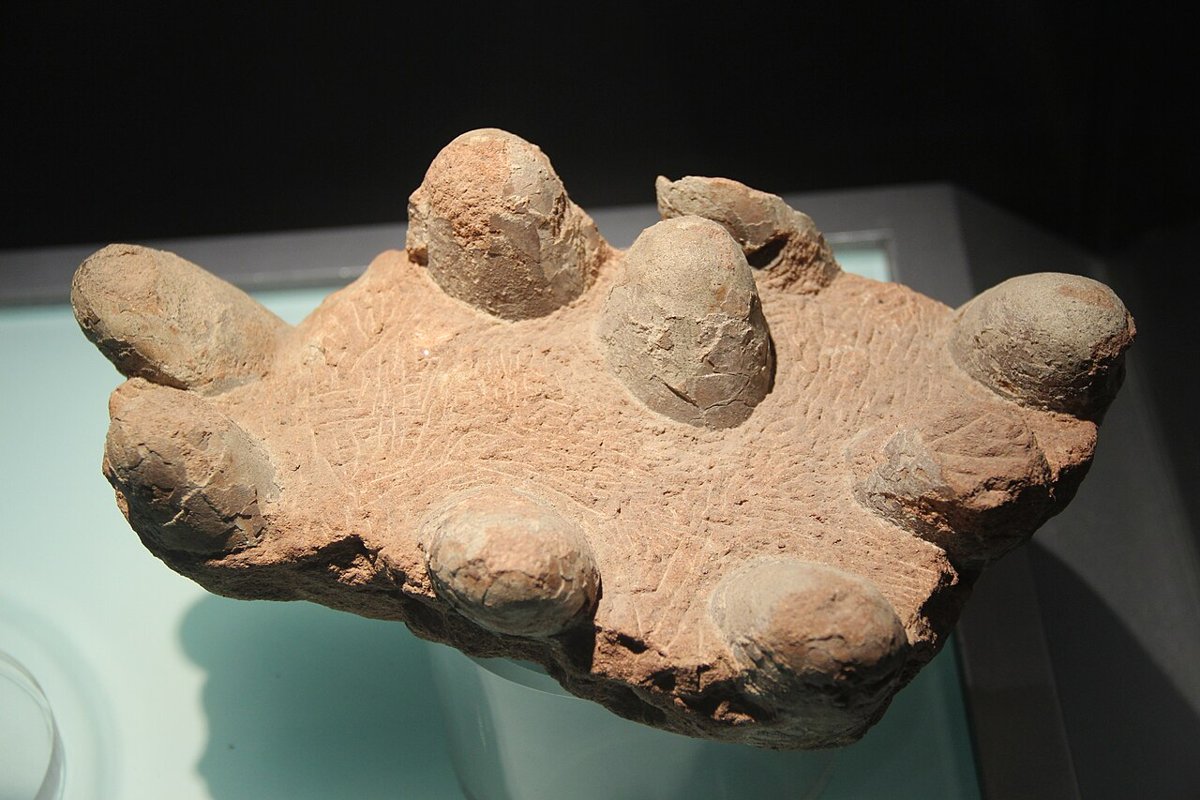
Fossil dinosaur eggs (troodontid), China. Photo: Gary Todd / Wikimedia Commons, CC0
Fact box: dinosaur eggs
- 1995: An oviraptorid found in Mongolia lies on its eggs like a brooding bird (Norell et al., Nature).
- A Troodon female probably laid only 4–6 eggs; nests with up to 24 eggs were likely shared (PNAS 2023).
- The oldest known leathery dinosaur eggs are from the Early Jurassic, China (National Science Review 2023).
- The first directly dated dinosaur egg is approx. 85.9 million years old and comes from a clutch of 28 eggs (Nature News 2025).
The evolution of the egg – from water to land
The first eggs were laid in water. Fish and amphibians still lay eggs without a shell, and without a shell and special membranes they dry out on land. That is why amphibian eggs are tied to water or damp places (OpenStax Biology; Cleveland Museum of Natural History).
In the Carboniferous, approx. 359–299 million years ago, the amniotes arose – the ancestors of today's reptiles, birds and mammals (UCMP, University of California Berkeley). Their great innovation was the amniotic egg. Inside the egg four membranes form: the amnion, chorion, yolk sac and allantois. The amnion surrounds the embryo with fluid, so it carries its own little "pond" with it. This made the animals far less dependent on water, and they could spread into drier regions (OpenStax Biology).
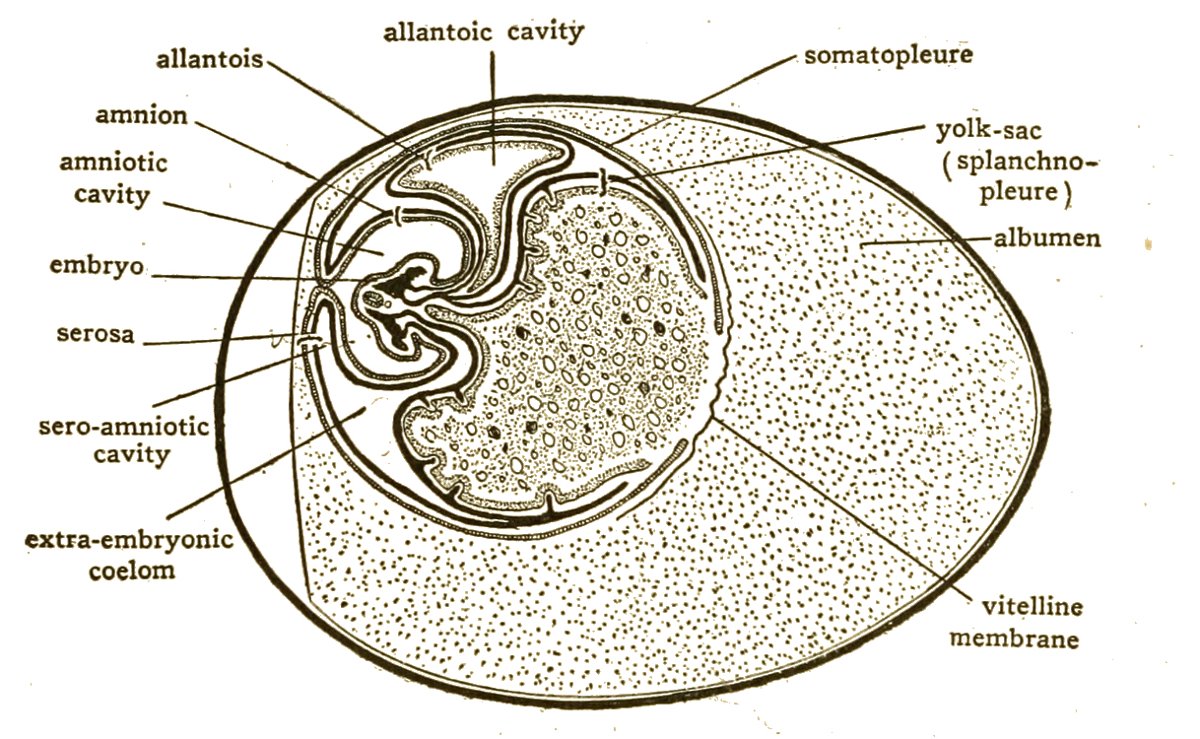
A hen's egg after about five days of incubation, in cross-section (textbook diagram). What the labels mean: embryo = the developing chick; amnion and amniotic cavity = the amnion and its cavity, the embryo's fluid-filled “pond” that protects against shocks and drying out; yolk-sac = carries nourishment from the yolk to the embryo; allantois and allantoic cavity = collects waste and helps with breathing; serosa = chorion/serosa, the membrane next to the shell, where oxygen and carbon dioxide are exchanged; albumen = egg white with water and protein; vitelline membrane = the yolk membrane; extra-embryonic coelom and sero-amniotic cavity = spaces between the membranes; somatopleure/splanchnopleure = the tissue layers the membranes are formed from. Functions of the membranes: OpenStax Biology 2e. Diagram: H.V. Neal and H.W. Rand / Wikimedia Commons, public domain
The shell is a compromise: it must hold in water and protect the embryo, yet be porous enough to let oxygen in and carbon dioxide out. Birds' shells are hardened with lime (calcium carbonate) – stiff, but fragile. In most other reptiles, such as turtles, the shell is soft and leathery, and the eggs must stay moist (OpenStax Biology). The turtle eggshell is also built of aragonite, a different crystal form of calcium carbonate than in bird eggs (UCMP).
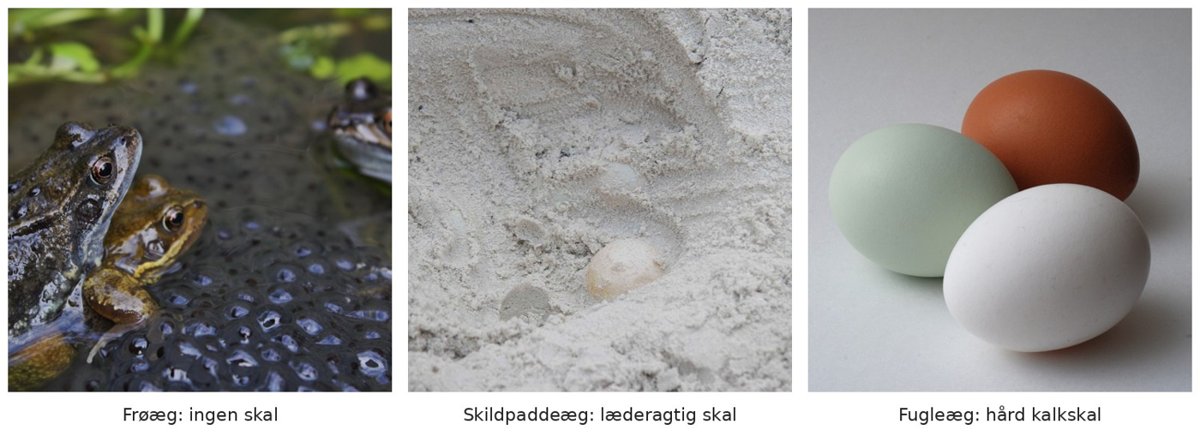
Three steps in the history of the egg. Left: frog spawn without a shell – it must lie in water. Centre: sea turtle eggs with a soft, leathery shell, buried in damp sand. Right: hen's eggs with a hard calcified shell (OpenStax Biology 2e). Photos: Thomas Brown (CC BY 2.0); Jennifer Strickland, USFWS (public domain); Gmoose1 (public domain) – all via Wikimedia Commons
Dinosaur eggs evolved too. In 2023 Chinese researchers described the oldest leathery dinosaur eggs known so far, from the Early Jurassic – a sign that the first dinosaur eggs were soft (Han et al., National Science Review 2023). The hard calcified shell came later, and coloured eggs already existed in dinosaurs (Wiemann et al., Nature 2018). Birds have inherited both the hard shell and the colour pigments.
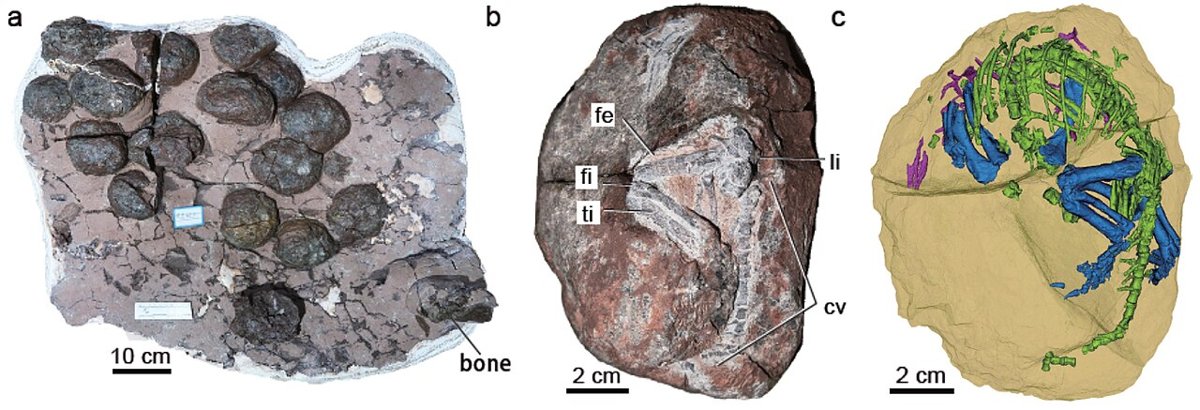
A clutch of 16 eggs and an embryo of the dinosaur Qianlong shouhu from the Early Jurassic, Guizhou, China. They are the oldest known leathery eggs; the find suggests that the first dinosaur eggs were soft (Han et al., National Science Review 2023). Photo: F. Han et al. / Wikimedia Commons, CC BY 4.0
And mammals? Early mammals laid eggs, and the monotremes – the platypus and the echidnas – still do (UCMP). In marsupials and placental mammals the shell has disappeared: the embryo grows inside the mother, and the placenta is formed from two of the old egg membranes, the chorion and the allantois (OpenStax Biology).
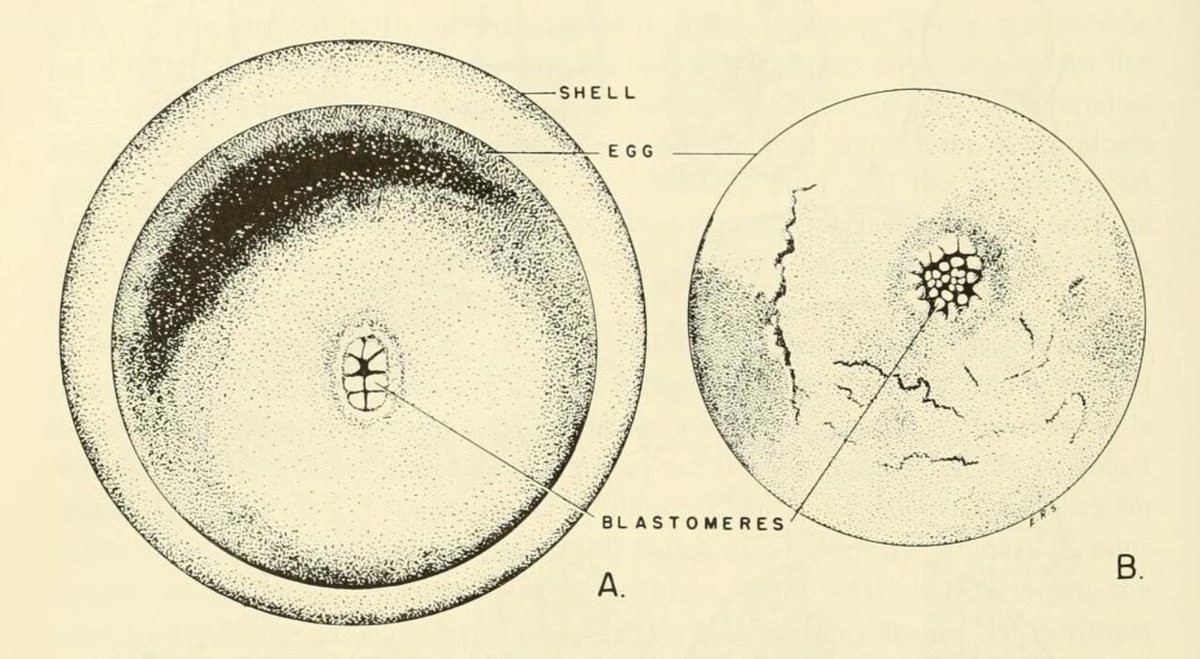
Eggs of the platypus (A) and echidna (B) in early development – drawing after Flynn and Hill (1939). The monotremes are the only living mammals that still lay eggs (OpenStax Biology 2e; UCMP Berkeley). Drawing: Olin E. Nelsen / Wikimedia Commons, public domain
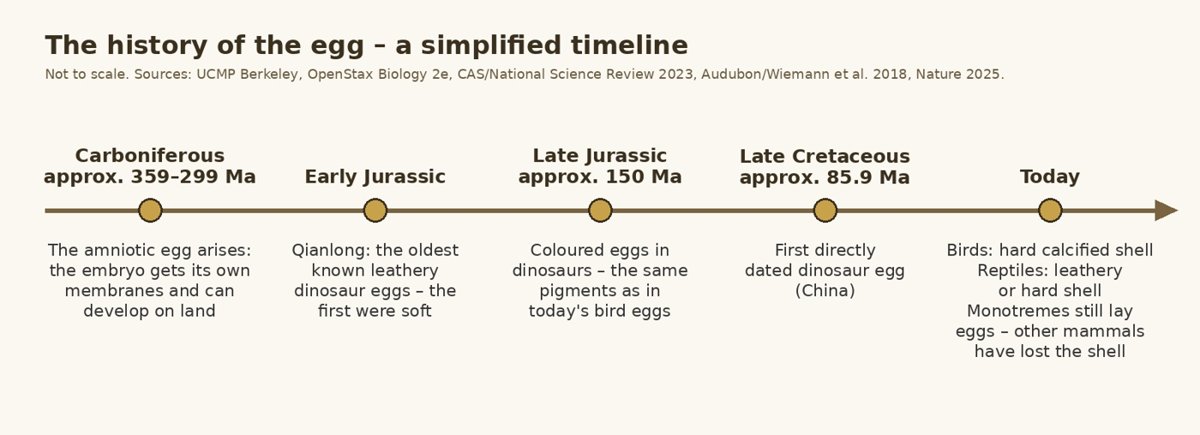
A simplified timeline of the history of the egg – drawn for this article from the sources below. The time axis is not to scale.
Fact box: the history of the egg in dates
- Carboniferous, approx. 359–299 million years ago: the amniotic egg arises (UCMP Berkeley).
- The amniotic egg has four membranes: amnion, chorion, yolk sac and allantois (OpenStax Biology 2e).
- Late Jurassic, approx. 150 million years ago: coloured dinosaur eggs (Audubon; Wiemann et al. 2018).
- Today, among mammals only the monotremes – platypus and echidnas – lay eggs (UCMP).
New discoveries and research
Condor eggs without a father (28 October 2021). Genetic analyses in the San Diego Zoo Wildlife Alliance's breeding programme showed that two California condor chicks had hatched from unfertilised eggs – so-called virgin birth (parthenogenesis). The females were housed with fertile males. It is the first time virgin birth in birds has been confirmed with molecular methods (Ryder et al., Journal of Heredity 2021).
Warm eggs in Troodon (March 2023). Researchers from Goethe University Frankfurt measured isotopes in fossil eggshells from the dinosaur Troodon. The shells formed at approx. 42 °C and approx. 29–30 °C – so Troodon could regulate its body temperature, but calcified the shell slowly like a reptile. Each female probably laid only 4–6 eggs, so the large nests with up to 24 eggs were probably shared nests (Tagliavento et al., PNAS 2023).
The oldest soft dinosaur eggs (October–November 2023). In Guizhou, China, researchers found five clutches of eggs with embryos of the long-necked dinosaur Qianlong shouhu from the Early Jurassic. The eggs are the oldest known leathery eggs and suggest that the first dinosaur eggs were soft (Han et al., National Science Review 2023; Chinese Academy of Sciences 13.11.2023).
A dinosaur egg dated directly (September 2025). For the first time a dinosaur egg has been dated directly, using uranium–lead dating of the shell itself. The egg comes from a clutch of 28 eggs in Shiyan, China, and is approx. 85.9 million years old. Some palaeontologists think the method needs further testing (Nature News 11.09.2025; Frontiers in Earth Science 2025).
Egg gallery – large, small, round and pointed
Eggs come in every size, colour and shape. Here is a selection – and the explanation of why they look the way they do.
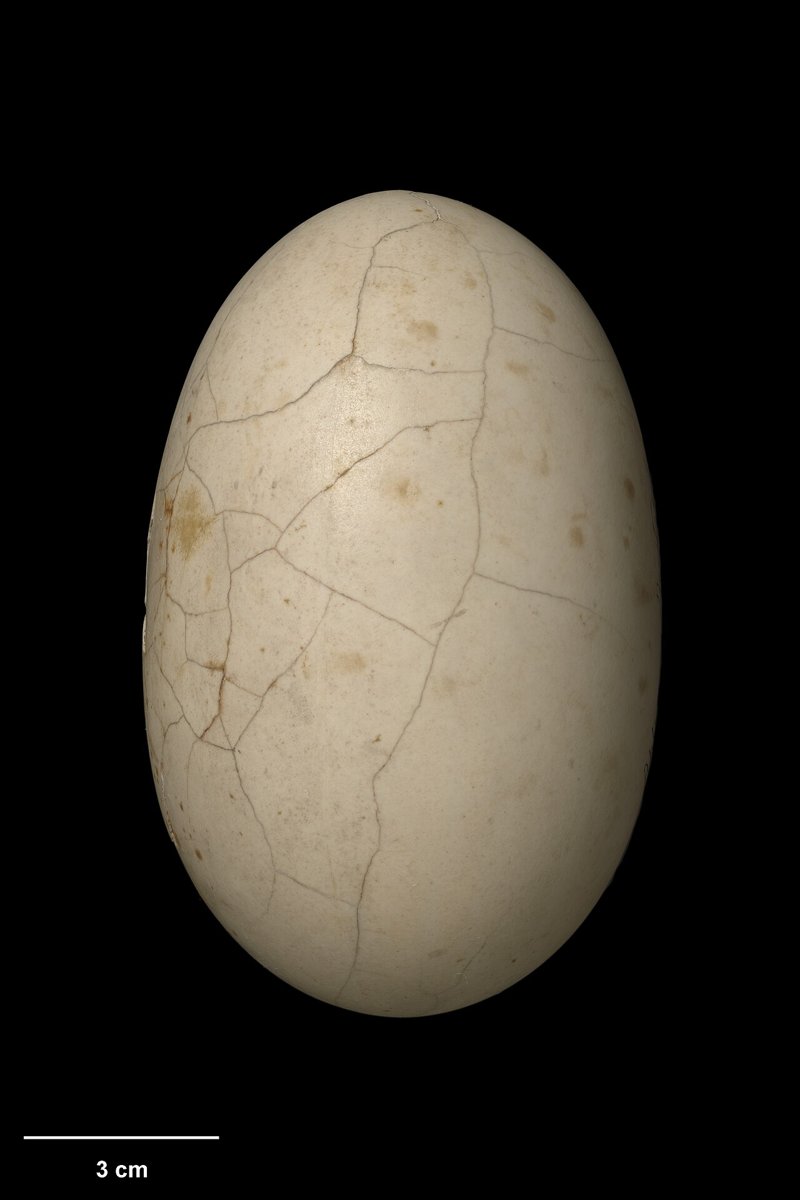
Kiwi (Okarito kiwi). The kiwi lays a huge egg for its size – approx. 15 % of the female's weight against approx. 2 % in the ostrich. Over 60 % of the egg is yolk, so the chick hatches fully developed (Smithsonian’s National Zoo). Photo: Te Papa, CC BY 4.0
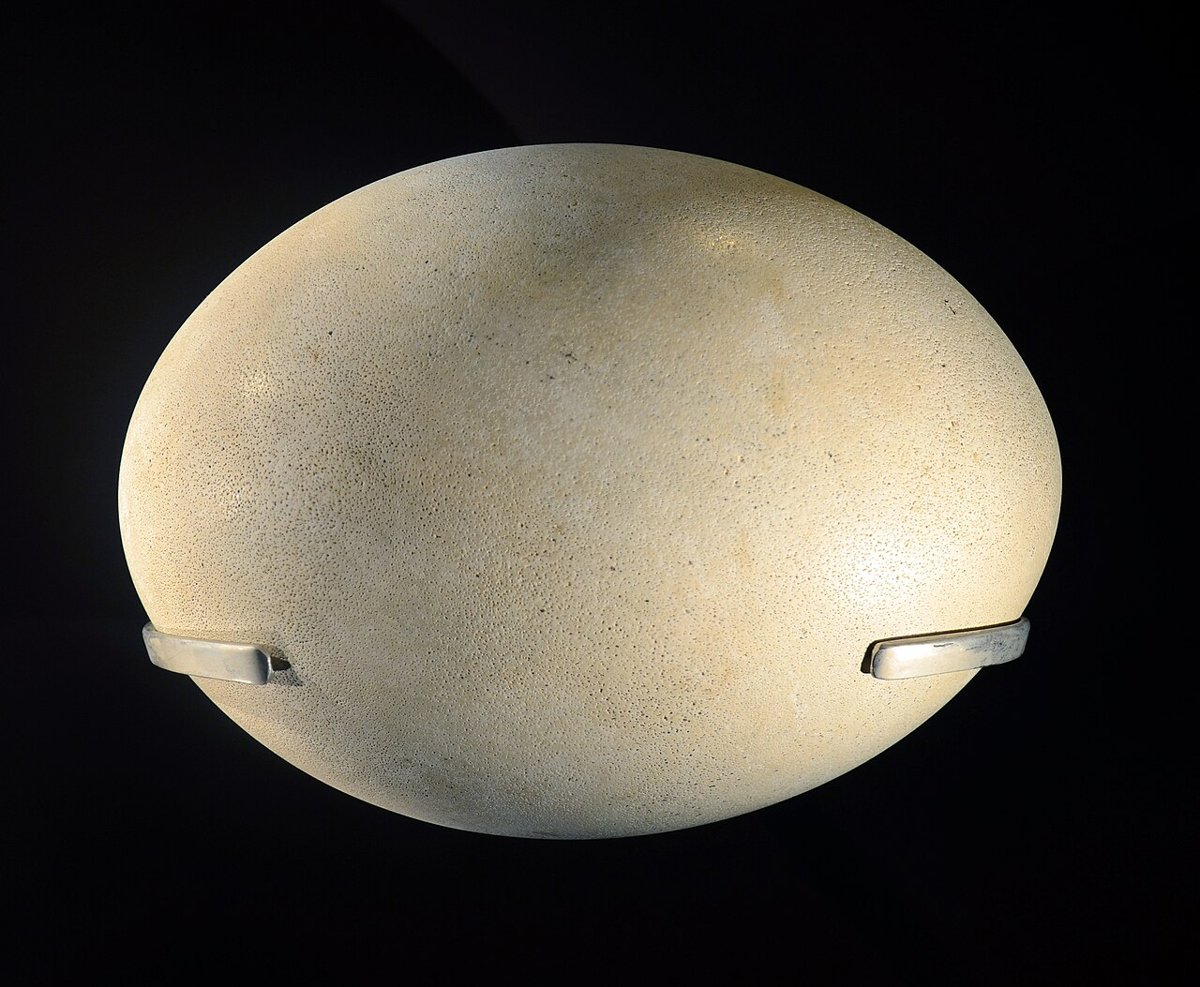
Egg of the extinct elephant bird of Madagascar, Muséum national d’Histoire naturelle, Paris. At around 9 kg it is the largest bird egg known (Stoddard, Current Biology 2022). Photo: Vassil, CC0
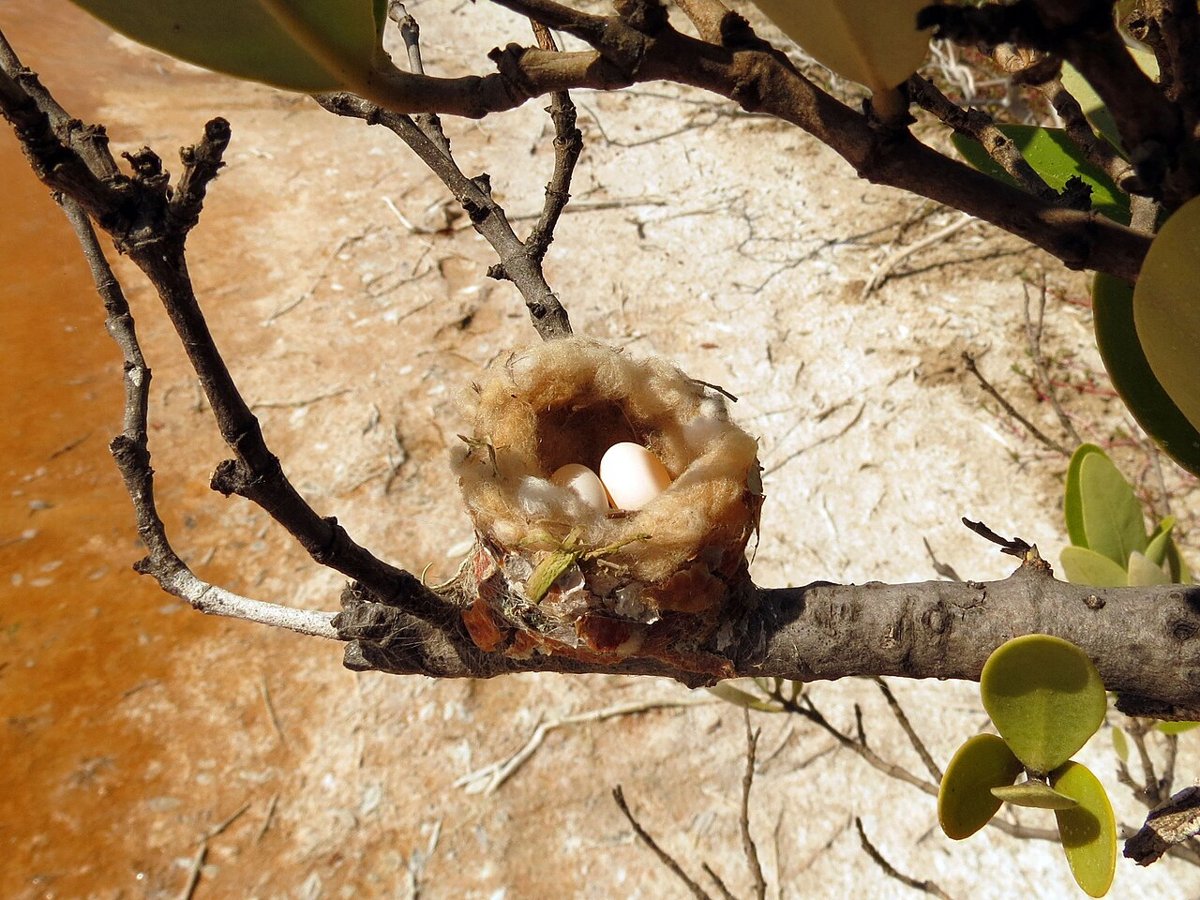
Hummingbird nest with eggs, Yucatán, Mexico. Hummingbird eggs weigh about half a gram – among the smallest bird eggs (Stoddard, Current Biology 2022). Photo: Katja Schulz, CC BY 2.0
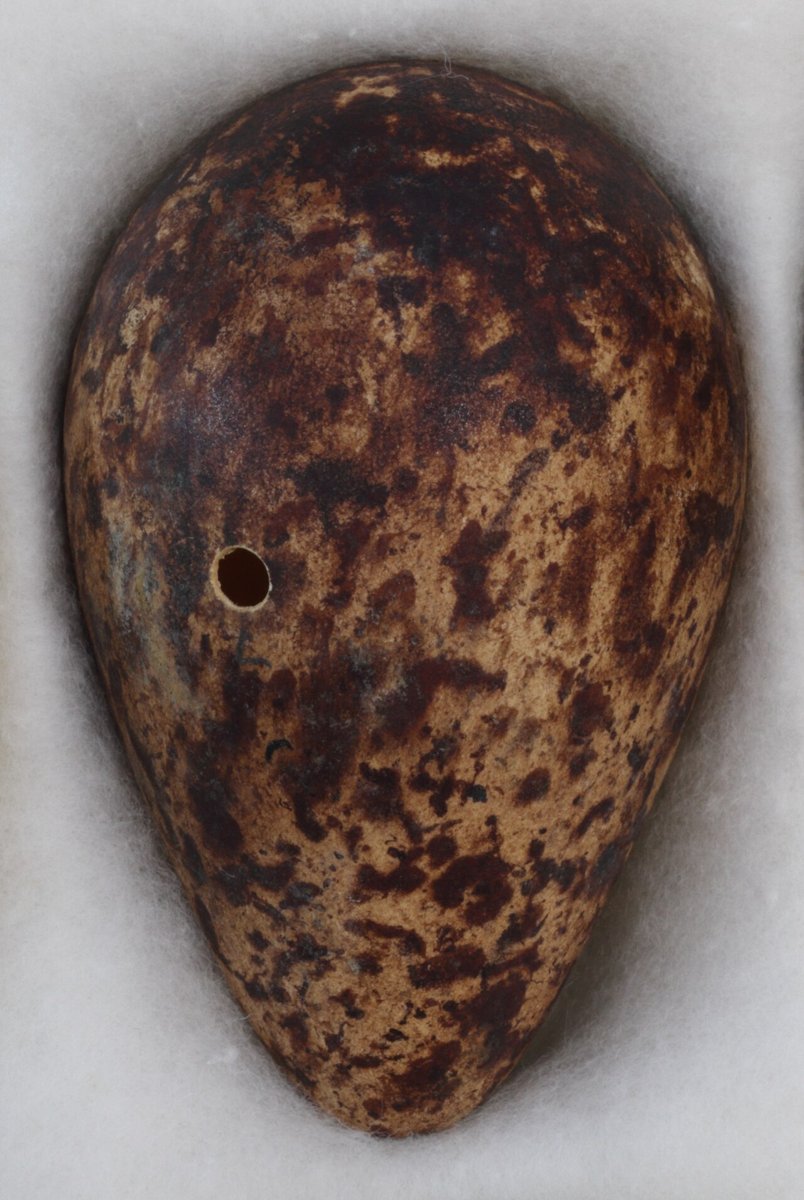
Common murre (guillemot) egg, Natural History Museum, London. The pointed, pear-shaped egg is more stable on the sloping cliff ledges where murres breed close together – as experiments with eggs on slopes showed (Birkhead et al., The Auk 2018). Photo: Natural History Museum, London, CC0
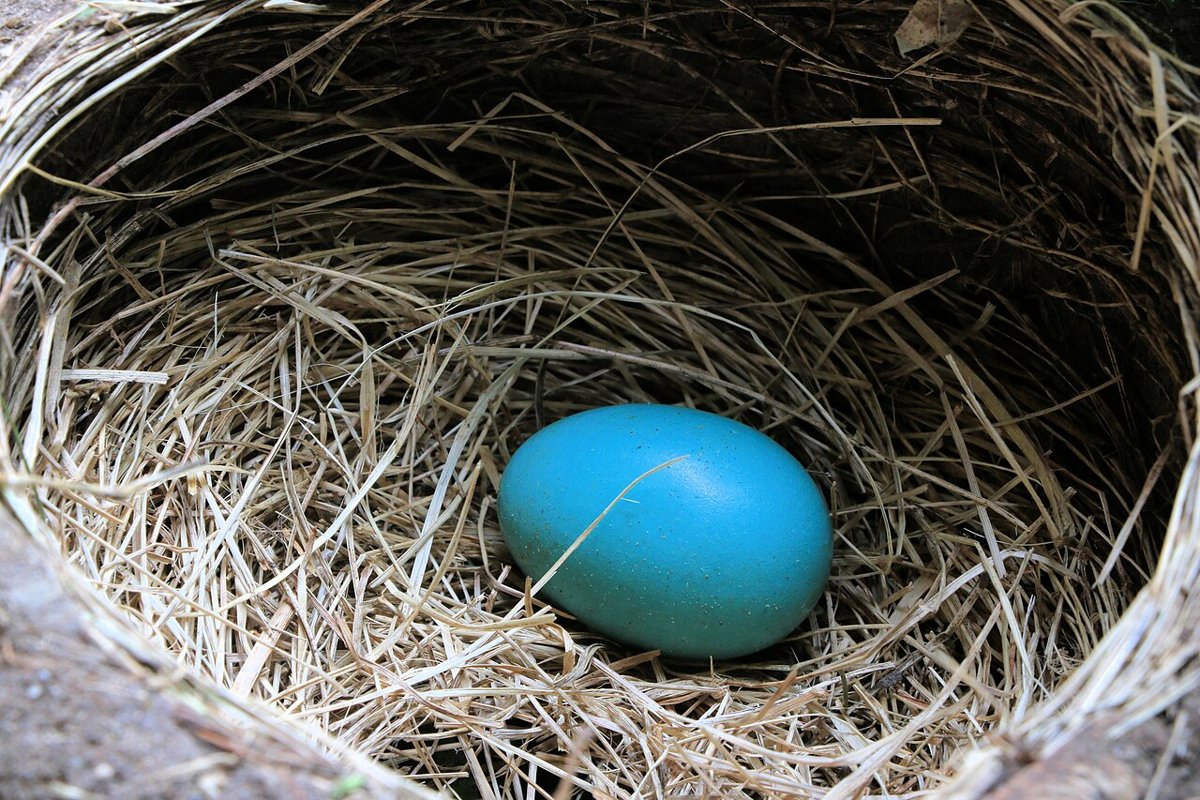
Eggs of the American robin. The blue colour comes from the pigment biliverdin (Audubon). Blue eggs are not well camouflaged, and why they are blue is still debated; one hypothesis is that the colour signals the female's health, but it has received only mixed support (Stoddard, Current Biology 2022). Photo: ImagePerson, CC BY 4.0
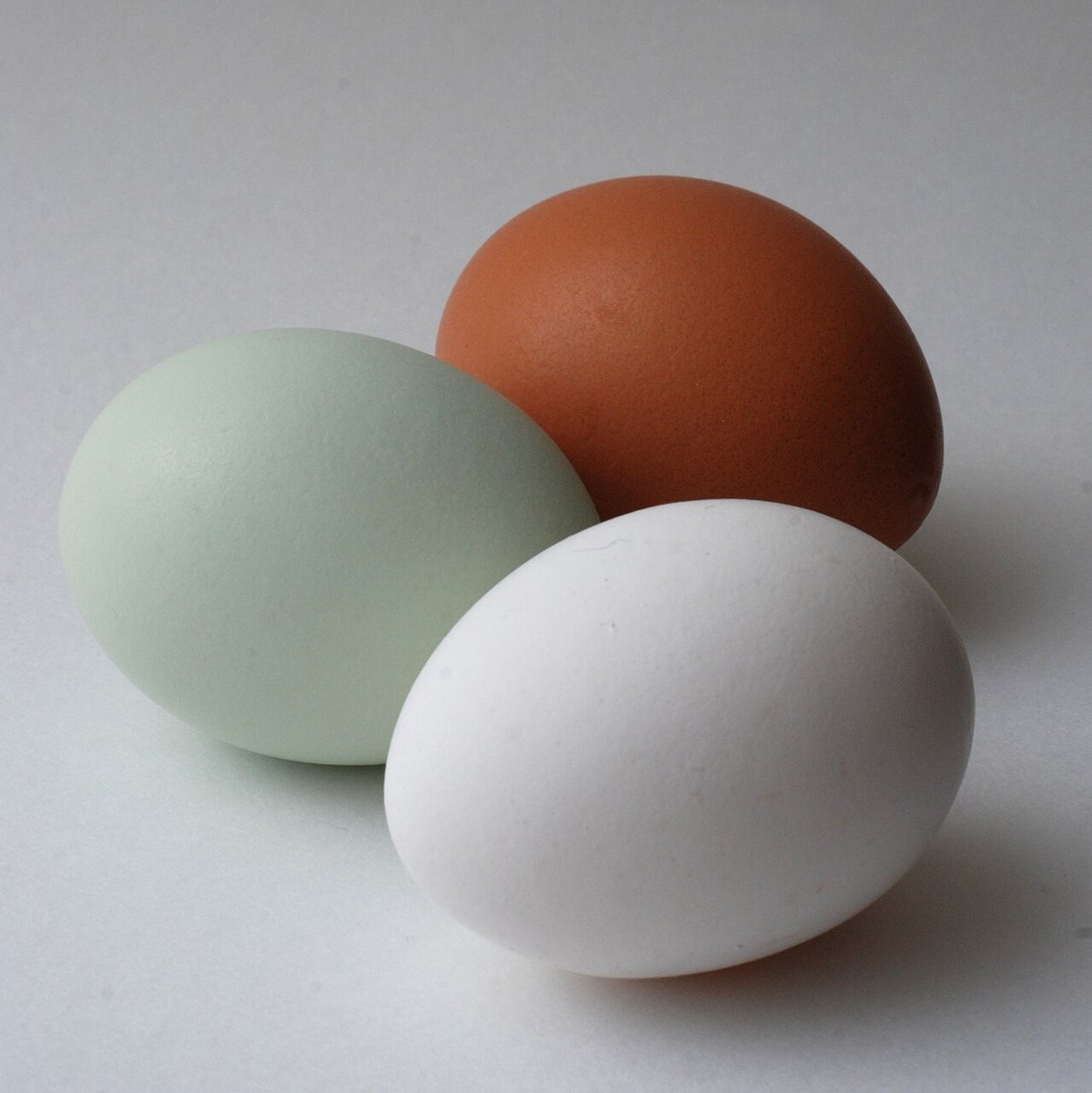
Hen's eggs: blue-green (Araucana), brown and white. All egg colours are made by just two pigments – red-brown protoporphyrin and blue-green biliverdin – on top of the white calcium shell (Audubon). Photo: Gmoose1, public domain
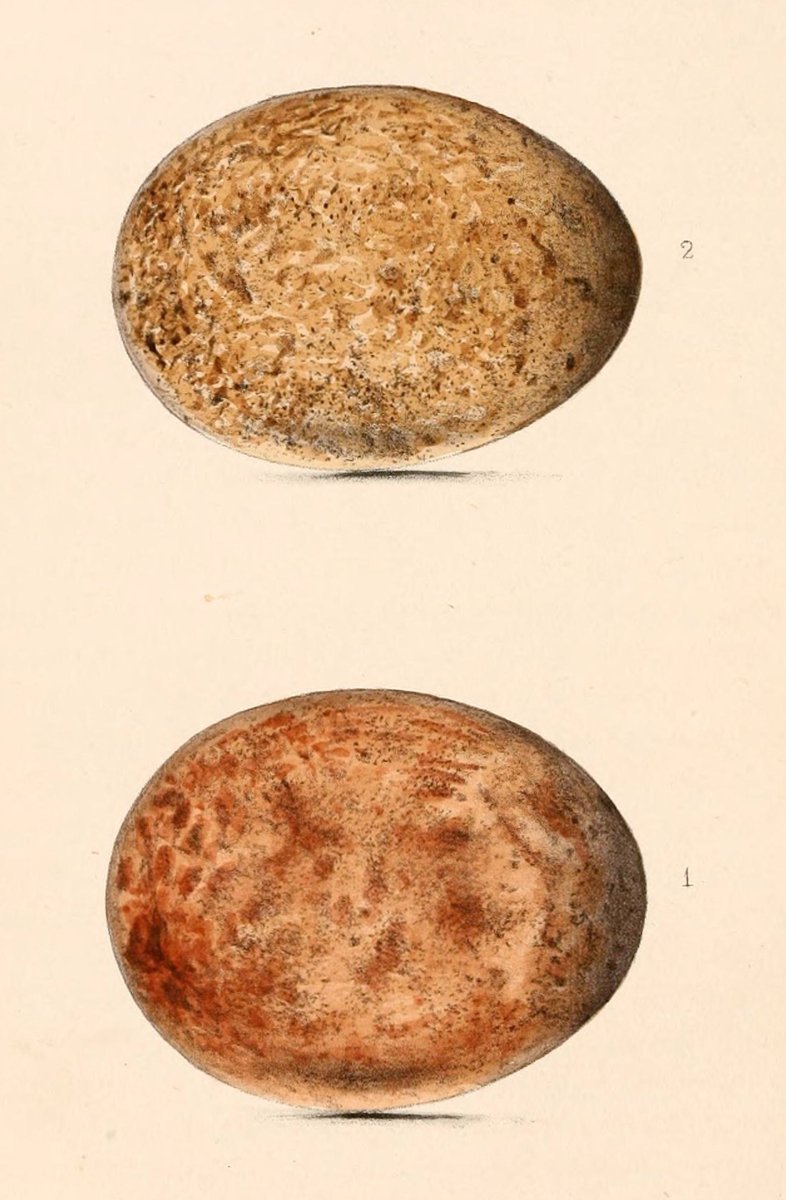
Saker falcon eggs, hand-coloured plate from 1864. The red-brown colour comes from protoporphyrin; researchers have used the brown eggs of the peregrine falcon as an example of almost pure protoporphyrin (Audubon). Illustration: W.C. Hewitson, public domain
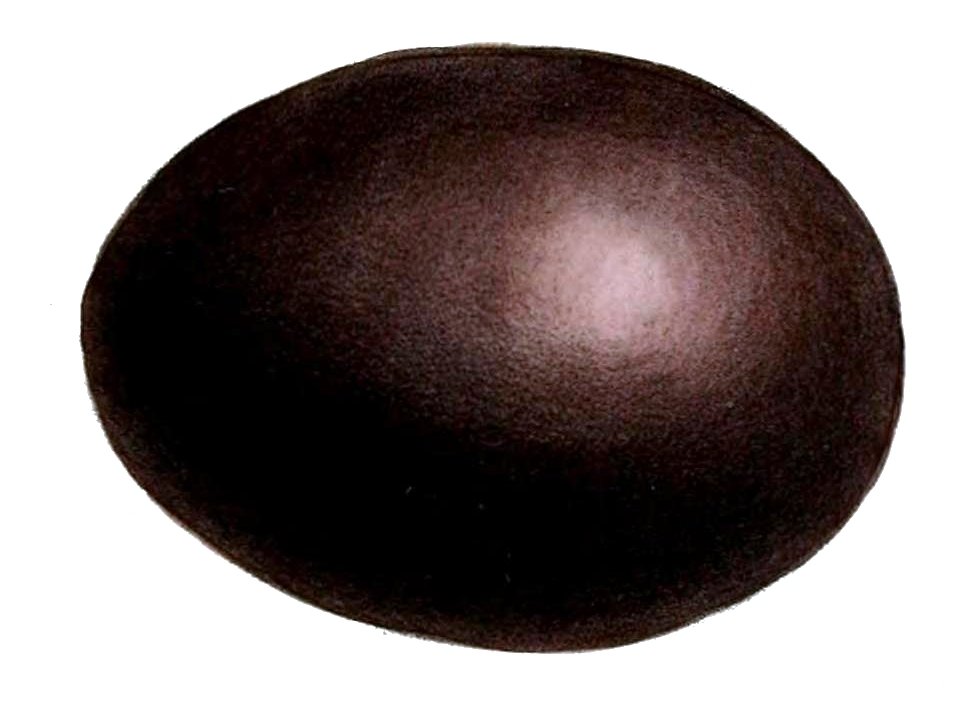
Eggs of the red-winged tinamou, illustration. Tinamous nest on the ground yet lay glossy, brightly coloured eggs. In the great tinamou, research suggests the colour is a signal to other females laying in the same nest (Cornell Lab of Ornithology). Illustration: John Jennens, public domain
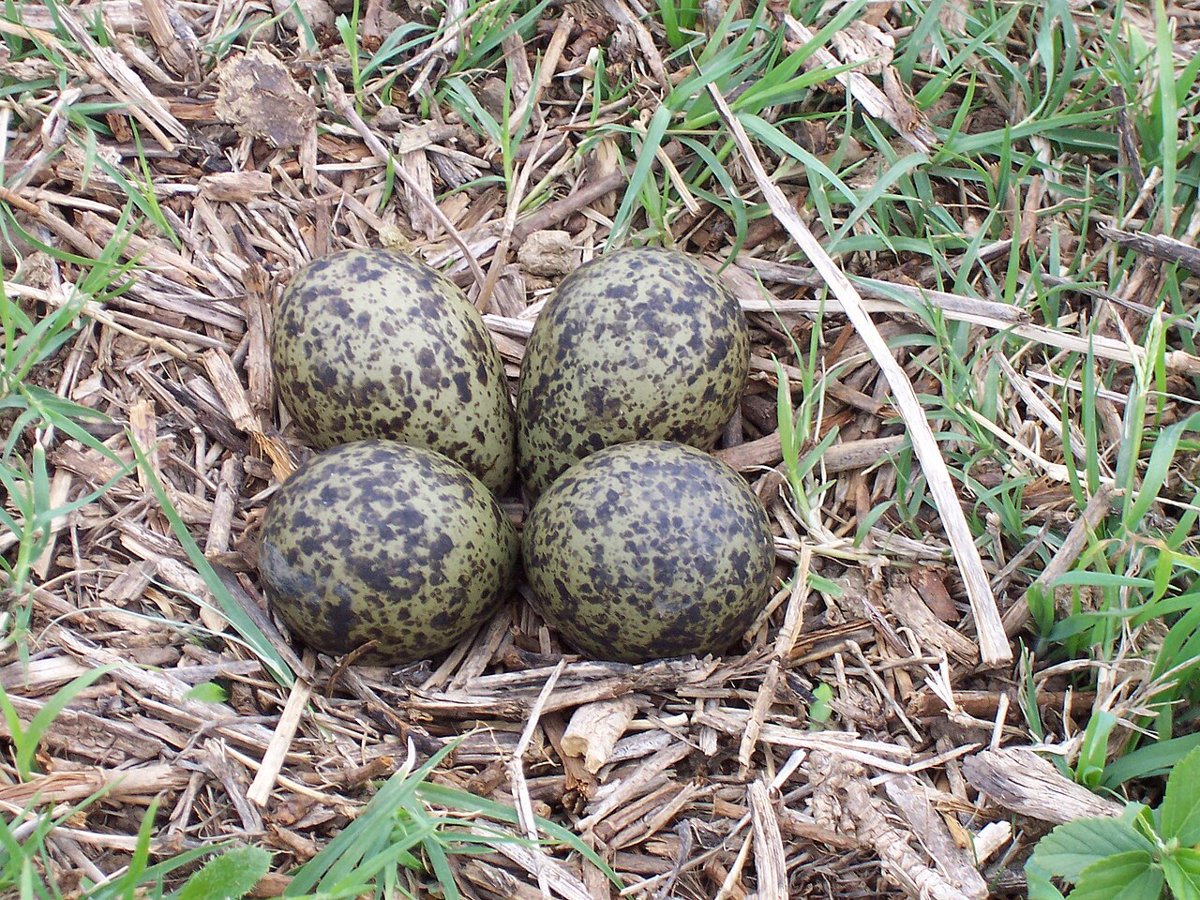
Masked lapwing eggs in a nest on the ground. Birds that nest in the open on the ground often lay speckled eggs that blend in with the surroundings and fool predators (Cornell Lab of Ornithology; Stoddard, Current Biology 2022). Photo: Prankphonecall, public domain
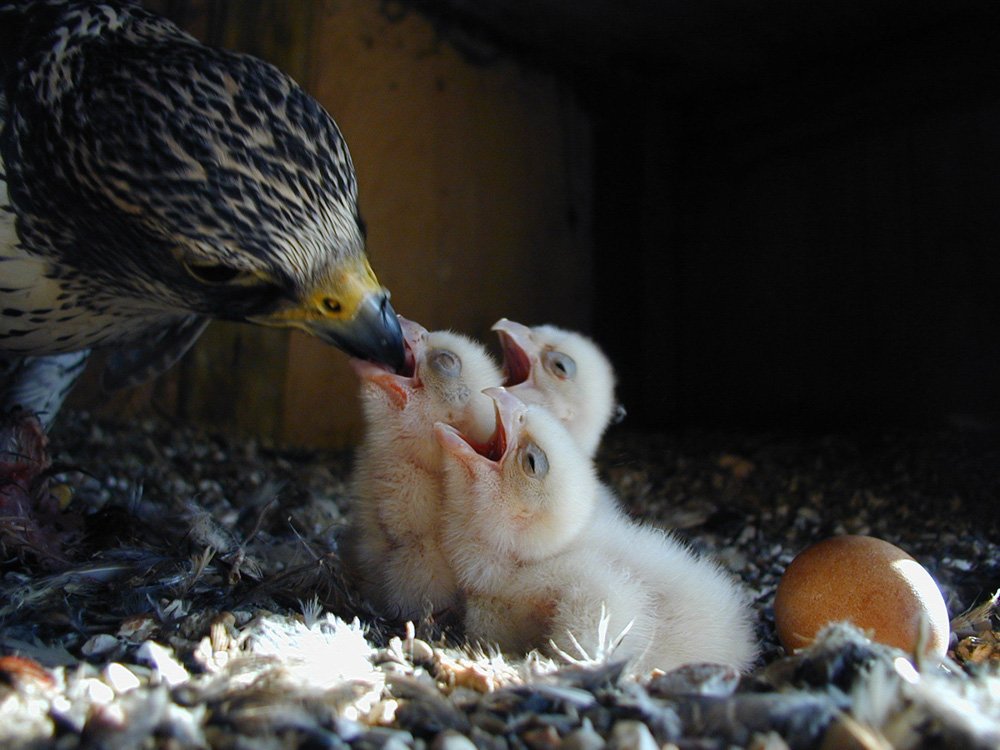
A gyrfalcon mother with chicks and an unhatched egg. Falcon eggs are red-brown and speckled – the colour comes from protoporphyrin (Audubon). Photo: Frank Wenzel
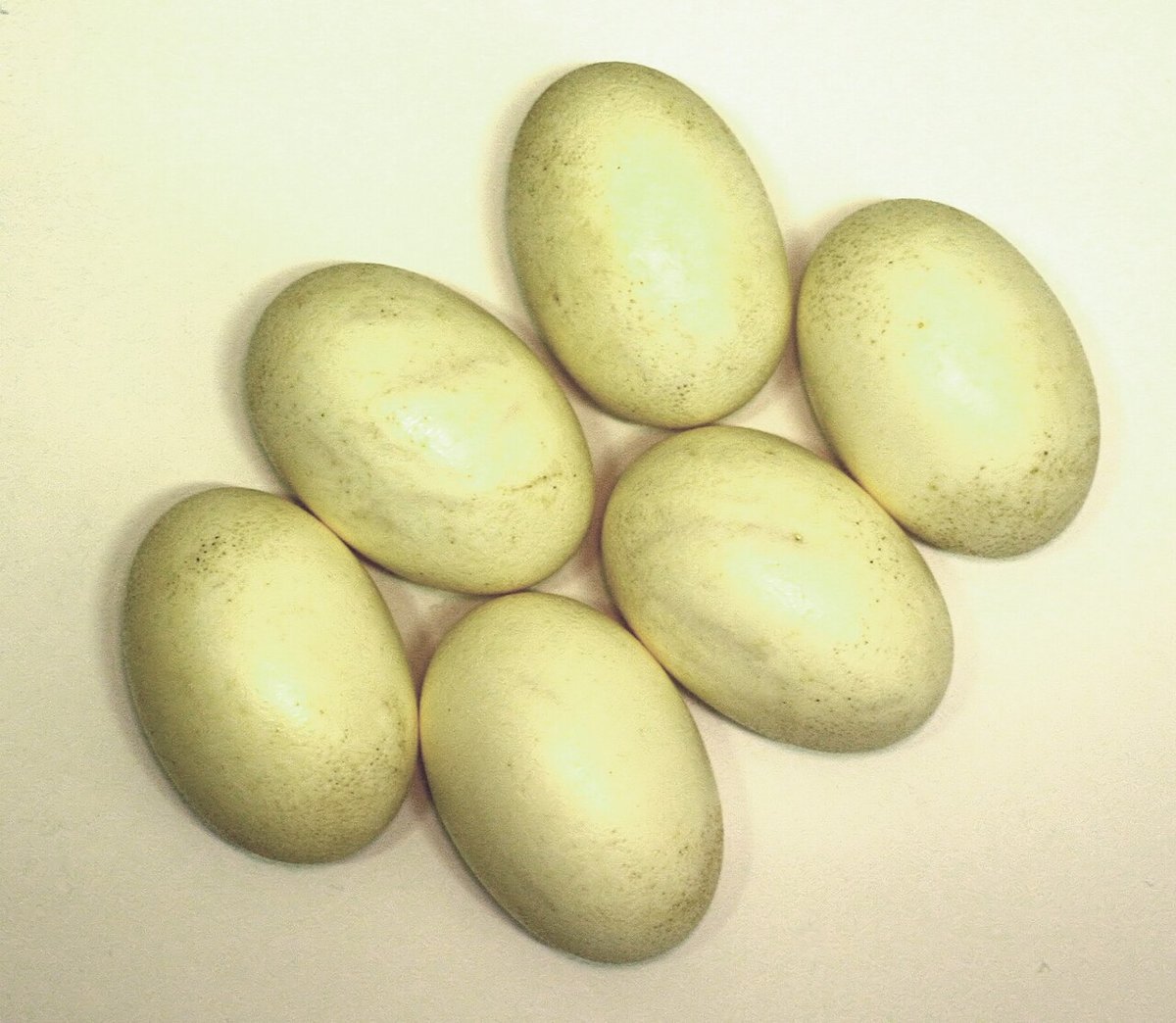
Nile crocodile eggs. Crocodiles lay amniotic eggs on land; the shell holds in water but lets oxygen and carbon dioxide pass (OpenStax Biology 2e). Photo: Kevin Walsh, CC BY 2.0
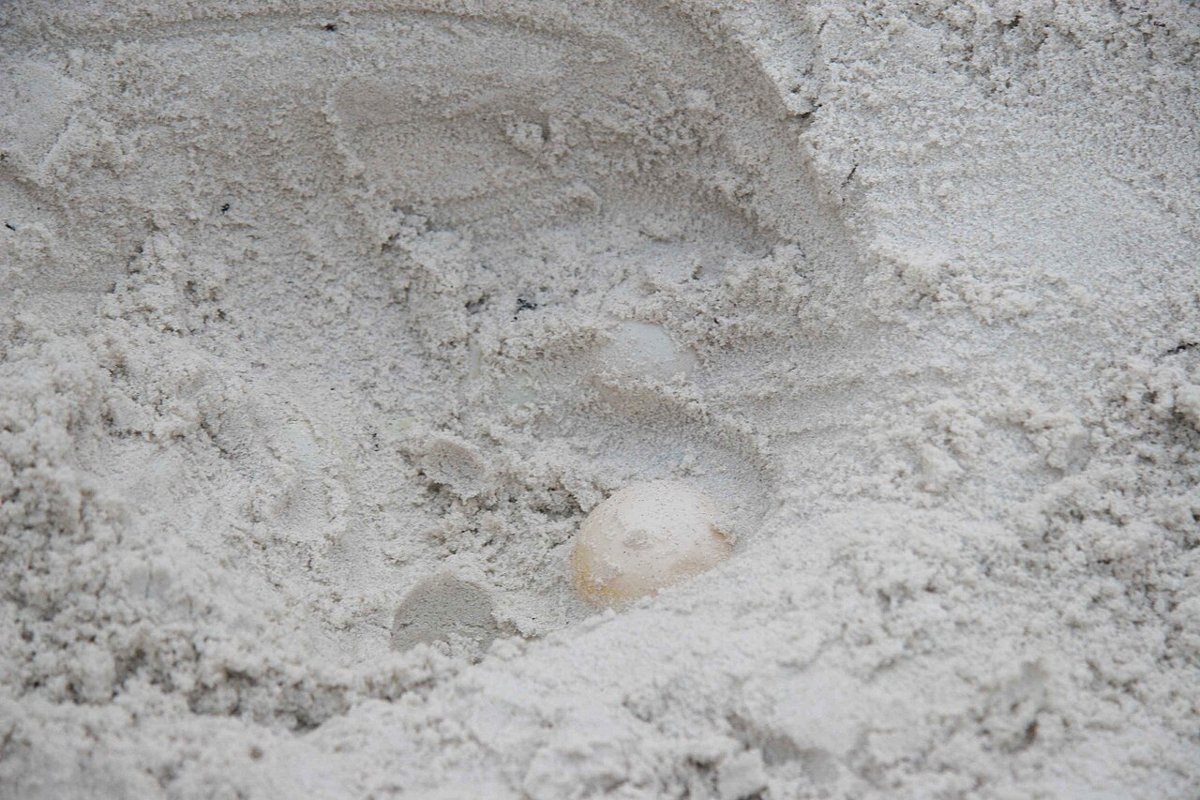
Sea turtle eggs, dug out of the sand. Most turtle eggs have a soft, leathery shell and must stay moist (OpenStax Biology 2e); the shell is built of aragonite (UCMP Berkeley). Photo: Jennifer Strickland, USFWS, public domain
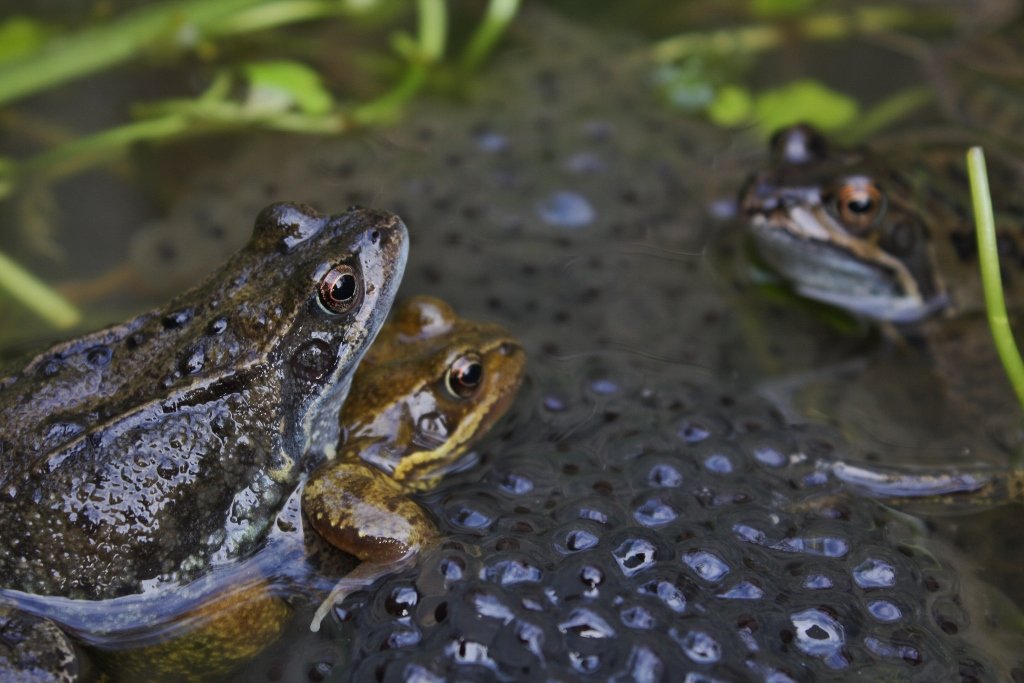
Common frog with frog spawn in a garden pond, London. Amphibian eggs have no shell and are therefore tied to water or damp places (OpenStax Biology 2e). Photo: Thomas Brown, CC BY 2.0
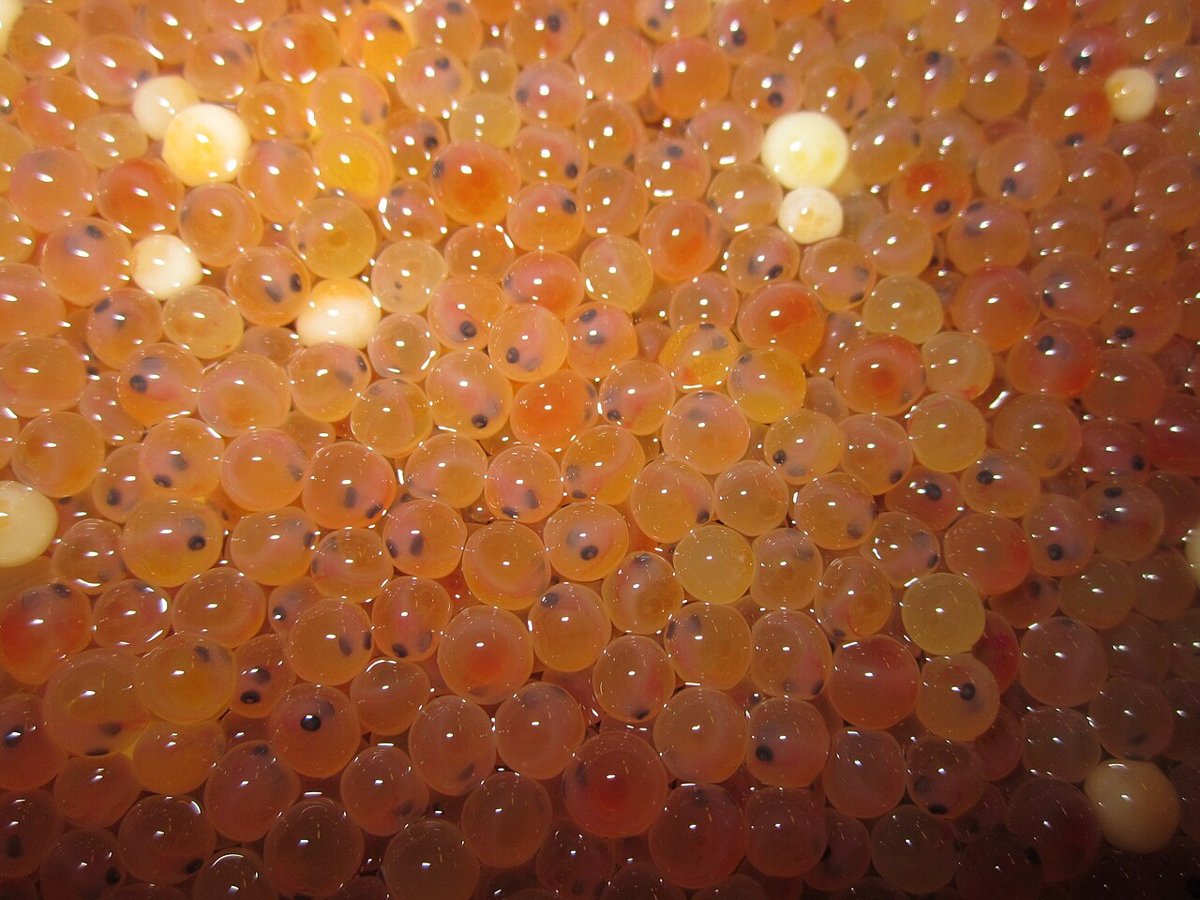
Trout eggs at a hatchery in Wyoming, at the so-called “eyed stage”, when the embryos' eyes can be seen through the soft, transparent shell. Fish eggs have no hard shell and develop in water. Photo: Liz Sunshine, USFWS, public domain
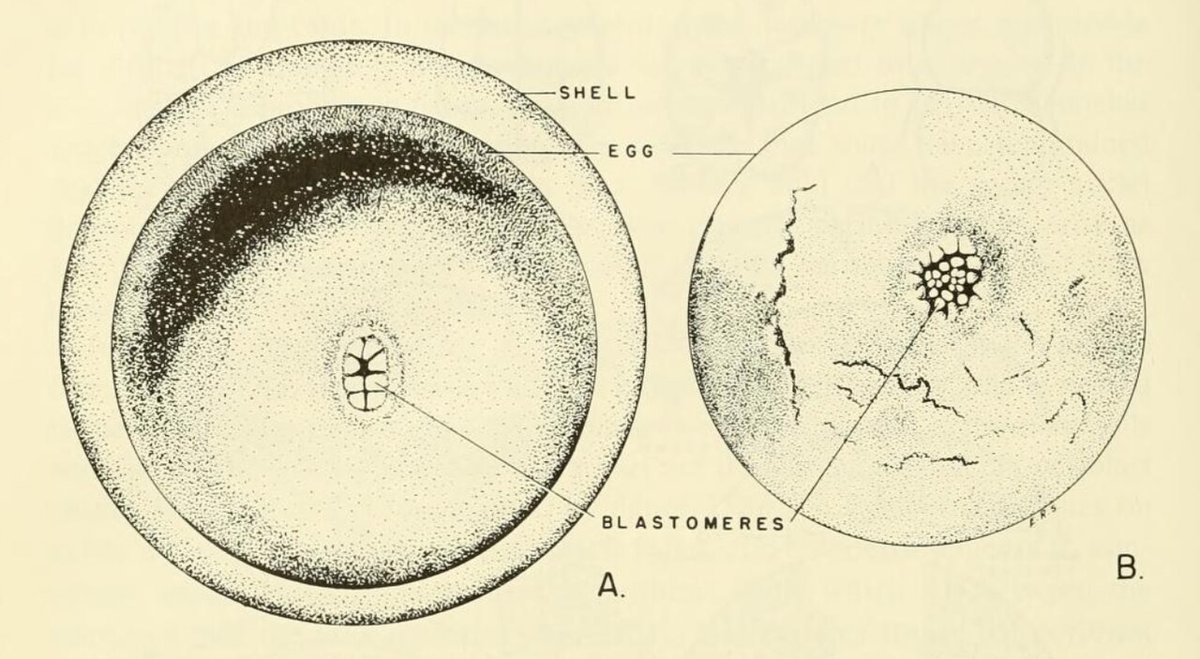
Platypus and echidna eggs (drawing). The monotremes are the only living mammals that lay eggs (UCMP Berkeley). Drawing: Olin E. Nelsen, public domain
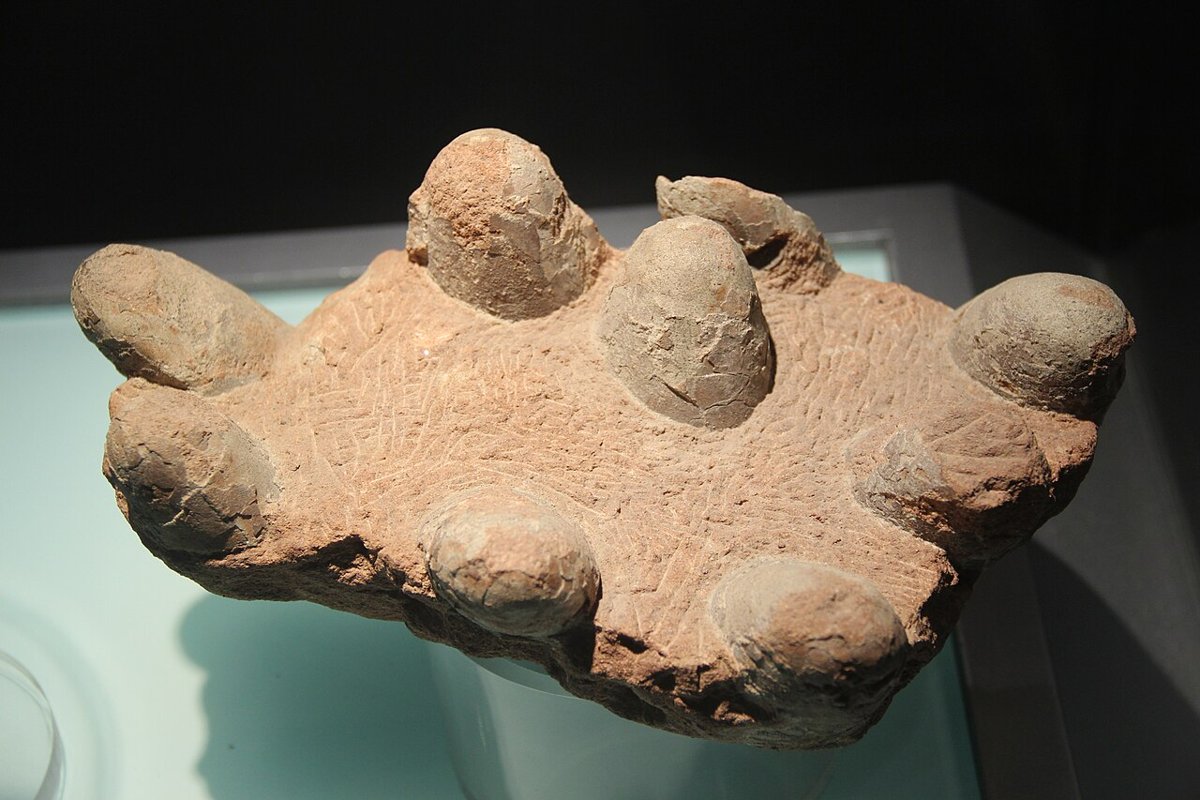
Fossil troodontid eggs, China. In the related Troodon, the shells show that the eggs were calcified slowly as in reptiles, and that each female probably laid only 4–6 eggs (Tagliavento et al., PNAS 2023). Photo: Gary Todd, CC0
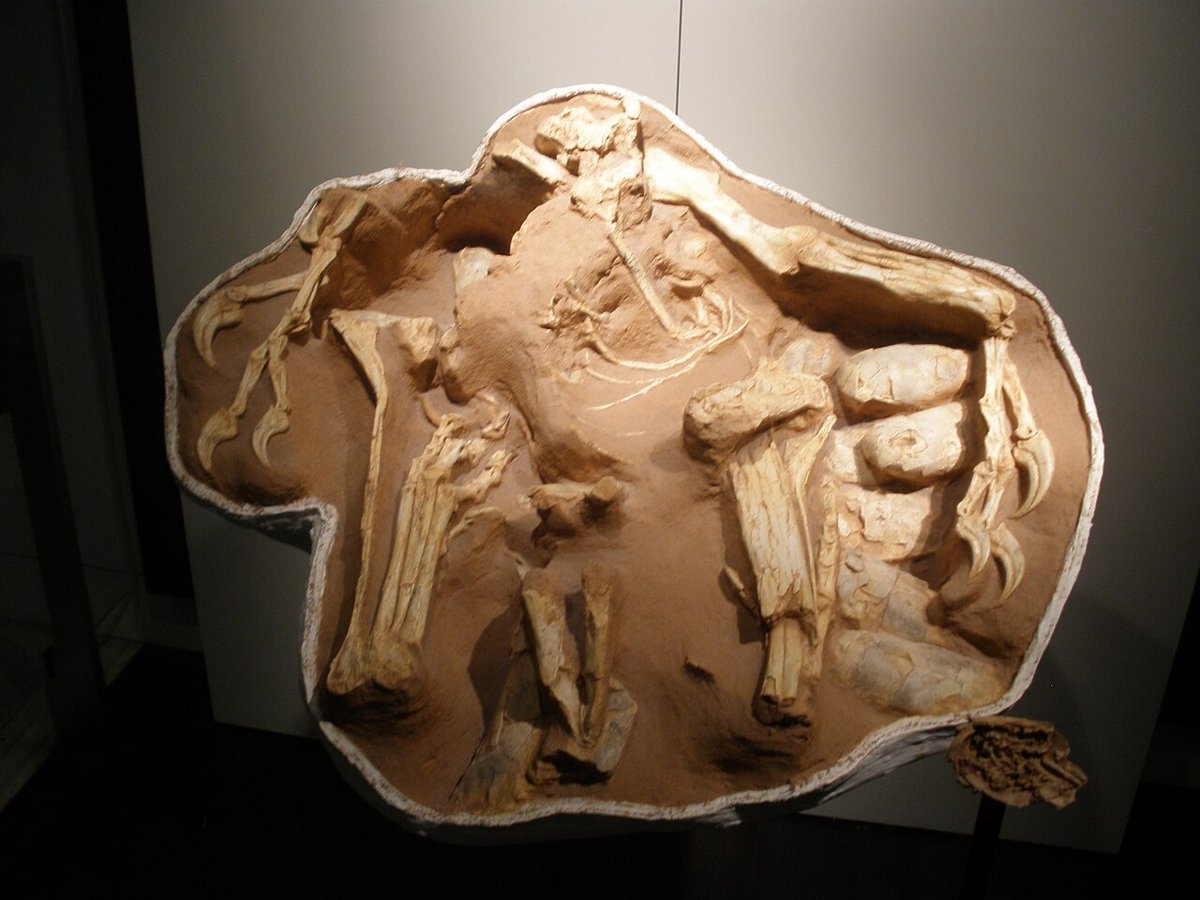
Fossil of an oviraptorid (Citipati, IGM 100/979) lying on its eggs like a brooding bird (Norell et al., Nature 1995). Photo: Ghedoghedo, public domain
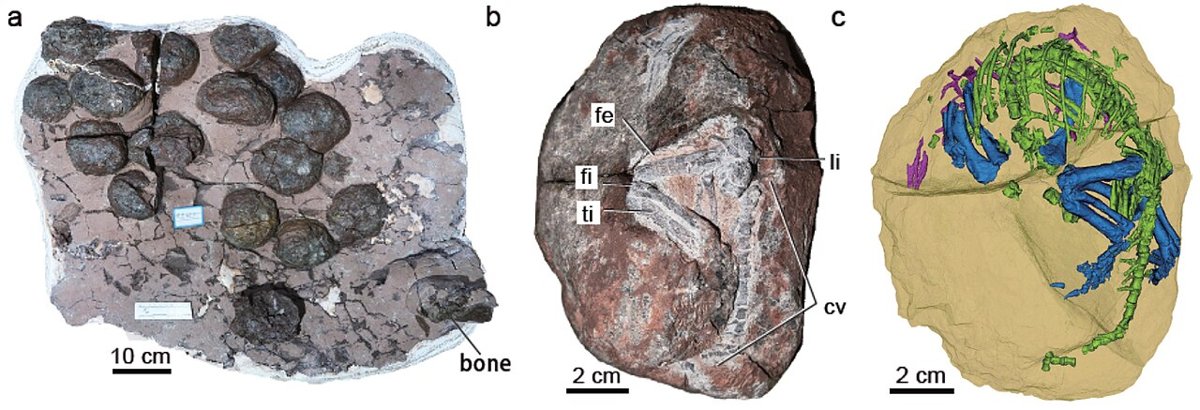
Leathery eggs of Qianlong shouhu, Early Jurassic – the oldest known soft dinosaur eggs (Han et al., National Science Review 2023). Photo: F. Han et al., CC BY 4.0
Fact box: egg records
- Largest bird egg ever: the elephant bird's, approx. 9 kg (Stoddard, Current Biology 2022).
- Largest egg of any living bird: the ostrich's (Stoddard, Current Biology 2022).
- Among the smallest: the hummingbird's, approx. 0.5 g (Stoddard, Current Biology 2022).
- The kiwi's egg weighs approx. 15 % of the female, the ostrich's only approx. 2 % (Smithsonian's National Zoo).
- Longest incubation in our table: bearded vulture (approx. 55–60 days) and Andean condor (54–58 days).
Why do eggs have different shapes?
Some eggs are almost as round as a table-tennis ball, others elongated or pointed. In 2017 an international team led by Mary Caswell Stoddard (Princeton and Harvard) measured around 50,000 eggs from approx. 1,400 bird species. The result, published in the journal Science: birds that are strong fliers often lay more elongated and asymmetric eggs. The researchers' explanation: a good flier needs a slim, streamlined body. That limits how wide the egg can be – so instead the egg becomes longer to hold enough.
Colour often follows the nest site. Birds that nest in holes – such as owls and woodpeckers – typically lay white eggs, while birds that nest more in the open, and especially on the ground, often lay brown, speckled eggs that are hard to spot (Cornell Lab of Ornithology; Current Biology 2022). All the many colours are made by just two pigments: red-brown protoporphyrin and blue-green biliverdin (Audubon).
Who lays eggs?
Eggs are far from something only birds produce. All birds lay eggs. So do almost all reptiles – turtles, crocodiles and most snakes and lizards. In fish and amphibians the eggs are usually shell-less and laid in water, often by the thousand. Insects lay eggs in every imaginable form. And then there are the mammals that lay eggs: the platypus and the echidnas (the monotremes) in Australia and New Guinea.
Come and experience the birds of prey
When you watch our eagles and falcons at the flight demonstration, you are seeing birds whose ancestors laid eggs in the age of the dinosaurs. We think that is rather wonderful. Welcome to Ørnereservatet.
Sources
- Stoddard, M.C. et al. (2017): Avian egg shape: Form, function, and evolution. Science 356: 1249–1254. https://doi.org/10.1126/science.aaj1945
- Norell, M.A. et al. (1995): A nesting dinosaur. Nature 378: 774–776. https://doi.org/10.1038/378774a0
- Norell, M.A. et al. (2020): The first dinosaur egg was soft. Nature 583: 406–410. https://doi.org/10.1038/s41586-020-2412-8
- Legendre, L.J. et al. (2020): A giant soft-shelled egg from the Late Cretaceous of Antarctica. Nature 583: 411–414. https://doi.org/10.1038/s41586-020-2377-7
- Wiemann, J. et al. (2018): Dinosaur egg colour had a single evolutionary origin. Nature 563: 555–558. https://doi.org/10.1038/s41586-018-0646-5
- Xing, L. et al. (2022): An exquisitely preserved in-ovo theropod dinosaur embryo… iScience 25: 103516. https://doi.org/10.1016/j.isci.2021.103516
- Raptor Research and Monitoring (2014): White-tailed Eagle – incubation and clutch size: https://www.raptormonitoring.org/wp-content/uploads/2015/05/Raptors-2014-White-tailed-Eagle.pdf
- The Peregrine Fund – White-tailed Sea-Eagle: https://peregrinefund.org/explore-raptors-species/eagles/white-tailed-sea-eagle
- Cornell Lab of Ornithology, All About Birds – Golden Eagle: https://www.allaboutbirds.org/guide/Golden_Eagle/lifehistory
- Cornell Lab of Ornithology, All About Birds – Gyrfalcon / Peregrine / Snowy Owl: https://www.allaboutbirds.org/guide/Gyrfalcon/lifehistory
- The Peregrine Fund – Peregrine Falcon, Gyrfalcon, Saker Falcon: https://peregrinefund.org/explore-raptors-species/falcons/saker-falcon
- Animal Diversity Web (University of Michigan) – Steller's sea eagle: https://animaldiversity.org/accounts/Haliaeetus_pelagicus/
- San Diego Zoo Wildlife Alliance – Steller's sea-eagle: https://animals.sandiegozoo.org/animals/stellers-sea-eagle
- Cleveland Metroparks Zoo – Andean Condor: https://resourcelibrary.clevelandmetroparks.com/animals/164
- The Peregrine Fund – Gyrfalcon: https://peregrinefund.org/explore-raptors-species/falcons/gyrfalcon
- The Peregrine Fund – Andean Condor: https://peregrinefund.org/explore-raptors-species/vultures/andean-condor
- The Peregrine Fund – Bearded Vulture: https://peregrinefund.org/explore-raptors-species/vultures/bearded-vulture
- Animal Diversity Web (University of Michigan) – Eurasian eagle-owl: https://animaldiversity.org/accounts/Bubo_bubo/
- The Peregrine Fund – Eurasian Eagle-Owl: https://peregrinefund.org/explore-raptors-species/owls/eurasian-eagle-owl
- Audubon Field Guide – Snowy Owl: https://www.audubon.org/field-guide/bird/snowy-owl
- The Barn Owl Trust – Barn Owl nesting: https://www.barnowltrust.org.uk/barn-owl-facts/barn-owl-nesting/
The evolution of the egg:
- UCMP, University of California Berkeley – Introduction to eggshells: https://ucmp.berkeley.edu/science/eggshell/eggshell1.php
- UCMP, University of California Berkeley – Amniota: https://ucmp.berkeley.edu/vertebrates/tetrapods/amniota.html
- OpenStax Biology 2e, 29.4 Reptiles (the amniotic egg): https://openstax.org/books/biology-2e/pages/29-4-reptiles
- Cleveland Museum of Natural History – The amniotic egg: https://www.cmnh.org/exhibits/g3-4-262
- Animal Diversity Web – Platypus (Ornithorhynchus anatinus): https://animaldiversity.org/accounts/Ornithorhynchus_anatinus/
New discoveries and research:
- San Diego Zoo Wildlife Alliance (28.10.2021): press release on parthenogenesis in the California condor: https://sandiegozoowildlifealliance.org/pr/CondorParthenogenesis
- Ryder, O.A. et al. (2021): Facultative parthenogenesis in California condors. Journal of Heredity 112(7): 569–574. https://doi.org/10.1093/jhered/esab052
- Tagliavento, M. et al. (2023): Evidence for heterothermic endothermy and reptile-like eggshell mineralization in Troodon, a non-avian maniraptoran theropod. PNAS 120. https://doi.org/10.1073/pnas.2213987120 · https://pmc.ncbi.nlm.nih.gov/articles/PMC10104568/
- Han, F. et al. (2023, online 9.10.2023): Exceptional Early Jurassic fossils with leathery eggs shed light on dinosaur reproductive biology. National Science Review 11. https://doi.org/10.1093/nsr/nwad258 · full text: https://pmc.ncbi.nlm.nih.gov/articles/PMC11067957/
- Chinese Academy of Sciences (13.11.2023): https://english.cas.cn/newsroom/news--archives/2023/research-news/202311/t20231113_1128605.shtml
- Nature News (11.09.2025): Dinosaur egg dated directly for the first time: https://www.nature.com/articles/d41586-025-02904-0
- Frontiers in Earth Science 13: 1638838 (2025): https://www.frontiersin.org/journals/earth-science/articles/10.3389/feart.2025.1638838/full
Egg colours, shapes and sizes (the gallery):
- Stoddard, M.C. (2022): Bird eggs. Current Biology 32: R1126–R1132. https://doi.org/10.1016/j.cub.2022.07.052
- Audubon – Cracking the Code on Egg Coloration: https://www.audubon.org/news/cracking-code-egg-coloration
- Cornell Lab of Ornithology, Living Bird – The Beauty and Biology of Egg Color: https://www.allaboutbirds.org/news/the-beauty-and-biology-of-egg-color/
- Smithsonian's National Zoo – North Island brown kiwi: https://nationalzoo.si.edu/animals/north-island-brown-kiwi
- Birkhead, T.R. et al. (2018): The pyriform egg of the Common Murre is more stable on sloping surfaces. The Auk 135: 1020–1032. https://bioone.org/journals/the-auk/volume-135/issue-4/AUK-18-38.1/The-pyriform-egg-of-the-Common-Murre-Uria-aalge-is/10.1642/AUK-18-38.1.full