


Inside the Egg
A new film from Ørnereservatet / Eagle World follows a golden eagle mother from the moment the egg is laid, through forty-two days in the dark, until the chick breaks out and sees the light for the first time.
Watch the film on YouTube: Inside the Egg – 42 days of a golden eagle
Why we made the film
We stand close to our eagles every day. At Ørnereservatet / Eagle World we have both golden eagles and white-tailed eagles. We watch them on the nest: warming the eggs, moving them with the beak, and sitting still for hours while life begins beneath them. For a long time we have wondered: what is actually happening in there? How does a chick breathe, sealed inside a shell? And how can a hunter be so gentle?
With the film Inside the Egg we want you to follow the roughly five minutes that hold forty-two days: from the egg being laid, to the chick being out, warmed and fed. It is built on research and on our own experience with both golden eagles and white-tailed eagles. The nest scenes are our own film footage of the golden eagle Rhina on her nest, from 2018 and from March 2026. Everything you see inside the egg is an AI reconstruction, built on what the science tells us – and clearly marked when a figure comes from a related raptor, not from the golden eagle itself. The film is also about motherhood: about a mother who is a predator, and who still touches the egg with the tip of her beak and covers the chick with her warmth.
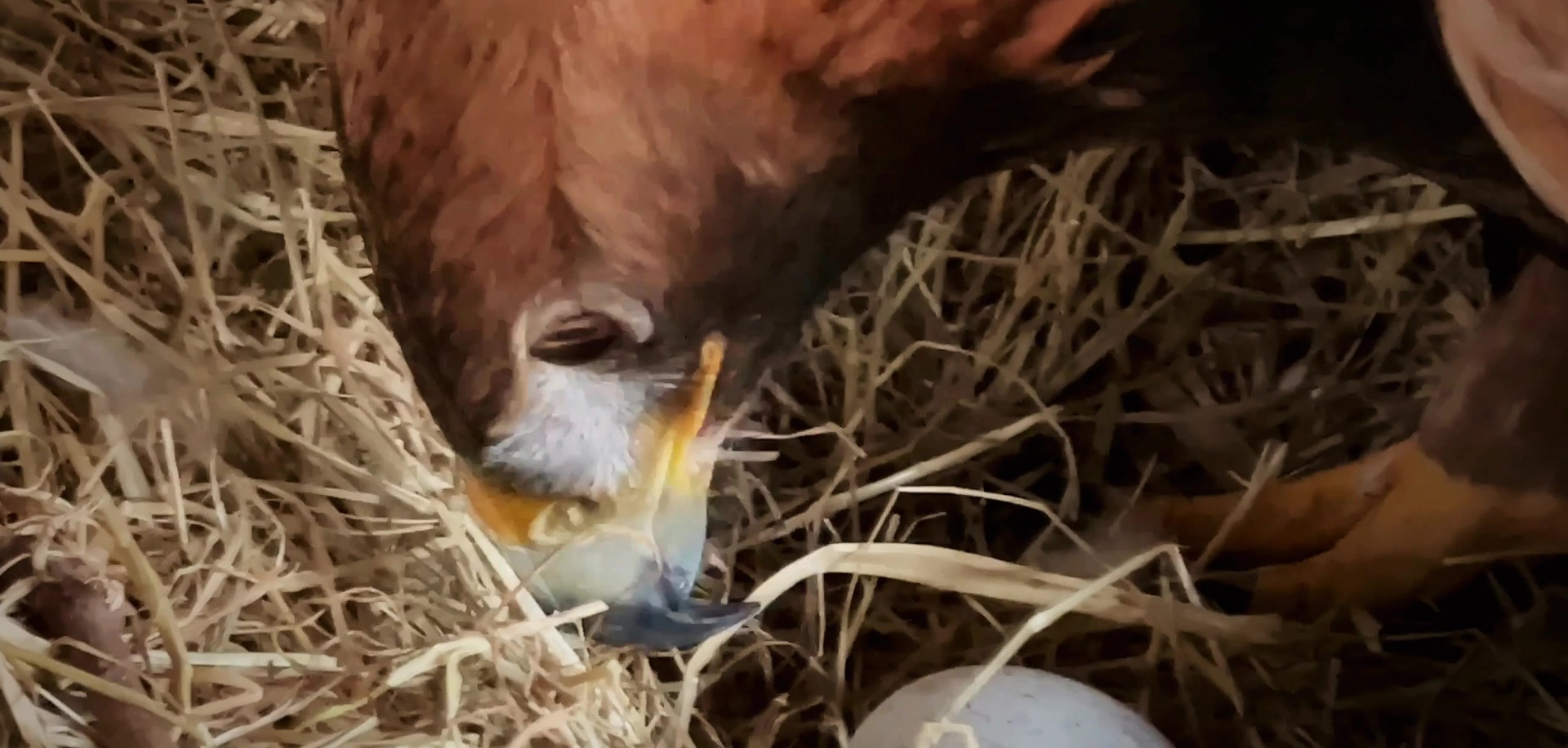
Our own film footage · the golden eagle Rhina on the nest, Eagle World.
An egg of about 140 grams
A golden eagle egg is typically about 75 millimetres long and 58 millimetres wide, and weighs close to 140 grams when it is laid. The shell is just over half a millimetre thick – about 0.6 millimetres [1]. It is cream or faintly pinkish, with brown blotches. Most clutches hold two eggs, laid three to five days apart. The female settles on the nest even before the first egg comes, and she incubates from the first egg, so the chicks typically hatch days apart [1].
The white-tailed eagle's egg is about the same size: typically about 75 × 58 millimetres and around 142 grams [15]. Most clutches here too hold two eggs, laid two to five days apart, and incubation begins with the first egg. But it is shorter than in the golden eagle: usually about 38 days, typically 34–46 days [16]. Both parents incubate [15][16], but the female generally takes the greater share, at least 70 percent, and sits at night [16].
Inside the egg there is no chick yet. Only a pale disc on the yolk, and the clear albumen around it. The yolk is the pantry. In the related tawny eagle it makes up about a fifth of the egg's contents [8]. It has to last the whole journey.
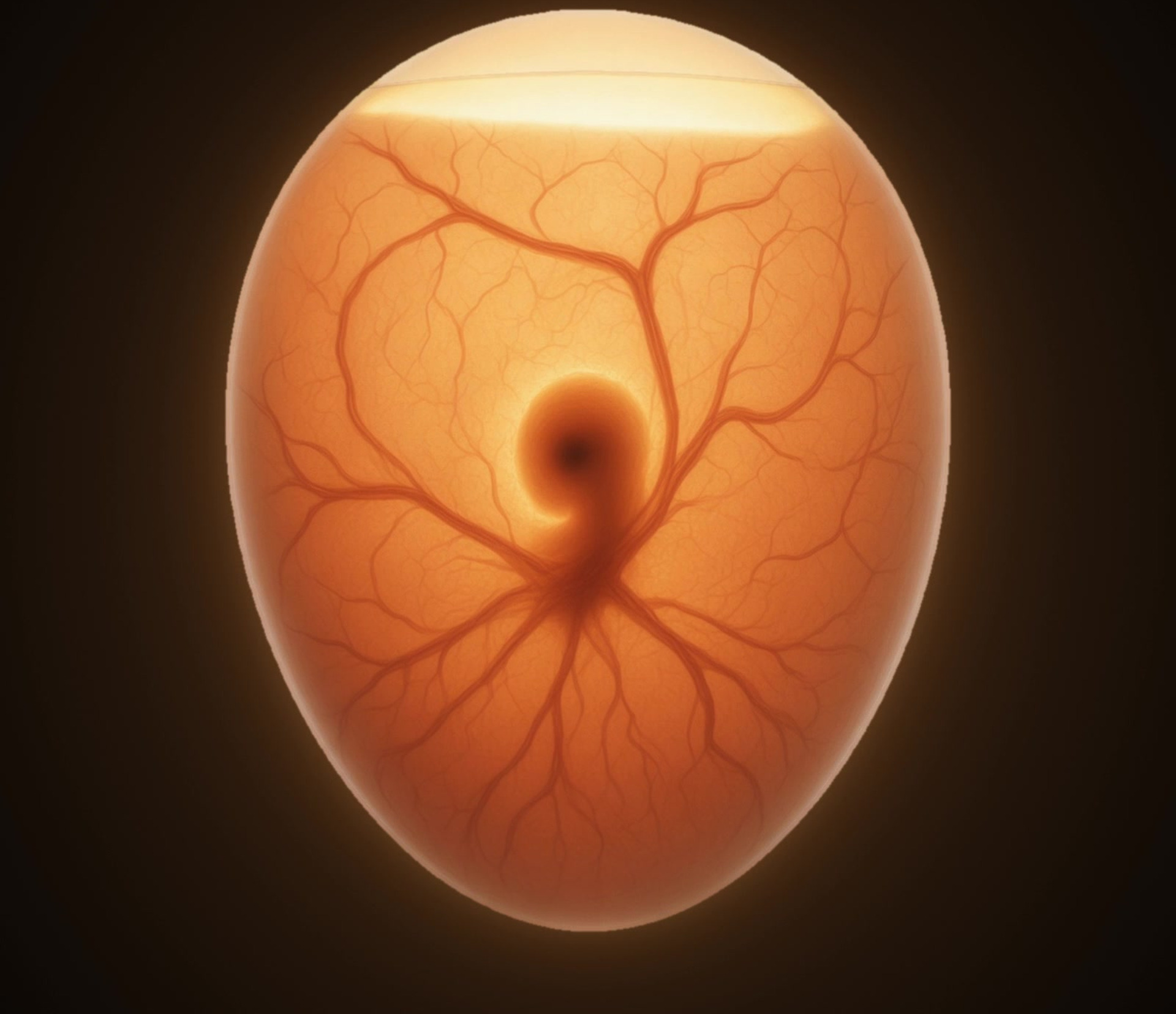
Inside the egg: heart, yolk and blood vessels. Illustration (AI reconstruction).
Forty-two days under her warmth
Incubation lasts on average 42 days, typically between 41 and 45 [1]. The female is almost always there. In a field study of wild golden eagles in Idaho she covered the eggs for more than four fifths of daylight, and every night. The male took over about twice a day, typically for under an hour, and sometimes brought her food. The eggs were left uncovered for less than four percent of the day [2].
How warm is the egg? With a pair in a large aviary, the core of a dummy egg fitted with a sensor was measured at about 32.8 °C, whether the mother or the father was sitting [3]. In incubators for eagle eggs, about 37.5 °C is typically used [6]. These are two different ways of measuring, and we do not know exactly what the temperature is inside a real golden eagle egg in the nest. In the film we use the figure measured in the aviary, and we put the source beside it.
How often does she turn the egg? This has not been measured in golden eagles. In bald eagles in a large aviary, the incubating bird stood and changed position about once an hour, probably to turn the eggs [7]. That is a figure from a related raptor. Snow may fall on the nest. In Idaho, an egg still hatched after lying in snow for between one and five hours late in incubation [1].
How the chick breathes and is nourished
How does a life breathe, sealed inside a shell? Through microscopic pores. In birds in general, the number rises with the size of the egg: about 10,000 pores in an 80-gram egg, and about 30,000 in a 500-gram egg. No published figure for the golden eagle has been found, but in an egg of this size there are many thousands of pores [9].
Beneath the shell, a membrane laced with blood vessels grows until it lines the inside of the egg. It works like a lung: oxygen in, carbon dioxide and water vapour out [10][11]. Day by day the egg grows lighter, and the air cell at the blunt end grows larger. In the peregrine falcon the egg loses about 15 percent of its weight before the chick makes the first hole [6]. That, again, is a figure from a related raptor.
Nourishment comes from the yolk. Within a few days a tiny heart begins to beat, and blood vessels spread across the yolk like roots, carrying its food to the embryo. The day-by-day timing we give for development is an estimate. There is no published staging table for the golden eagle embryo, so we have used stages from the chick embryo and from the American kestrel, scaled to a 42-day incubation [4][12][13]. This is stated clearly in the film. In time an egg tooth forms on the tip of the beak, and feathers begin as tiny buds. Late in the process the last of the yolk is drawn into the belly: a reserve to carry the chick through hatching.
The hatching position, and the first light
In the final week the embryo turns. Its spine lies along the length of the egg. The head tucks under the right wing, and the beak points to the air cell. This is the hatching position. Other positions can make it hard for the chick to get out. This knowledge comes mainly from the bearded vulture and from poultry, not from measured golden eagles [5]. In the bearded vulture the air cell begins to enlarge clearly seven to ten days before hatching, and the beak breaks into the air cell about three days before [5].
Then the beak pushes into the air space. The first breath of air. The lungs begin to work.
Two or three days before hatching, the chick can be heard calling from inside. This has been described from a single golden eagle nest [1]. Above, the parents change. With a pair in a large aviary the male came to the nest more often and offered the female small pieces of food a day to a day and a half before hatching [3].
Then the egg tooth strikes the shell. A crack. And through it, for the first time, light. In the film we give that moment a quiet, almost spiritual breath: light from the Sun, our nearest star, meeting a living eye – and then back to the mother's gaze.

First light through the crack. Illustration (AI reconstruction).
Now the clock runs in hours. For golden eagles, the work from first crack to freedom can take about a day and a half. The figure comes from a single nest [1]. In raptors in incubators it typically lies between one and three days, on average about 50 hours [6]. The chick chips around the shell, rests, and chips again. The mother watches over it. At one nest the female was even seen tugging at the egg. No one knows why [1].
Then the cap lifts. A wet, exhausted chick of about 100 to 110 grams. Within about two hours its down is dry and grey-white, and its eyes are half open [1].
A hunter, and a mother
Above the egg sits a hunter. These feet are built to hold struggling prey [14]. And yet she is gentle. In bald eagles, the arriving bird has been seen stepping into the nest with its feet balled, talons turned away from the eggs [7]. She lowers her head and moves the egg with the tip of her beak. That is the contrast the film is built around: the feet that can take prey, and the careful way she settles on the egg.
When the chick is out, she carries the large shell pieces to the edge of the nest in her beak. She tears morsels so small the chick can swallow them, and lowers her head to meet it. With a pair in a large aviary she fed about eight times a day, with about 25 tiny pieces each time [3]. For the first ten days she warms the chick for more than four fifths of the day [1].
Then she settles over it. The feet that hunt. The beak that tears. And all of it, for this.
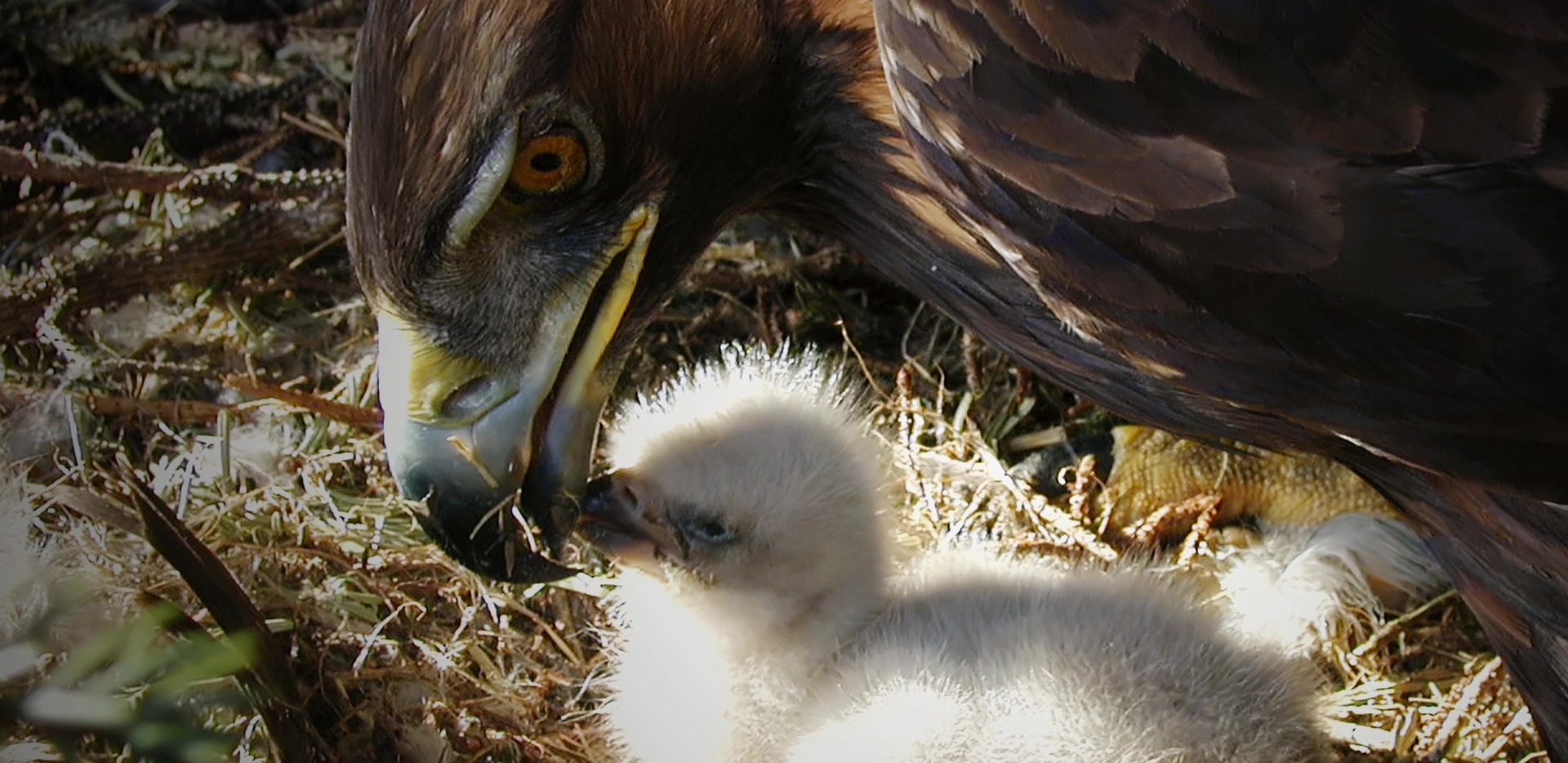
Our own photo · golden eagle mother and chick, Eagle World.
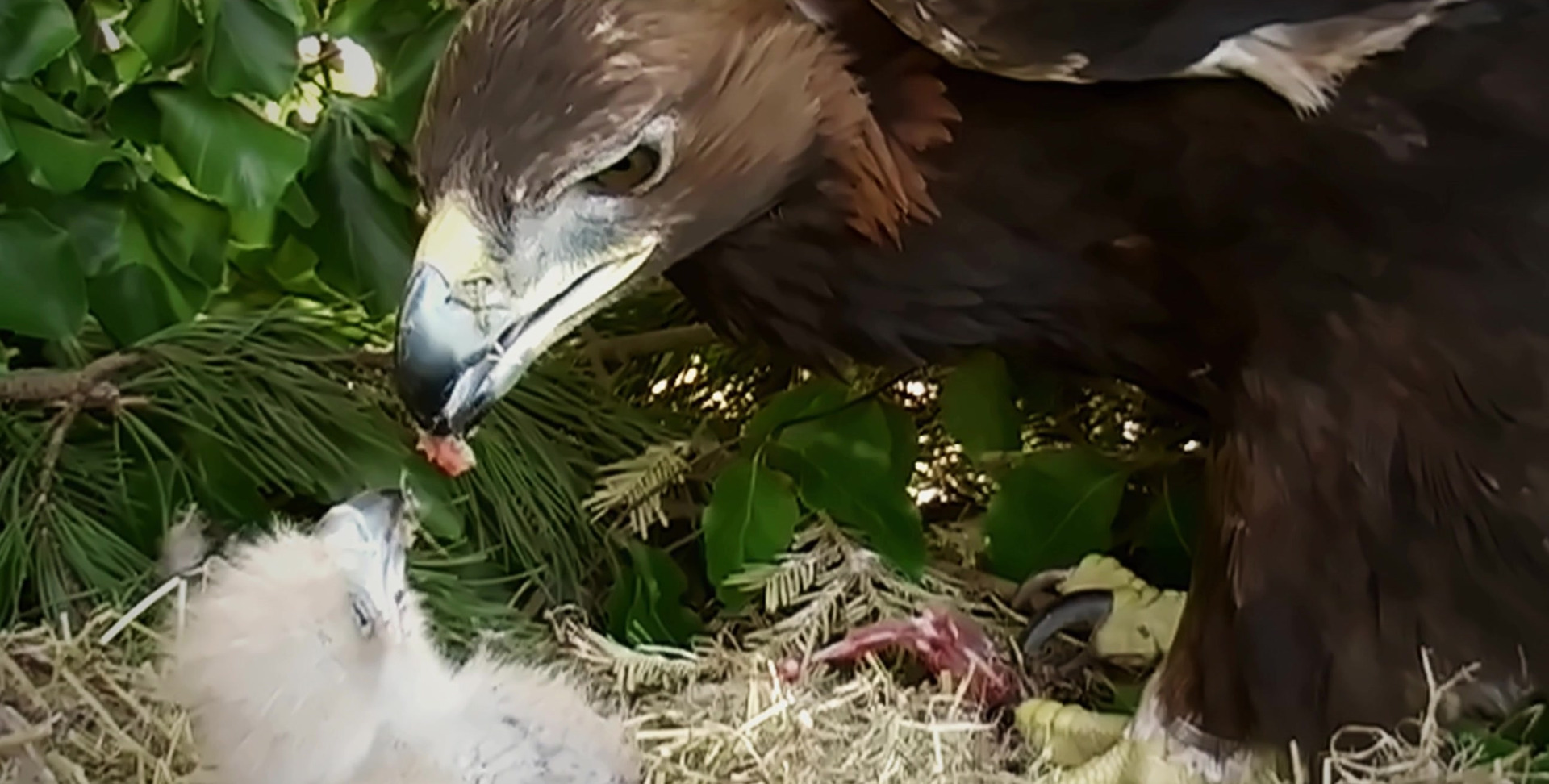
Our own film footage · a golden eagle mother feeding her chick, Eagle World.
Why AI is so fantastic for exactly this
We want to say it plainly: without artificial intelligence we could not have made this film. No one can film inside a living golden eagle egg day after day without destroying what we want to understand. AI has helped us to:
- gather and compare research on the egg, incubation, breathing and hatching, with sources we can check;
- reconstruct what happens inside the egg: the heart, the blood vessels, the pores, the air cell, the hatching position and the first light;
- bring our own footage of Rhina on the nest together with the reconstructions, and colour-grade them so the whole film holds together;
- add an English narrator's voice to the film. The voice is synthetic (AI-generated).
The music is The Awakening of Life.
It is a tool that lets us share research in a completely new way, and we are excited about the possibilities.
But we also want to be honest. The nest scenes are real. Everything inside the egg is an AI-generated reconstruction, built on science – and where golden eagle figures are missing, we say so clearly. No one has photographed a golden eagle embryo day by day. We can only come as close as the sources allow.
Sources
1. Katzner, T.E. et al. (2020). Golden Eagle (Aquila chrysaetos), version 2.0. Birds of the World, Cornell Lab of Ornithology. https://birdsoftheworld.org/bow/species/goleag/cur/breeding
2. Collopy, M.W. (1984). Parental care and feeding ecology of Golden Eagle nestlings. The Auk 101:753–760. https://doi.org/10.2307/4086902 · https://digitalcommons.usf.edu/cgi/viewcontent.cgi?article=21196&context=auk
3. Craighead, D.J. (1980). Sex differences in nest construction, incubation and parental behavior in American golden eagles. MSc thesis, University of Montana. https://scholarworks.umt.edu/etd/7455 (a pair in a large aviary)
4. Pisenti, J.M. et al. (2001). Embryonic development of the American Kestrel: external criteria for staging. Journal of Raptor Research 35:194–206. https://digitalcommons.usf.edu/jrr/vol35/iss3/3/
5. Llopis, A. (2024). Bearded Vulture EEP: guidelines for artificial incubation and chick rearing (1st ed., February 2024). https://4vultures.org/wp-content/uploads/2024/02/Protocol-Bearded-Vulture-artificial-incubation-and-chick-rearing-1st-version-February-2024.pdf (bearded vulture)
6. Platt, J.B., Bird, D.M. & Bardo, L. (2007). Chapter 21 in Raptor Research and Management Techniques. Raptor Research Foundation. https://raptorresearchfoundation.org/wp-content/uploads/2023/02/Techniques_Manual_Chapter-21.pdf
7. Gerrard, P.N., Wiemeyer, S.N. & Gerrard, J.M. (1979). Raptor Research 13(2). https://digitalcommons.usf.edu/jrr/vol13/iss2/8 (bald eagle in a large aviary)
8. Carey, C., Rahn, H. & Parisi, P. (1980). Calories, water, lipid and yolk in avian eggs. The Condor 82:335–343. https://digitalcommons.usf.edu/condor/vol82/iss3/14 (tawny eagle)
9. Ar, A. & Rahn, H. (1985). Pores in avian eggshells. Respiration Physiology 61:1–20. https://europepmc.org/article/MED/4035113 · review: https://pubmed.ncbi.nlm.nih.gov/3298530 (birds in general)
10. Onagbesan, O. et al. (2007). Gas exchange during storage and incubation of avian eggs. World's Poultry Science Journal. https://orbi.uliege.be/bitstream/2268/160019/1/Onagbesan%20et%20al%202007%20WPSJ.pdf
11. Gabrielli, M.G. & Accili, D. (2010). The chick chorioallantoic membrane. Journal of Biomedicine and Biotechnology. https://pmc.ncbi.nlm.nih.gov/articles/PMC2842975/
12. Hamburger, V. & Hamilton, H.L. (1951). A series of normal stages in the development of the chick embryo. https://homepage.univie.ac.at/brian.metscher/Hamburger51_ChickStages.pdf
13. Embryonic chicken as a model of cardiac biology and development. Review article. https://pmc.ncbi.nlm.nih.gov/articles/PMC6591676/
14. Fowler, D.W., Freedman, E.A. & Scannella, J.B. (2009). Predatory functional morphology in raptors. PLoS ONE 4:e7999. https://pmc.ncbi.nlm.nih.gov/articles/PMC2776979/
15. BTO BirdFacts. White-tailed Eagle (Haliaeetus albicilla). British Trust for Ornithology. https://www.bto.org/learn/about-birds/birdfacts/white-tailed-eagle
16. Hardey, J., Crick, H., Wernham, C., Riley, H., Etheridge, B. & Thompson, D. (2013). Raptors: a field guide for surveys and monitoring (3rd ed.). The Stationery Office, Edinburgh. White-tailed eagle chapter: https://raptormonitoring.org/wp-content/uploads/2015/05/Raptors-2014-White-tailed-Eagle.pdf