


The aviary – how a falcon or eagle should live
The first thing most people ask when they dream of becoming a falconer is: Which bird should I get? It should be: Where will it live? The aviary is the bird's home all year round – also when it is not flying. Here we use photos from Ørnereservatet and drawings to illustrate how a good aviary is put together, and why.
Start with yourself
Before a single post goes into the ground, ask yourself some honest questions:
- Do I have the time? It takes a great deal of time. The bird takes time and demands time – every single day, all year round, also on holidays and when it rains.
- Will I give it good conditions? An aviary is not a cage. It must offer shelter, sun, a bath, peace and safety.
- Can I afford it? An aviary built properly by a bricklayer and a carpenter easily costs DKK 50,000 for a falcon. On top of that comes a very well thought-out interior. On top of that come surveillance cameras. You need at least one camera per aviary, and they cost at least DKK 1,000 per camera and up, depending on how professional the equipment needs to be.
- Do I have the space and the permits? In Denmark, birds of prey may only be kept with a permit from the state, and hunting with a bird of prey requires a special endorsement on the hunting licence.
- Who looks after the bird when I can't?
If you can answer yes to all of it, read on.
One bird or a pair?
A breeding aviary and an aviary for a single bird differ in size, fittings and monitoring.
A breeding pair must not be disturbed. That is why the pairs are monitored, so you notice if a strange animal creeps up to or over the aviary. The falconer may then have to take over the rearing (Eagle World Magasin no. 01, 2022, p. 37).
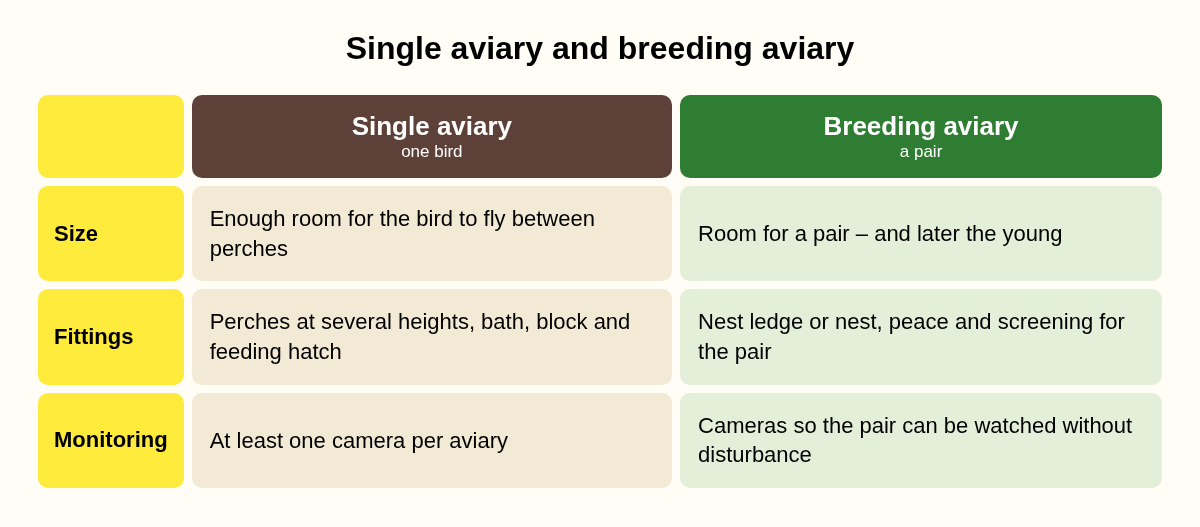
Single aviary and breeding aviary. Graphic: Ørnereservatet
What do the rules say?
In Denmark, birds of prey may only be kept in captivity with a permit from the Danish Agency for Green Land Conversion and Aquatic Environment (Styrelsen for Grøn Arealomlægning og Vandmiljø). This is set out in the executive order on keeping birds in captivity. If you want to hunt with the bird, you also need an endorsement for hunting with birds of prey on your hunting licence and a legal holding of birds of prey.
The law sets no fixed dimensions for the aviary itself. In our view, these are the minimum sizes (length × width × height):
- Small falcon: 3 × 2 × 2.5 m
- Large falcon: 5 × 3 × 3 m
- Eagle: 8 × 5 × 3 m
In our view, 3 × 2 × 2.5 m is the minimum for a small falcon. Our own aviaries are usually 2–3 times larger. The larger aviaries easily cost twice as much. And size is not everything – it is the details that decide whether the bird thrives and keeps its feathers intact.
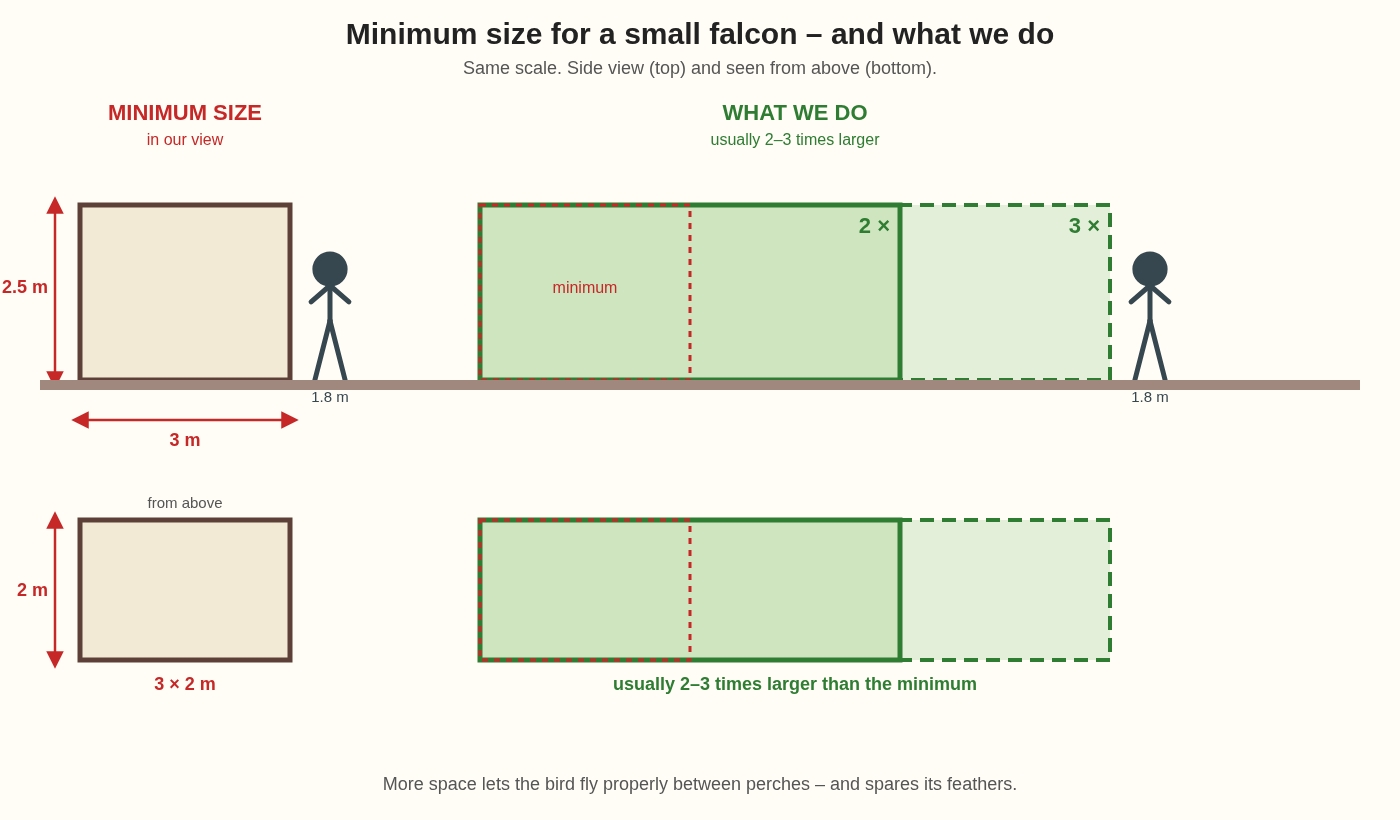
Minimum size for a small falcon – and what we do. Graphic: Ørnereservatet
The falcon's aviary – step by step
The drawing shows an aviary for a large falcon seen from the side. Each number has a reason:
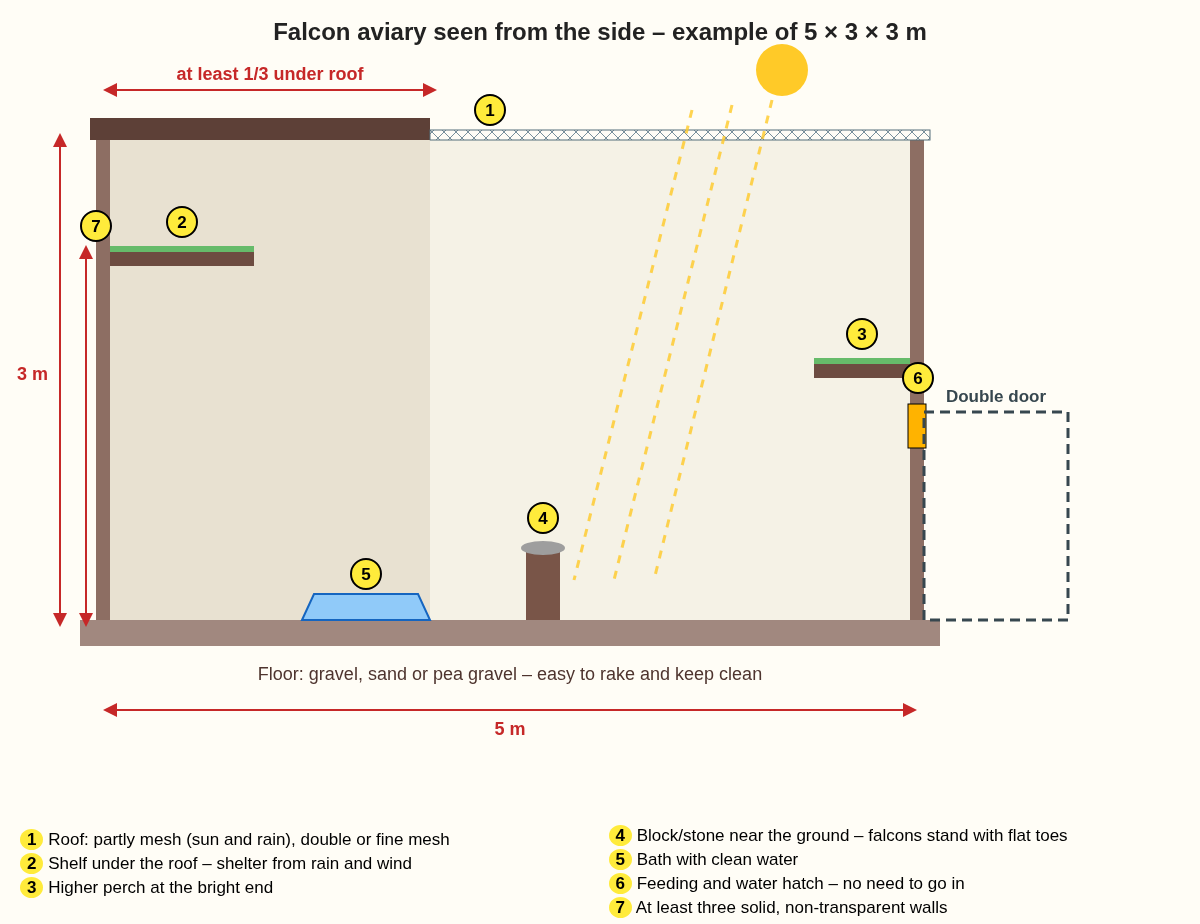
The falcon aviary seen from the side. Graphic: Ørnereservatet
- The roof should be partly closed against bad weather and partly open, so sun and rain get in. The mesh should be double and/or fine-meshed, so martens, mink and wild birds of prey cannot get at the bird.
- At least a third under roof and at least one perch there, so the bird can always find shade and shelter.
- Several perches at different heights. One perch is not enough. The bird must be able to choose so it feels safe. Battens covered with artificial grass or coir matting and natural branches of different thicknesses are good.
- A block or stone. Falcons prefer to stand with flat, outstretched toes, as on a stone. Hawks and buzzards stand with curled toes, as on a branch.
- The bath. The bird must be able to bathe every day when it is not freezing. Bathing keeps the feathers in good condition.
- Feeding and water hatch. If you can give food and change the water from outside, the bird is not disturbed every time.
- Solid walls. Most birds do best with at least three walls of solid, non-transparent panels. An aviary made entirely of wire is not ideal – the bird can fly into the mesh and damage its tail, wings and the cere above the beak. Where there is mesh, it must be screened.
And then the double door: a two-door system, so the bird does not slip out when you go in. The floor can be gravel, sand or pea gravel, raked regularly – but not during the moult, when the bird needs peace.
How it looks at our place – the falcons
Our guests do not see the aviaries, because the birds need peace to breed, preen and bathe – visitors experience them only at our flight displays.
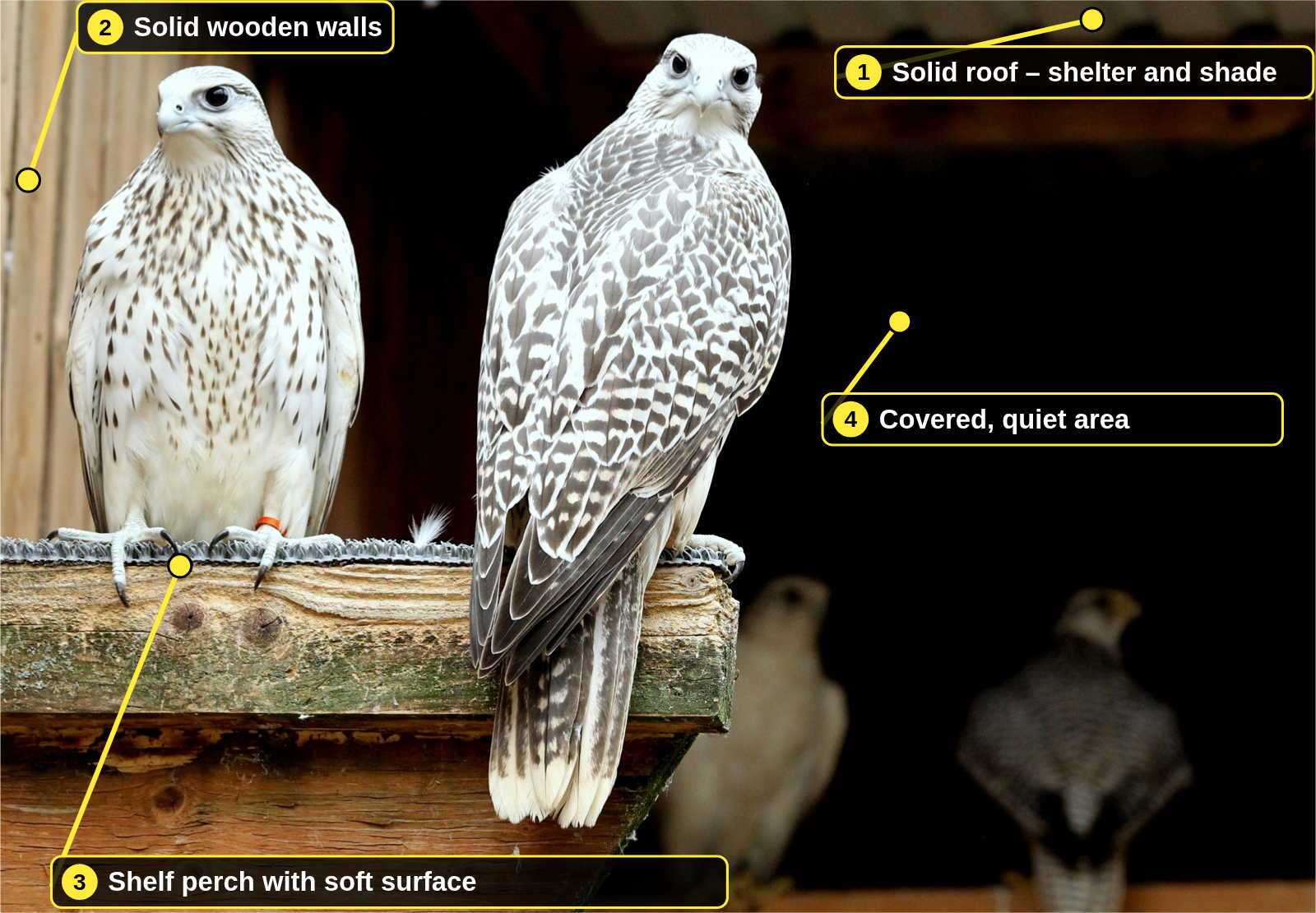
Gyrfalcons in the aviary at Ørnereservatet. Photo: Ørnereservatet. Graphic: Ørnereservatet
What do you see? (1) A solid roof gives shelter and shade. (2) The walls are made of wood, so the birds cannot see through them and become restless. (3) The shelf perch has a soft surface that protects the feet. (4) Behind it is a covered, darker area where the birds can withdraw. Note also that there are several perches – the birds choose for themselves.
Lessons from our new falcon facility
In our own magazine, Eagle World Magasin no. 01 (2022, p. 12), we described the new falcon facility we built in autumn 2021. These are aviaries for smaller falcons – not for eagles. Here are the most important lessons:
- Each bird or pair has its own aviary.
- Wood is the main building material. Wood is quiet. Steel sheets are noisy when the wind makes branches hit the roof or when rain beats against it. Wood was also chosen for sustainability.
- Aviaries wear out. Many of the old ones were built 40 years ago and needed replacing. The new ones are built with more focus on durability, and more care has gone into the small details.
- Building work is a risk. The birds had to move temporarily, and while the old aviaries were being torn down, the birds' natural enemies – such as mink, polecat and marten – could get closer.
- The fittings vary from bird to bird. Size, the placement and size of perches and closeness to trees all matter. It is a process in which you must always be open to new insights – also from the large reserves in Europe we work with.
How it looks at our place – the eagles
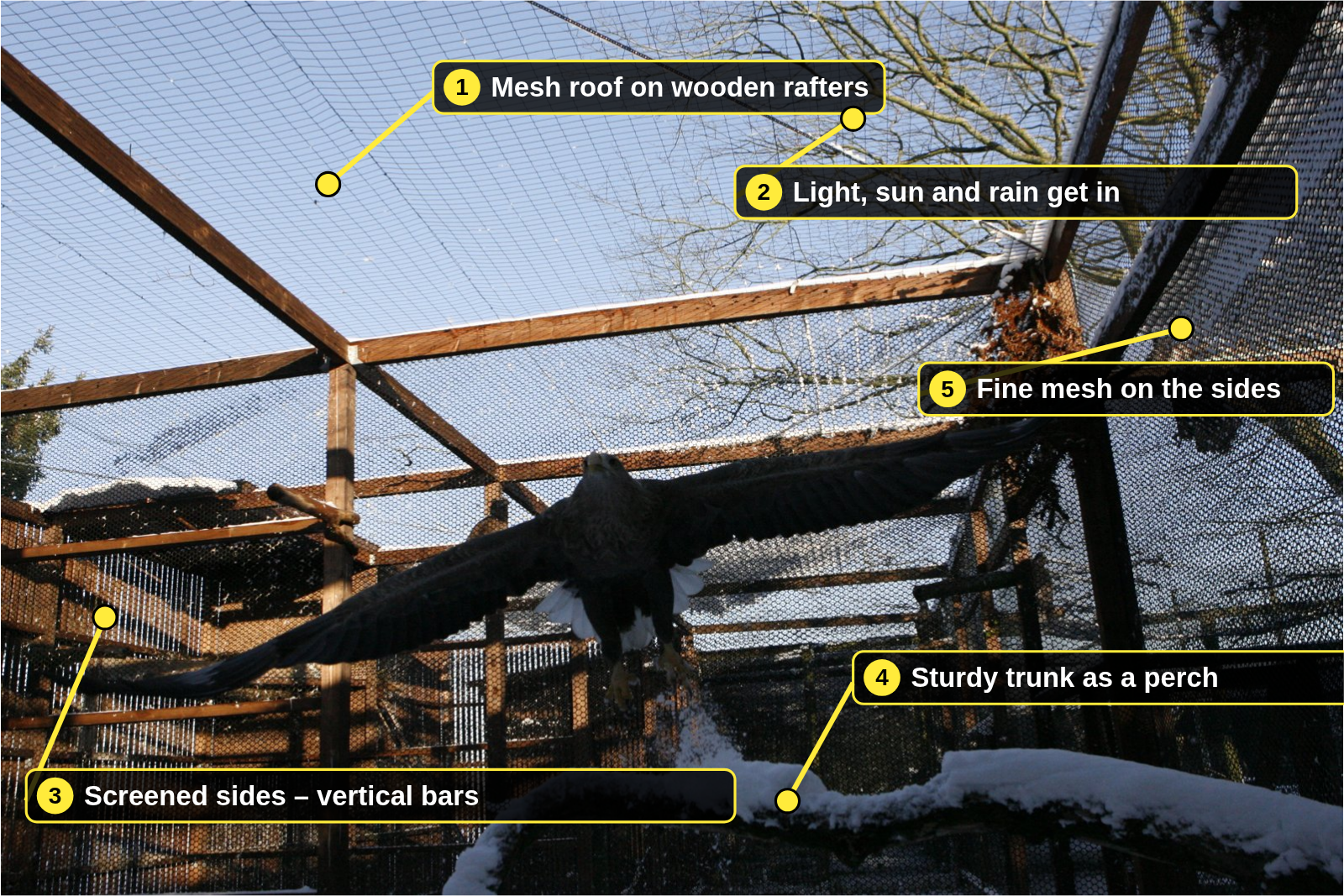
White-tailed eagle in the large eagle aviary on a winter's day. Photo: Ørnereservatet. Graphic: Ørnereservatet
What do you see? (1) The roof is mesh stretched over wooden rafters. (2) It lets in light, sun and rain. (3) The sides are screened with vertical bars. (4) A sturdy trunk serves as a perch – an eagle needs something that can carry it. (5) The sides have fine mesh. And most important: there is room here for the eagle to spread its wings fully and fly. A white-tailed eagle is a big bird, so the eagle aviary must be much larger than the falcon's.
Our facilities for eagles are enormous. The flight-training facility is the size of a football pitch and can be seen on Google Maps: See the facility from the air.
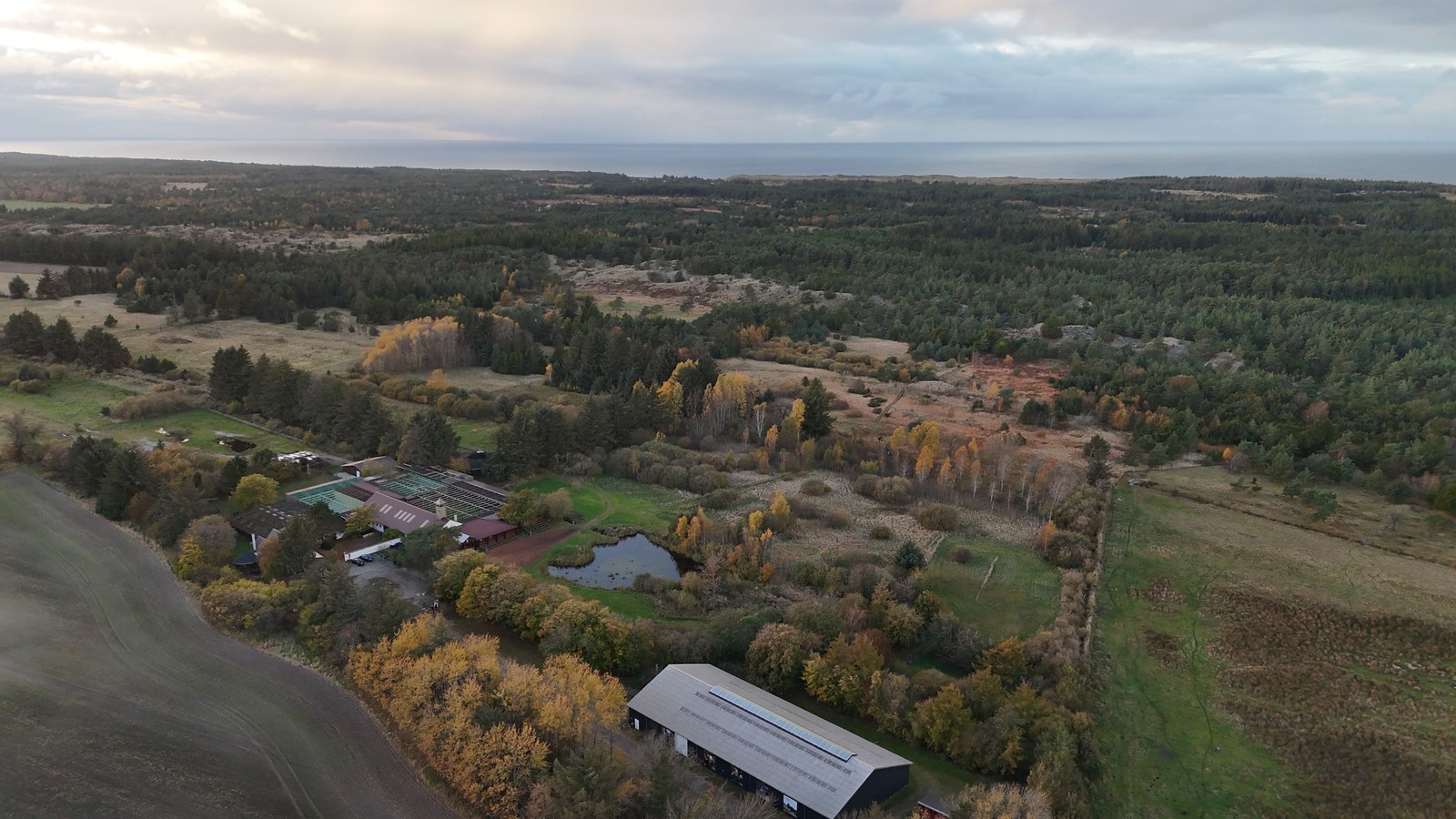
Ørnereservatet seen from the air. Drone photo: Peter Frank Wenzel
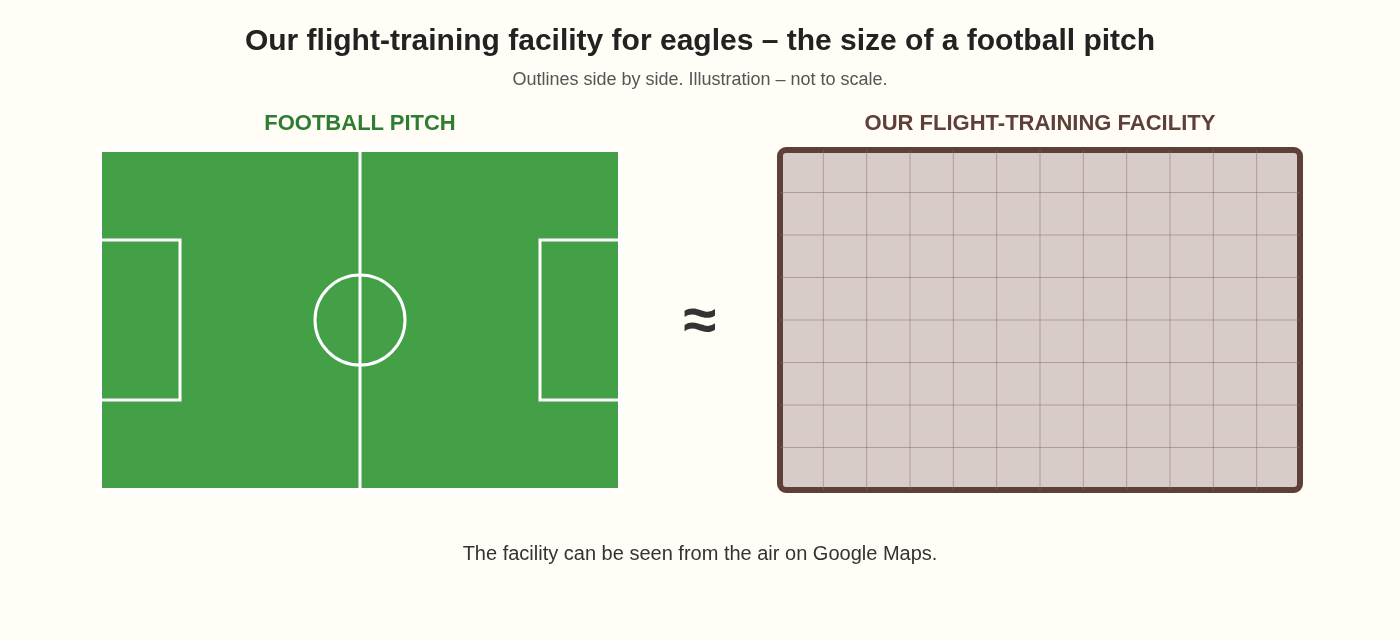
Our flight-training facility compared with a football pitch (not to scale). Graphic: Ørnereservatet
Our own aviaries are continually repaired and secured against mink. An aviary is never finished.
How they do it in other countries
England. The Hawk Board, which brings together the British falconry organisations, has published a code of welfare and husbandry. It gives no fixed dimensions but a checklist: the bird must always have access to clean water for drinking and bathing. In Ireland, the National Parks and Wildlife Service (NPWS) writes that birds of prey not in training should be loose in aviaries, and that the small traditional "mews" are not a place for a bird to live for long.
USA. Here the rules are federal (50 CFR § 21.82). The facility must be approved before you may get a bird. It must protect against predators and domestic animals, have a suitable perch for each bird, at least one opening for sunlight, and be large enough that the bird cannot hit the sides when it flies from the perch. Walls that are not solid must be protected on the inside, e.g. with vertical bars spaced narrower than the bird's body. The states may set stricter requirements. In Ontario, Canada, for example, the falconry club recommends that ordinary chicken wire is not used as the main barrier.
United Arab Emirates. Abu Dhabi Falcon Hospital opened on 3 October 1999. When it gets too hot to fly in summer, the falcons moult in large free-flight aviaries, where they stay for about six months. These are fantastic facilities – but the principle is the same as in a garden in Vendsyssel: space, peace, clean water and safety.
For most falconers it is not about marble and air conditioning, but about a solid, well thought-out aviary built for the very bird you have.
In short
Build the aviary before you get the bird. Build it solidly, and think the fittings through. And be honest with yourself: Do you have the time? The bird needs it.
If you want to experience the birds for real, come to a flight display at Ørnereservatet.
Read also
Saker falcon (Falco cherrug) · Free e-book: The kings' hunting falcons · When the white-tailed eagles came by
Sources
- Ørnereservatet: Eagle World Magasin no. 01 (2022, in Danish), p. 12 "Nyt falkeanlæg" (aviaries for smaller falcons) and p. 37 (breeding and monitoring)
- Danish executive order on keeping birds in captivity, BEK no. 848 of 21 June 2016, §§ 3–5
- Danish executive order on hunting and control using birds of prey, BEK no. 1072 of 27 August 2018
- Styrelsen for Grøn Arealomlægning og Vandmiljø: Jagt med rovfugl (in Danish)
- The Hawk Board: HB Code of Welfare & Husbandry for Falconry
- National Parks and Wildlife Service (Ireland): GN04 Birds of Prey in Zoos, v1.2
- U.S. Code of Federal Regulations: 50 CFR § 21.82 Falconry standards, para. (d)
- Ontario Hawking Club: Facility Standards (2019)
- Abu Dhabi Falcon Hospital: falconhospital.com and interview with Dr Margit Gabriele Müller in Aletihad