


Shakespeare and the Falcons
A falcon is killed by an owl, and for the audience the world is turned upside down. Shakespeare mentions hawking more than fifty times in his works. Was he a falconer himself? We do not know. In a new film we follow his falcons from Stratford to Elsinore.
By Peter Frank Wenzel, Ørnereservatet / Eagle World
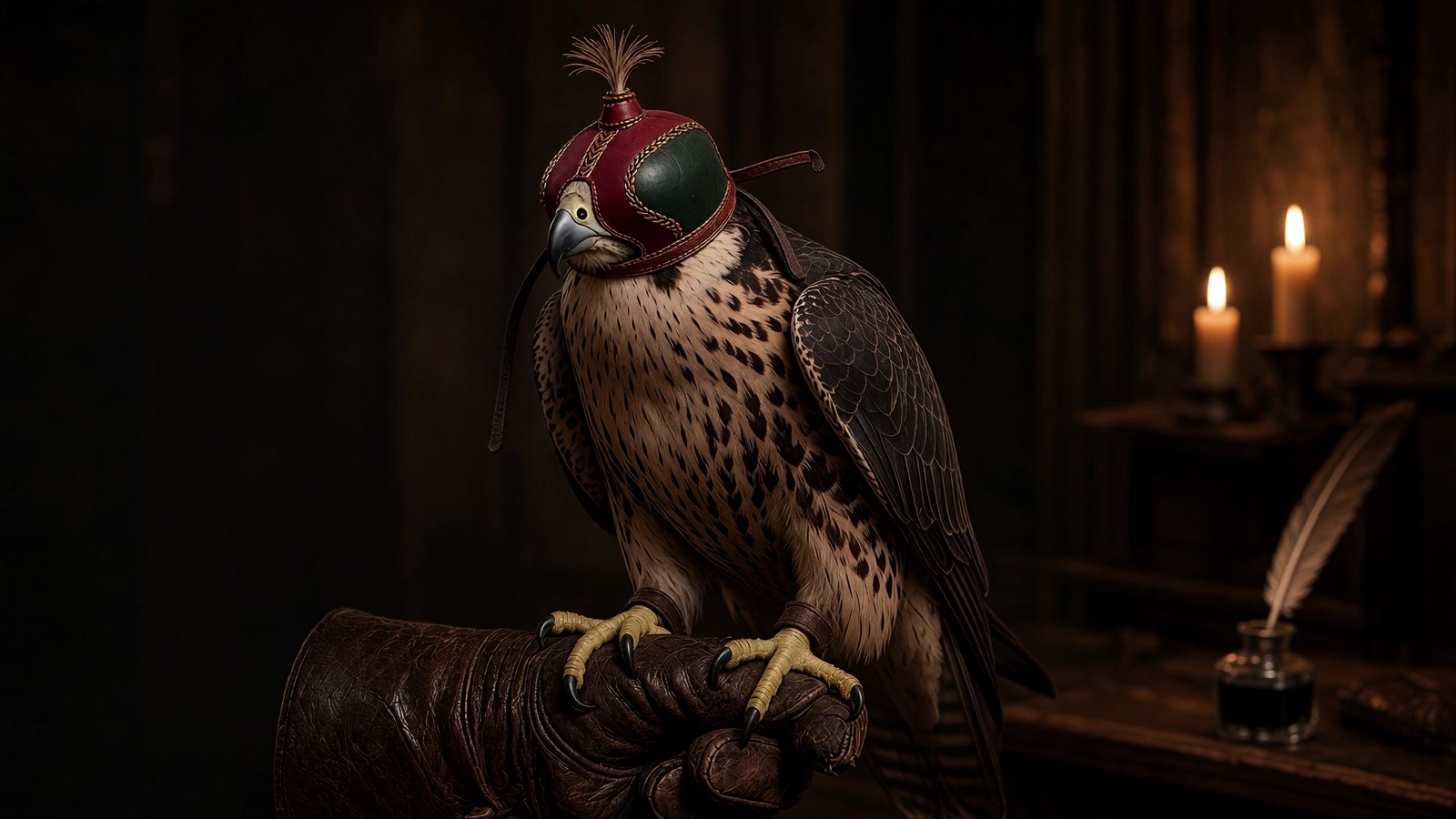
A hooded peregrine by candlelight, with a quill and ink beside it. AI reconstruction.
A falcon, an owl and a world turned upside down
Scotland, the day after King Duncan has been murdered. An old man tells of a strange thing he has seen: "On Tuesday last, a falcon, tow’ring in her pride of place, was by a mousing owl hawked at and killed." (Macbeth, Act 2, Scene 4.)
A small owl killing a falcon. For Shakespeare’s audience this was more than strange. It was a sign that the order of nature had been turned upside down, just as the murder of the king had overturned the order of the realm.
More than fifty times
The scholar Maurice Pope has counted. Shakespeare mentions hawking more than fifty times. His fellow playwrights Marlowe, Kyd and Greene hardly mention it at all.
That is striking, because Shakespeare was not born into the nobility. He was baptised in Stratford-upon-Avon in 1564, a tradesman’s son from a market town. At eighteen he married Anne Hathaway. By 1592 he was acting and writing in London, and in 1599 his company opened the Globe in Southwark. His family stayed in Stratford, where in 1597 he bought New Place, the largest house in town. He died there in 1616.
Was he a falconer himself?
Many falconers have thought so, and in 1897 the Irish judge Dodgson Madden wrote a whole book on that idea: that Shakespeare wrote like a man who knew these sports at first hand. But no document says that Shakespeare ever flew a hawk or owned one. Maurice Pope called the idea that Shakespeare wrote from experience "a matter of feeling not of demonstration".
The honest answer is that we do not know. At the very least, he watched closely and knew the words. So did his audience.
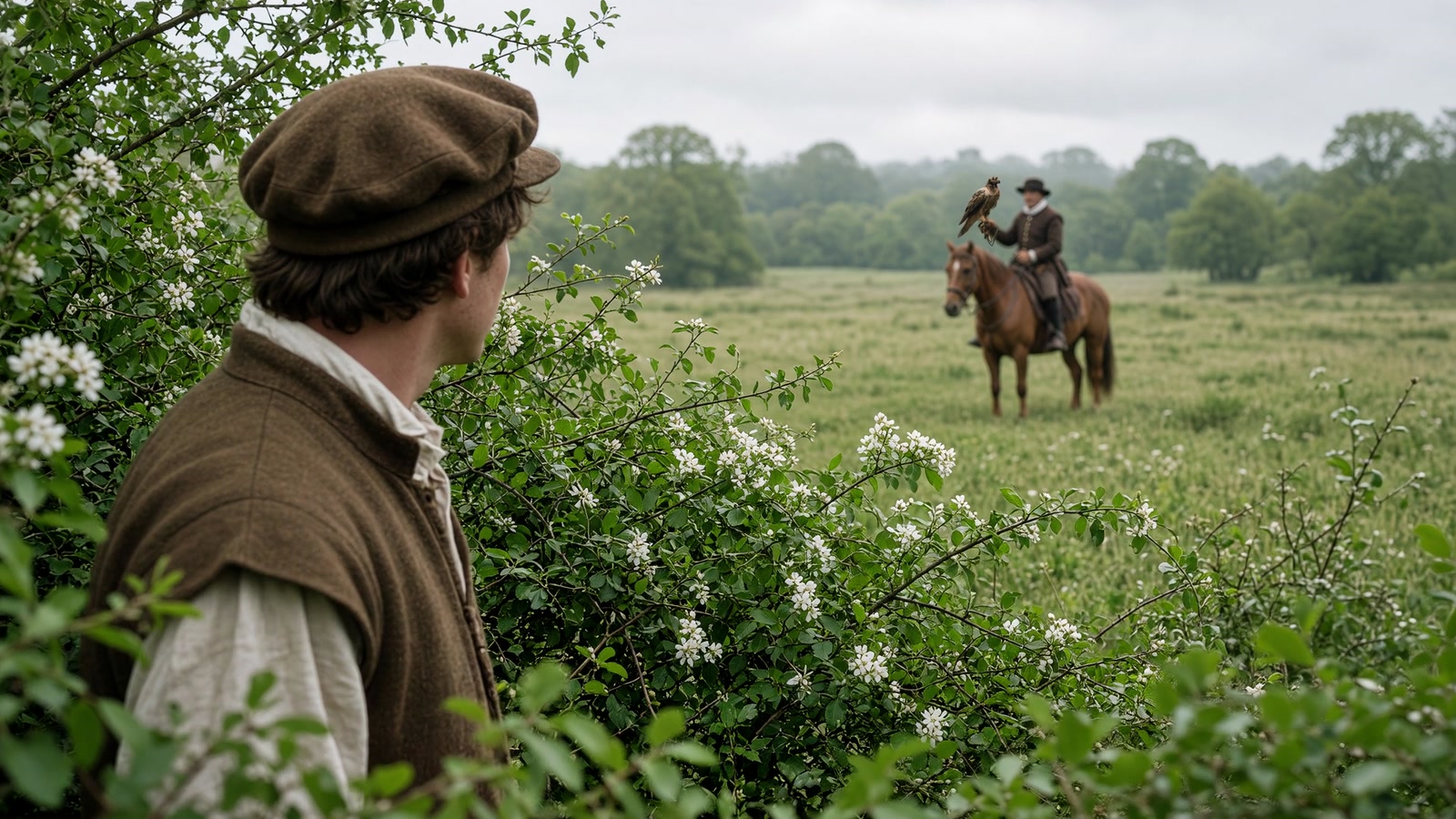
A young man watches from a hedge as a nobleman rides out with a goshawk. AI reconstruction.
The hierarchy of hawks
Hawks carried rank. The Book of Saint Albans, printed in 1486, pairs birds with stations in life: an eagle for an emperor, a gerfalcon for a king, a peregrine for an earl, a goshawk for a yeoman and a sparrowhawk for a priest.
The famous line "a kestrel for a knave" is not in the printed book. It comes from a fifteenth century manuscript, Harley MS 2340 in the British Library. And according to the British Library, the list hardly reflects real practice. In daily life, the quarry and the country decided which bird you flew. Still, your hawk told the world who you were.
The court and the king
Shakespeare wrote for audiences who knew that code, and for patrons near the top of it. His poem Venus and Adonis, from 1593, is dedicated to the Earl of Southampton. In it the goddess kisses "even as an empty eagle, sharp by fast, tires with her beak on feathers, flesh, and bone".
In 1603 King James I took Shakespeare’s company under his patronage as the King’s Men. James praised hunting with hounds above all. Of hawking he wrote in Basilikon Doron (1599): "I condemn it not, but I must praise it more sparingly."
A hawking party on stage
In Henry VI, Part 2, the king and his lords have been hawking at Saint Albans. King Henry admires the Lord Protector’s falcon: "And what a pitch she flew above the rest!" Suffolk sneers that those hawks fly high because "they know their master loves to be aloft". Soon the lords are quarrelling over the crown.
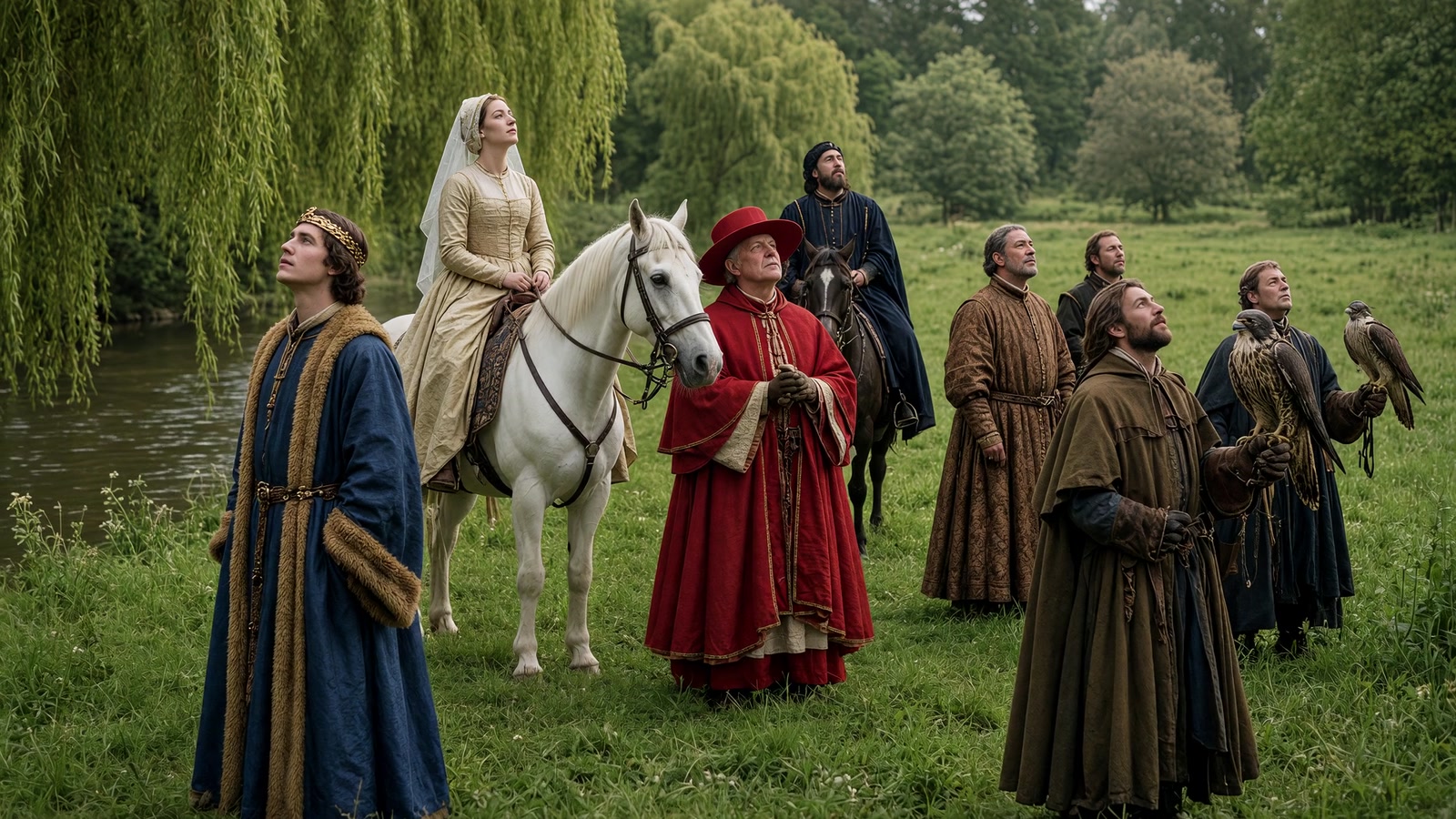
The king and his lords by the river, with falcons on the glove. AI reconstruction.
From Verona to Elsinore
Shakespeare’s falcons fly far beyond England.
In Verona, Juliet calls after Romeo: "O, for a falc’ner’s voice to lure this tassel-gentle back again!" (Romeo and Juliet, 2.2.) A tassel-gentle, or tercel, is a male peregrine. The larger female was simply the falcon. Later Juliet asks night to "hood my unmanned blood, bating in my cheeks" (3.2). An unmanned hawk is not yet used to people. It bates, flapping wildly off the fist, until a hood calms it in the dark.
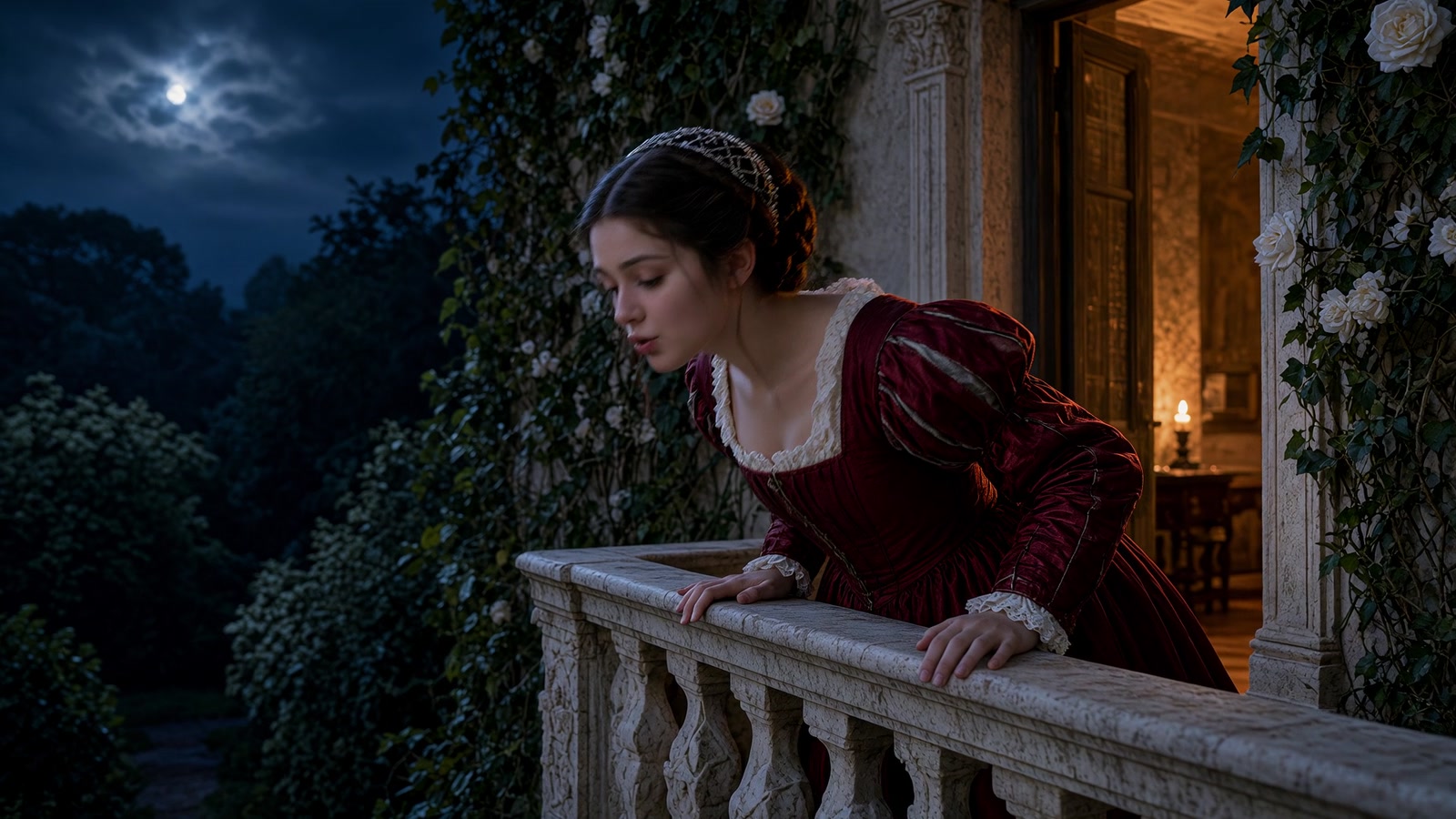
Juliet on her balcony in Verona at night. AI reconstruction.
In Padua, Petruchio speaks of his new wife Katherine as a falcon to be trained: "My falcon now is sharp and passing empty" (The Taming of the Shrew, 4.1). He will "man my haggard" and keep her from sleep. Falconers did keep a new hawk hungry and awake until it accepted them. Turned on a wife, the image is hard to hear today.
On Cyprus, Othello’s jealousy speaks the same language: "If I do prove her haggard, though that her jesses were my dear heartstrings, I’d whistle her off and let her down the wind to prey at fortune" (Othello, 3.3). Jesses are the leather straps on a hawk’s legs. A hawk cast off down the wind was being let go for good.
In Scotland, Macbeth calls on "seeling night" (3.2). To seel was to close a new hawk’s eyes with a fine thread. And when Macduff learns that his family is dead, he cries: "O hell-kite! All? What, all my pretty chickens and their dam at one fell swoop?" (4.3). It is the earliest known use of "swoop" for the strike of a bird of prey.
In Elsinore, Hamlet welcomes the travelling players: "We’ll e’en to’t like French falconers, fly at anything we see" (Hamlet, 2.2). He also says he knows "a hawk from a handsaw". Handsaw may mean a heron, but nobody is certain.
Words from the mews
Falconry did leave marks on English. Haggard first described a wild hawk, before it meant a worn face. A lure was the falconer’s bait on a cord, and allure comes from an Old French word for training a falcon to it. To rouse was first a hawk shaking its feathers.
Other stories do not hold up. Hoodwinked is in Shakespeare, but dictionaries trace it to blindfolding a person. Fed up is first recorded around 1900. Tired comes from an Old English word for weary, not from the falconer’s "tire", when a hawk tears at its food. And wrapped around your little finger seems to come from winding thread, not from jesses.
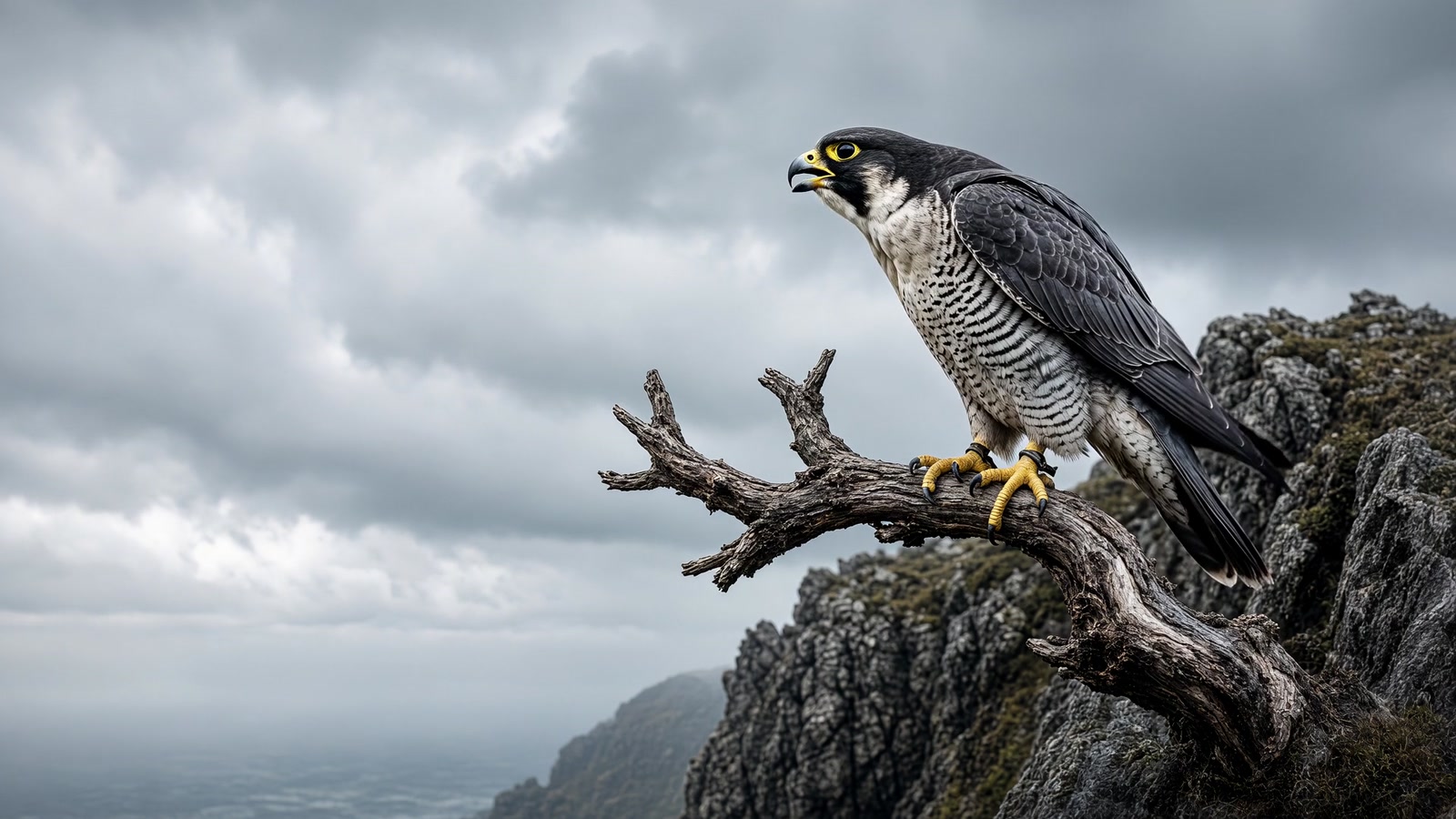
A wild adult peregrine on a branch. This was a haggard. AI reconstruction.
Here at Eagle World
So why so many falcons? Because his audience, from the yard of the Globe to the palace, knew the language of the sport, and one bird could carry rank, power and passion in a single image. Whether he ever flew a hawk himself, we may never know.
Here at Eagle World, Ørnereservatet in Denmark, the old words still fly with our birds. The film is in English, with Danish and German subtitles. The historical scenes are AI reconstructions, clearly marked, and the maps are illustrations. Quotations follow the Folger Shakespeare texts.
Sources for all factual claims are listed below. You are always welcome here at Eagle World.
Watch the film on YouTube: Shakespeare and the Falcons
Sources
Folger Shakespeare, texts and line numbers: https://www.folger.edu/explore/shakespeares-works/
Macbeth 2.4.14-16, 3.2.52-53, 4.3.256-258; Romeo and Juliet 2.2.169-170, 3.2.14-15; Othello 3.3.301-304; The Taming of the Shrew 4.1.190-198; Henry VI, Part 2 1.2.59-60, 2.1.5-6, 2.1.10-11; Hamlet 2.2.403, 2.2.453-454; Venus and Adonis lines 55-56 and the dedication.
Maurice Pope, "Shakespeare’s Falconry", Shakespeare Survey 44, Cambridge University Press, 1991, pp. 131-144: https://www.cambridge.org/core/books/abs/shakespeare-survey/shakespeares-falconry/CCB8A293AD752A8DED5B1FD45DC0F7BE
Dictionary of Irish Biography, Madden, Dodgson Hamilton: https://www.dib.ie/biography/madden-dodgson-hamilton-a5301
The Spectator, 6 November 1897 (review of Madden’s book): https://archive.spectator.co.uk/article/6th-november-1897/3/books
Britannica, William Shakespeare: https://www.britannica.com/biography/William-Shakespeare
Britannica, Globe Theatre: https://www.britannica.com/topic/Globe-Theatre
Britannica, King’s Men: https://www.britannica.com/topic/Kings-Men
Shakespeare Birthplace Trust, New Place: https://www.shakespeare.org.uk/explore-shakespeare/shakespedia/shakespeares-new-place/about-shakespeares-new-place/
James I, Basilikon Doron (1599), in The Political Works of James I: http://www.perseus.tufts.edu/hopper/text?doc=Perseus%3Atext%3A1999.03.0071%3Asection%3D3%3Asubsection%3D6
The Book of Saint Albans (1486), facsimile ed. William Blades, 1881: https://www.gutenberg.org/files/71266/71266-h/71266-h.htm
British Library, A Kestrel for a Knave: https://www.bl.uk/stories/blogs/posts/a-kestrel-for-a-knave
Folger, Birds of Shakespeare: The peregrine falcon: https://www.folger.edu/blogs/shakespeare-and-beyond/birds-of-shakespeare-peregrine-falcon/
Internet Shakespeare Editions, Falconry and hawking: https://internetshakespeare.uvic.ca/Library/SLT/society/husbandry/hawking.html
Online Etymology Dictionary: haggard, lure, allure, rouse, swoop, hoodwink, fed, tire, tercel: https://www.etymonline.com
eagleworld.dk