


The Emperor Who Learned from His Falcons
On Frederick II of Hohenstaufen (1194–1250) and his book "The Art of Hunting with Birds" – told by a falconer
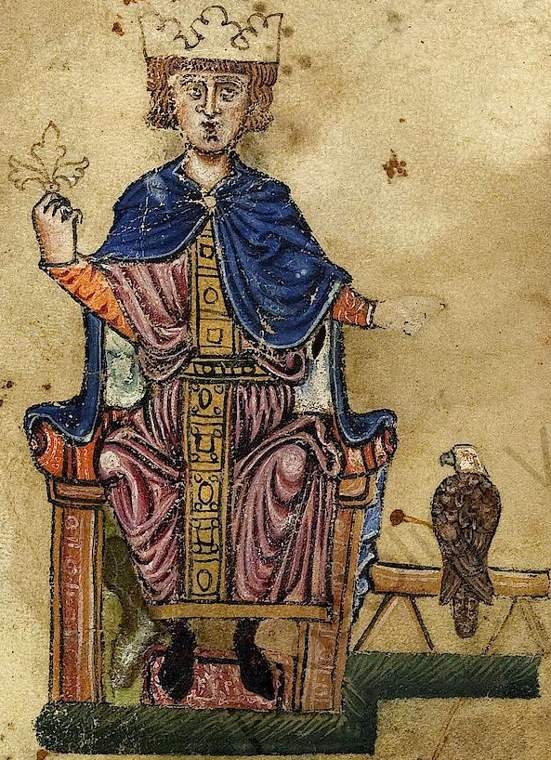
Emperor Frederick II with a falcon. Pal. lat. 1071 (Public Domain, Wikimedia Commons)
When I stand with a falcon on my glove early in the morning, I often think about how old this art is. One man has meant more than most to the way we understand birds of prey in Europe. He was an emperor, a king and a warlord. But his great passion was the bird on his fist.
His name was Frederick II of Hohenstaufen. Some 800 years ago he wrote a book on falconry that falconers and ornithologists still read today. In this article we tell the story of the man, of the book, and of what we as falconers today recognise in his advice.
An emperor from Sicily
Frederick was born on 26 December 1194 in Jesi in Italy. His father was the Holy Roman Emperor Henry VI, and his mother was Constance of Sicily. Both parents died while he was a child, and he grew up in Sicily, in and around Palermo.
At that time Sicily was a meeting place of cultures. Latin, Greek, Jewish and Arab traditions lived side by side. It shaped him for the rest of his life. According to tradition he spoke several languages, possibly including Arabic, and he was curious about everything from mathematics to the lives of animals.
He became king of Sicily, king of Germany and, in 1220, was crowned emperor in Rome. Later he also became king of Jerusalem. His contemporaries called him stupor mundi, "the wonder of the world". The phrase is often attributed to the English chronicler Matthew Paris.
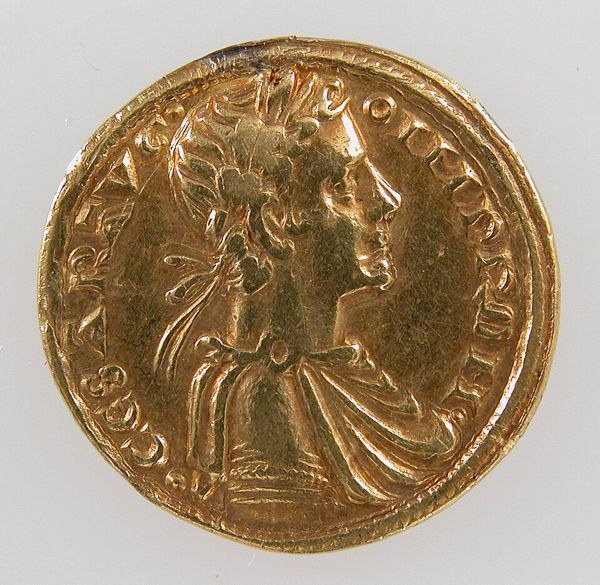
Frederick's gold coin, an augustalis, struck in his Kingdom of Sicily. Metropolitan Museum of Art (CC0, Wikimedia Commons)
Conflict with the pope
Frederick's life was full of conflict, above all with the papacy. Pope and emperor fought for power in Italy, and Frederick was excommunicated several times: first in 1227, because he had postponed a promised crusade, and again in 1239. At the Council of Lyon in 1245, Pope Innocent IV declared him deposed, accusing him of, among other things, perjury and suspected heresy. Frederick never accepted the verdict and fought on until his death.
He died on 13 December 1250 at Castel Fiorentino in Apulia and was buried in Palermo Cathedral.
The crusade and the meeting with Arab falconers
In 1228 Frederick finally set out on crusade, while still excommunicated. It became an unusual crusade. Instead of great battles, he negotiated with Sultan al-Kamil of Egypt. In 1229, through an agreement, the Treaty of Jaffa, he returned Jerusalem to Christian hands, and he crowned himself king of Jerusalem.
For us falconers the crusade matters for another reason. This is where the emperor encountered Arab falconry. He tells us so himself in his book:
The Arabs used the hood before any other people we know. We saw it with our own eyes when we crossed the sea: the Arabs used the hood in this art. The kings of the Arabs sent us their most skilled falconers, and we also summoned experienced men from Arabia and from many other lands. We learned from them what they knew best.
— Book 2, chapters 77 and 78 (our translation)
Frederick also sought knowledge from scholars beyond Europe. He sent letters with questions on natural science, mathematics and philosophy to the learned men of his time, including in the Islamic world, and his court gathered scholars such as the Scottish polymath Michael Scot.
A life with birds
Frederick's court moved around a great deal, and the falcons travelled with it. He kept falconers from many lands at his court and spent large sums gathering knowledge. In the preface to his book he writes that he never gave up the work, even though he was often bound by "heavy and almost insoluble tasks in governing our kingdoms and the empire".
In Apulia, in southern Italy, he had Castel del Monte built in the 13th century. The octagonal castle is now on UNESCO's World Heritage List, which highlights its mathematically precise plan and its blend of classical, Islamic and northern European Gothic elements. The castle has often been linked with the emperor's hunting, but its real purpose is not known for certain.
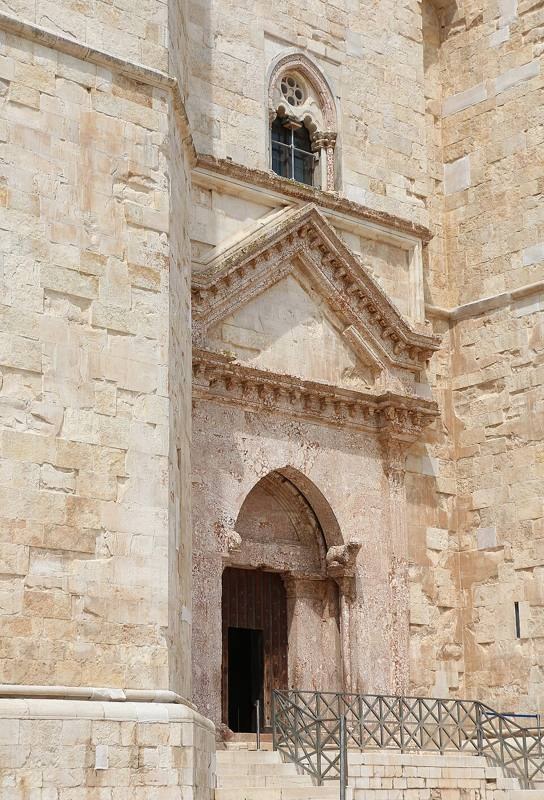
The entrance portal of Castel del Monte in Apulia (photo: Bernard Gagnon, CC0, Wikimedia Commons)
The book: De arte venandi cum avibus
Frederick's great work is called De arte venandi cum avibus, "On the art of hunting with birds". He worked on it for many years, and it is considered to have been written in the 1240s. The exact date is uncertain.
The book is far more than a hunting manual. It describes the bodies of birds, their feathers, moult, migration and way of life. Only then does it turn to falconry itself: how a wild falcon becomes a hunting partner, and how it is flown at different quarry.
The full version consists of six books:
- Book 1: birds in general, their bodies, food and migration
- Book 2: birds of prey, the qualities of the falconer and the work of winning the bird's trust, including the hood
- Book 3: the lure and other equipment
- Book 4: hunting cranes with the gyrfalcon
- Book 5: hunting herons with the saker falcon
- Book 6: hunting waterfowl with the peregrine falcon
"See for yourself" – the emperor and Aristotle
The most remarkable thing about the book is its tone. In the Middle Ages, Aristotle was the great authority on animals. Frederick respected him, but he was not afraid to contradict him. He drily points out that Aristotle often repeats what "some say":
But what they have said he may not have seen for himself, and those who said it did not see it either.
Our aim is to show things as they are.
— Preface to Book 1 (our translation)
He did not stop at words. He carried out experiments. Many believed that vultures found carrion by smell. The emperor wanted to see for himself:
With their eyes closed, they did not notice the meat we threw in front of them – though nothing blocked their nostrils.
— Book 1, chapter 10 (our translation)
He concluded that the vultures found their food by sight. Later research has shown that the picture is more mixed, since some American vultures do in fact have a keen sense of smell. But the method is what matters: a question, a test and a result. That is why the book is often regarded as an early example of observational natural science.
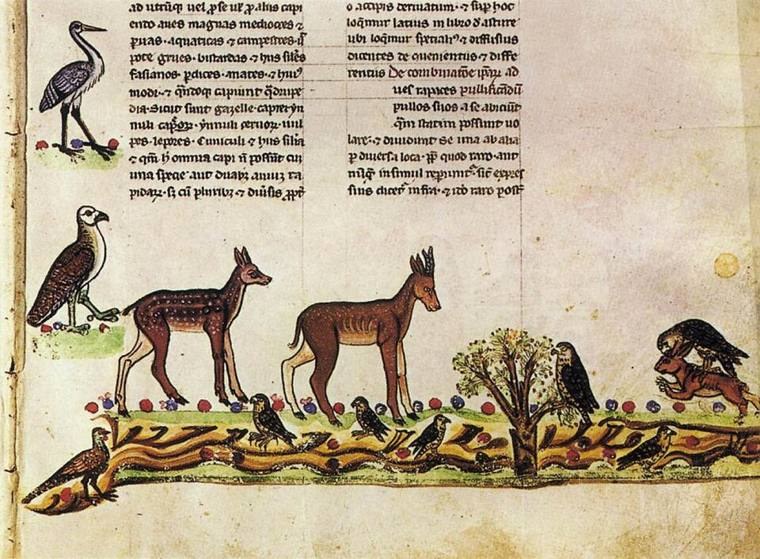
Margin with birds and deer. Pal. lat. 1071 (Public Domain, Wikimedia Commons)
The gyrfalcon – the noblest falcon
For Frederick, the gyrfalcon was the king of falcons. Here we meet a link to the Nordic countries:
Gyrfalcons are larger, stronger, bolder and swifter than all other falcons. That is why we speak of them first, as the most worthy. […] Some nest on an island in the northern sea between Norway and Greenland, which in German is called Island, that is, the land of ice. They are the best of all.
— Book 2 (our translation)
In the Middle Ages, Nordic falcons were among the most coveted gifts between princes, and the pale birds from Iceland and Greenland were especially prized. That gives us in Denmark a special reason to take an interest in the emperor's book. Greenland and Iceland were then part of the Nordic world from which the falcons were traded.
The gyrfalcon is still the largest falcon in the world. Wild gyrfalcons are protected today, and falconers use captive-bred birds.
The hood – a gift from the Arabs
The hood is one of the clearest examples of what the emperor learned from the Arabs. Before it became common in Europe, falconers temporarily sewed the bird's eyelids shut to keep it calm. Frederick describes the old method, but he himself preferred the hood. He writes that falconers "here on this side of the sea have since taken it over from us", and that this "deserves not to be forgotten by posterity".
He was right. The hood is today one of the falconer's most important tools, and it has made working with the birds far gentler.
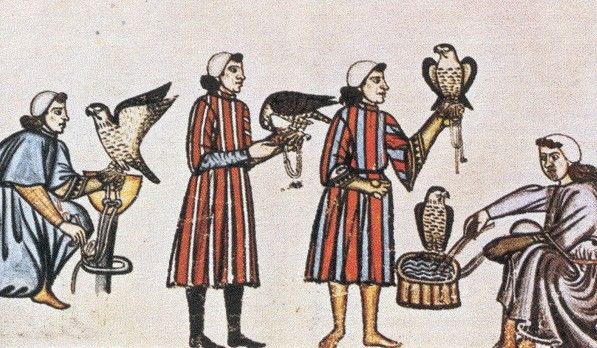
Falconers with falcons, perches and a bath. Pal. lat. 1071 (Public Domain, Wikimedia Commons)
King Manfred's manuscript – and the book lost at Parma
The emperor's own copy of the book has been lost. During the siege of Parma, the emperor built a wooden camp which he named Vittoria (victory). On 18 February 1248, while he himself was out hunting, the camp was stormed, plundered and burned. It is believed that a precious illustrated copy of the falcon book was lost on that occasion. Some years later, in 1264–65, a merchant from Milan offered Charles of Anjou two large volumes about dogs and falcons that had belonged to Frederick. Whether this was his own copy of the falcon book is not known.
The most famous manuscript we have today is Pal. lat. 1071 in the Biblioteca Apostolica Vaticana. It was made for Frederick's son, King Manfred, who was king of Sicily from 1258 to 1266, and is therefore usually dated to those years. It contains only the first two books, but it is filled with hundreds of bird pictures in the margins. Manfred himself added notes, marked for example "Rex" or "addidit Rex" ("added by the king"). The pictures in this article come from that manuscript. It has been digitised and can be viewed freely online at both the Vatican Library and Heidelberg University Library.
The full text in six books is known from a 13th-century manuscript in the University Library of Bologna. The other six-book manuscripts, including those in Paris, Nantes, Valencia, Rennes and Oxford, are copies of it.
The printed editions: 1596 and 1788
The book was first printed in Augsburg in 1596, edited by Marcus Welser (in Danish often Velser). That edition contains the two-book version with King Manfred's additions. In 1788–1789 the naturalist J.G. Schneider republished the text in Leipzig with a commentary. Schneider's edition is the one we used when we translated selected passages into Danish ourselves.
The book was translated into French as early as around 1300. The first English translation of the complete work appeared in 1943. Our excerpts are our own translation directly from the Latin. You can read them on our page with excerpts from the falcon book: Excerpts from the falcon book (in Danish)
What does Frederick mean today?
For ornithology, the book is one of the earliest works in which birds are described from first-hand observation. The emperor describes the birds' migration, moult and anatomy with an accuracy that was rare in his time.
For falconry, he is one of the great founding fathers of the art. Many of his terms and tools are still in use, and his book is read by falconers all over the world.
In 2010 falconry was inscribed on UNESCO's Representative List of the Intangible Cultural Heritage of Humanity, as "a living human heritage". The inscription has since been extended in 2012, 2016 and most recently in 2021, when 24 countries were behind it, including Germany, Austria, Belgium, the Netherlands, Poland, France and Italy. Denmark is not on the list. UNESCO stresses that the art is passed on from master to apprentice and that it rests on respect for the birds and for nature. Frederick would probably have nodded in recognition.
What we as falconers recognise in his advice
When I read the emperor's book, I am struck by how little has changed in the relationship between human and bird. He understood that a bird of prey cannot be forced:
A bird that flies through the air cannot be taken by force – only by skill.
— Book 1, chapter 1 (our translation)
He knew that trust is built through food, calm and repetition. First the bird must eat willingly on the fist in a quiet room, and only then, little by little, should it get used to people, sounds and dogs. That is still how we work, only without sewing the eyes shut.
And then there is his portrait of the good falconer. It fits all of us:
He must not be hot-tempered. The bird often does things that may make him angry, and a man who acts in anger will easily ruin it, for the bird is a fragile creature.
— Book 2, chapter 47 (our translation)
He also writes that the falconer should stay with the art all his life, because "the art is long, and something new keeps turning up". Every falconer can sign up to that. At our flight displays here at Ørnereservatet, we try to pass on the same respect for the birds to our visitors.
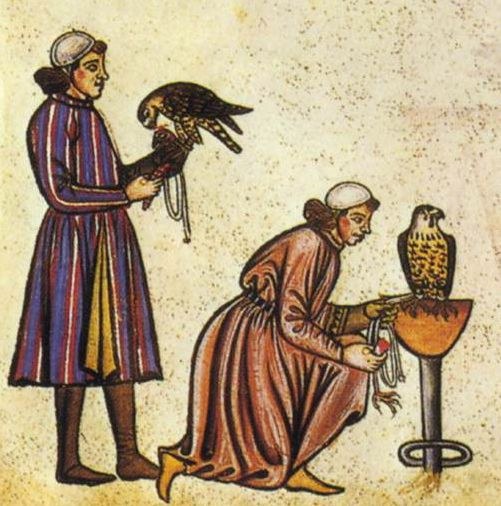
Two falconers. Pal. lat. 1071 (Public Domain, Wikimedia Commons)
Sources
Frederick's text and manuscripts
- Biblioteca Apostolica Vaticana, Pal. lat. 1071 (digitised): https://digi.vatlib.it/view/MSS_Pal.lat.1071
- Universitätsbibliothek Heidelberg, Bibliotheca Palatina digital, Pal. lat. 1071: https://digi.ub.uni-heidelberg.de/diglit/bav_pal_lat_1071
- J.G. Schneider (ed.), Reliqua librorum Friderici II. Imperatoris De arte venandi cum avibus, Leipzig 1788, vol. 1: https://archive.org/details/ReliquaLibrorumFridericiIIVol1
The quotations are our own translation from the Latin of Schneider's edition, slightly abridged.
On Frederick II and the book
- Encyclopaedia Britannica, "Frederick II, Holy Roman emperor": https://www.britannica.com/biography/Frederick-II-Holy-Roman-emperor
- Encyclopaedia Britannica, "falconry": https://www.britannica.com/sports/falconry
- UNESCO World Heritage, "Castel del Monte": https://whc.unesco.org/en/list/398
- Wikipedia, "De arte venandi cum avibus" (manuscripts, editions, Parma): https://en.wikipedia.org/wiki/De_arte_venandi_cum_avibus
- Wikipedia, "Siege of Parma" (1247–1248): https://en.wikipedia.org/wiki/Battle_of_Parma
- Wikipedia, "Frederick II, Holy Roman Emperor" (excommunications, the court): https://en.wikipedia.org/wiki/Frederick_II,_Holy_Roman_Emperor
Falconry as cultural heritage
- UNESCO, "Falconry, a living human heritage" (2021): https://ich.unesco.org/en/RL/falconry-a-living-human-heritage-01708
Images (Wikimedia Commons)
- Emperor Frederick II with a falcon, Pal. lat. 1071 (Public Domain): https://commons.wikimedia.org/wiki/File:Frederick_II_and_eagle.jpg
- Augustalis, gold coin, Metropolitan Museum of Art (CC0): https://commons.wikimedia.org/wiki/File:%E2%80%9CAugustalis%E2%80%9D_of_Frederick_II_Hohenstaufen_%28r._1215%E2%80%9350%29_MET_sf67-265-26s1.jpg
- Castel del Monte, photo Bernard Gagnon (CC0): https://commons.wikimedia.org/wiki/File:Castel_del_Monte,_Italy_04.jpg
- Margin with birds and deer, Pal. lat. 1071 (Public Domain): https://commons.wikimedia.org/wiki/File:Falconry_Book_of_Frederick_II_1240s_Deer_and_Birds.jpg
- Falconers with falcons and a bath, Pal. lat. 1071 (Public Domain): https://commons.wikimedia.org/wiki/File:De_arte_venandi_cum_avibus3.jpg
- Two falconers, Pal. lat. 1071 (Public Domain): https://commons.wikimedia.org/wiki/File:Falconry_Book_of_Frederick_II_1240s_detail_falconers.jpg


