


The Falcon Hood – a Craft Made for One Particular Bird
According to The Archives of Falconry in the USA, no single object symbolises falconry like the small leather hood on a falcon's head.1 It looks simple, but it is one of the finest crafts in falconry, because a good hood is not a size you buy off the shelf. The Danish Falconry Club (Dansk Falkejagt Klub) puts it this way: every falcon has its own hood, which fits only that bird. No two birds and no two hoods are ever exactly alike.2
This is the story of the hood: from the first Arab falconers, through emperors, kings and Dutch hood makers, to today's workshops. It is also the story of why every single hood has to be fitted to the bird that will wear it.
Contents
- Why does the falcon calm down?
- From the Middle East to Europe
- The first "working drawing": Frederick's rules for a hood
- Hoods in the ground – what excavations tell us
- Middle Ages and Renaissance: the hood becomes a work of art
- Valkenswaard: the village of hood makers
- Hoods of the East: Arab, Persian, Indian
- The eagle's hood: the Kazakh tomaga
- Many traditions, many materials
- Anglo-Indian and American: the hood reinvented
- The craft: how a hood is made for one particular bird
- The hood today
- The hood at the Eagle Reserve
- Notes
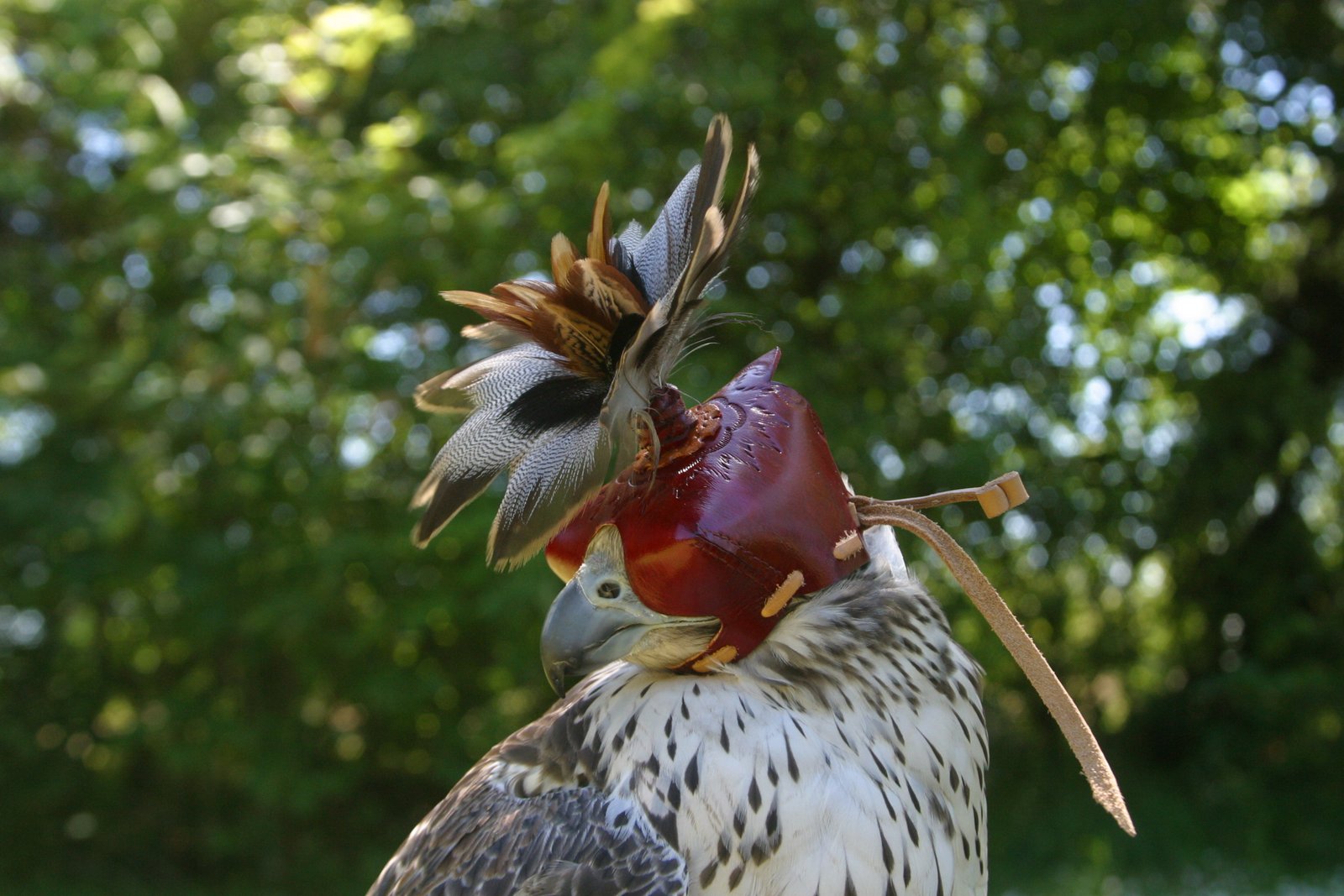
A large female gyrfalcon wearing the hood Ivan sits completely calm. The hood is shaped so that it does not touch the eyes, and the beak is free.
Why does the falcon calm down?
Birds of prey rely almost entirely on their eyesight. A well-fitting hood can therefore spare the bird stress in unfamiliar surroundings, writes the Danish Falconry Club.2 What the bird cannot see, it does not react to. According to Encyclopaedia Britannica, falcons in particular are accustomed to the hood from the very start of training. Without a hood, a falcon keeps seeing things it wants to chase and wastes energy trying to leave the glove.3
Quote
"Hood my unmanned blood, bating in my cheeks,
With thy black mantle till strange love grow bold"Juliet asks the night to act like a hood. "Unmanned" (untamed) and "bating" (a hawk flinging itself off the fist) are falconry terms.
— Juliet in Shakespeare's Romeo and Juliet (c. 1597), act 3, scene 2.4
The effect has also been measured. In an American study, eight red-tailed hawks were handled for 15 minutes, both with and without a hood. Hooded, the birds had significantly lower heart and breathing rates.5 A hood does not remove all stress, however. An older study of red-shouldered hawks found that heart rates still rose when hooded birds were handled.6 The hood is an aid, not an excuse for rough handling. That is why the British organisation The Hawk Board recommends that hoods are not left on for long periods.7
For the bird, the hood is also a signal: when it comes off, it is time to fly.8
From the Middle East to Europe
According to UNESCO, falconry has been practised for more than 4,000 years.9 Where it began is debated. In 1943, the historian Hans J. Epstein linked it to the early civilisations of the Middle East. More recent research also points to the Asian steppes and suggests falconry may have arisen in several places.1011
On the hood, the sources agree more: it came to Europe from the Arab world. The key source is Emperor Frederick II (1194–1250) and his great work on falconry, De arte venandi cum avibus ("On the art of hunting with birds"). Frederick writes that "the falcon's hood is a discovery of Oriental peoples, the Arabs having, so far as we know, first introduced it into active practice", and that he saw it in use "when we sailed across the seas", probably during his crusade of 1228–1229.12 Arab chiefs sent him falcons and "falconers expert in the use of the hood". He adopted the method, "so that our contemporaries have learned its use from us" (Wood and Fyfe's 1943 English translation).13 A magnificently illustrated manuscript of the work has been digitised by the Vatican Library.14
That is why Frederick is often credited with introducing the hood to Europe, for example by the German falconers' association Orden Deutscher Falkoniere.15 Harting even writes that before the Crusades the hood was unknown to European falconers, and that Frederick adopted it "from the Syrian Arabs".16
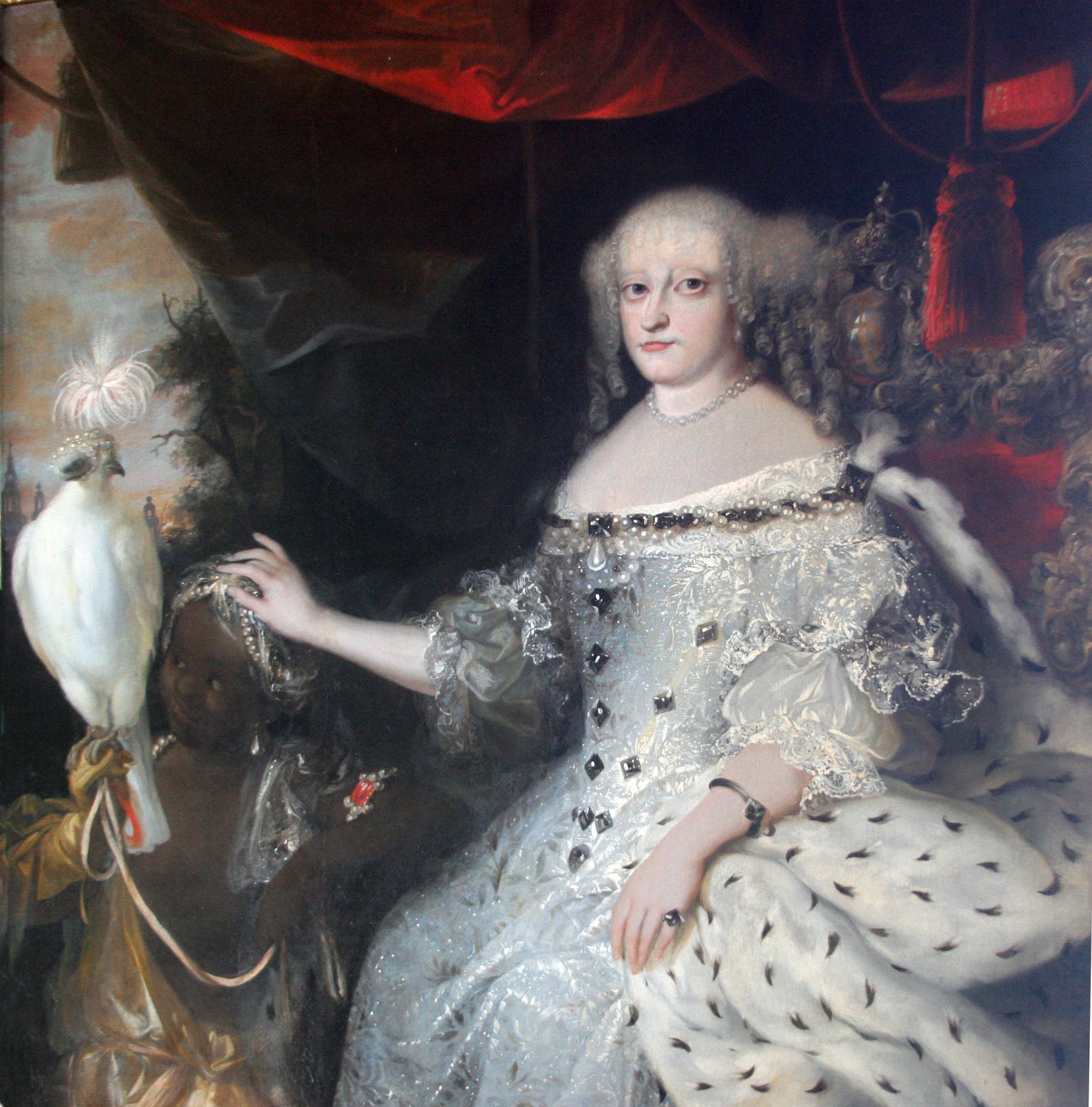
Historical painting of royals and nobles with gyrfalcons in fine, costly hoods, here set with pearls. Portrait of Queen Sophie Amalie by Abraham Wuchters, 1667. Museum of National History, Frederiksborg Castle.
The first "working drawing": Frederick's rules for a hood
Frederick also described how a hood should be made, and his description still reads almost like a working drawing for hood makers (after Wood and Fyfe):13
- The hood is of leather and encloses the head down to the throat. Only the beak and nostrils protrude.
- The leather should be "neither too hard nor too soft".
- The hood "must in every respect conform to the shape and size of the falcon's head".
- It must be wider over the crown and eyes, so it does not press on the eyes, and narrower at the throat, so it stays on.
- The falcon must see nothing, but be able to breathe freely.
Frederick himself added small ventilation holes in the crown. He had noticed that the falcon's head overheated under the hood and was then chilled when the hood came off.13
So some 800 years ago, the core idea was the same as today: the hood is made to fit the bird, not the other way round.
Hoods in the ground – what excavations tell us
In the Nordic countries, falconry is much older than the hood. In Swedish high-status graves from the 6th century onwards, for example at Gamla Uppsala, Vendel, Valsgärde and Rickeby, archaeologists have found bones of goshawks, sparrowhawks and peregrine falcons, often together with horses, dogs and prey such as cranes.1718 In the Gokstad mound in Norway, where a man was buried around the year 910, two goshawks lay among the grave goods. It is the first certain find of birds of prey in a Norwegian Iron Age grave.19
As far as we know, no hood has been found from the Viking Age. That fits the written sources, according to which the hood only reached Europe in the 13th century.16 Leather rarely survives in the ground, so the oldest excavated hoods are few and late. One of the clearest finds is a simple hood of thin, soft calf leather from the 14th century, excavated in 2006 at the Palace of the Grand Dukes of Lithuania in Vilnius.20 From medieval Russia, leather straps have been found together with the leg bones of birds. Researchers debate whether they are falconers' jesses or amulets.21
Middle Ages and Renaissance: the hood becomes a work of art
At the falconries of Europe's courts, the hood became a status symbol. The Victoria and Albert Museum in London holds an English hood from the early 17th century in gold-tooled leather with silk velvet and silver embroidery. The plume on top is both decoration and a handle for removing the hood.22 The Metropolitan Museum of Art in New York has a 17th-century European hood of leather and felt.23
Quote
"'Tis a hooded valor, and when it appears, it will bate."
The French Constable mocks a man's courage: like a hooded falcon it stays hidden, and when unhooded it only bates instead of flying.
— Shakespeare, Henry V (c. 1599), act 3, scene 7.24
Falconers distinguished between two kinds of hood. One was a plain, easy leather hood without a plume. It opened wide at the back, the bird could feed through it, and it was used while a newly caught bird was being tamed. Once the bird was trained, it received the "hood proper" with its plume.16 The hood was called chaperon in French, huif in Dutch and Haube in German.16
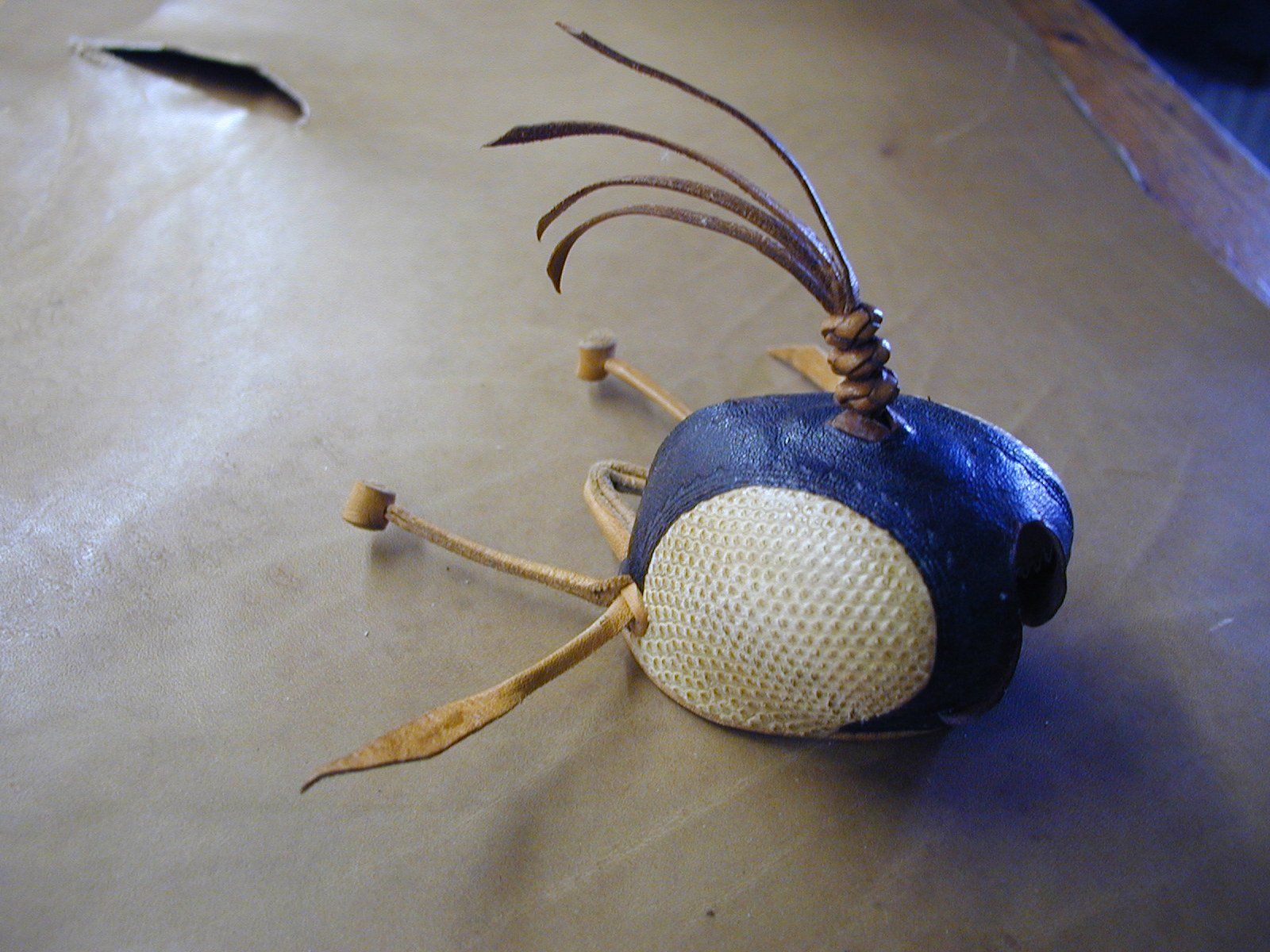
The plume on top is both decoration and a handle, letting the falconer remove the hood with one hand.
Valkenswaard: the village of hood makers
From the 16th century onwards, the heathlands of Holland and Brabant were Europe's centre for trapping and training hunting falcons. The heaths lay on the peregrine's migration route, and the village of Valkenswaard in particular sent falconers to princely courts all over Europe. According to the local falconry museum, Dutch falconers made their own equipment: hoods (huiven), bells, straps and jesses.25
There is a Danish connection too. According to the Falconry Heritage Trust, the Danish kings' gift falcons were carried to the courts of Europe on perches and wearing hoods, accompanied by Danish or Dutch falconers. Between 1731 and 1793 alone, the same source says, 4,600 Danish "presents" were dispatched.26
The Mollen family became synonymous with the Dutch hood. Adriaan Mollen (1816–1895) was head falconer to the King of the Netherlands. His son Karel Mollen (1854–1935) was a falcon trapper and trainer, well known for his bells and hoods.2627 According to The Archives of Falconry, the Mollen Dutch hood was still the standard in America in the 1920s and 30s. The supply ended with Karel Mollen's death.1
The Dutch hood is stitched from three pieces of leather, moulded over a block of wood or metal and closed at the back by two braces. It holds its shape and leaves room around the eyes. According to The Archives of Falconry, however, the classic Dutch hoods were heavy and had a rigid, rectangular beak opening through which a falcon often could not cast.1
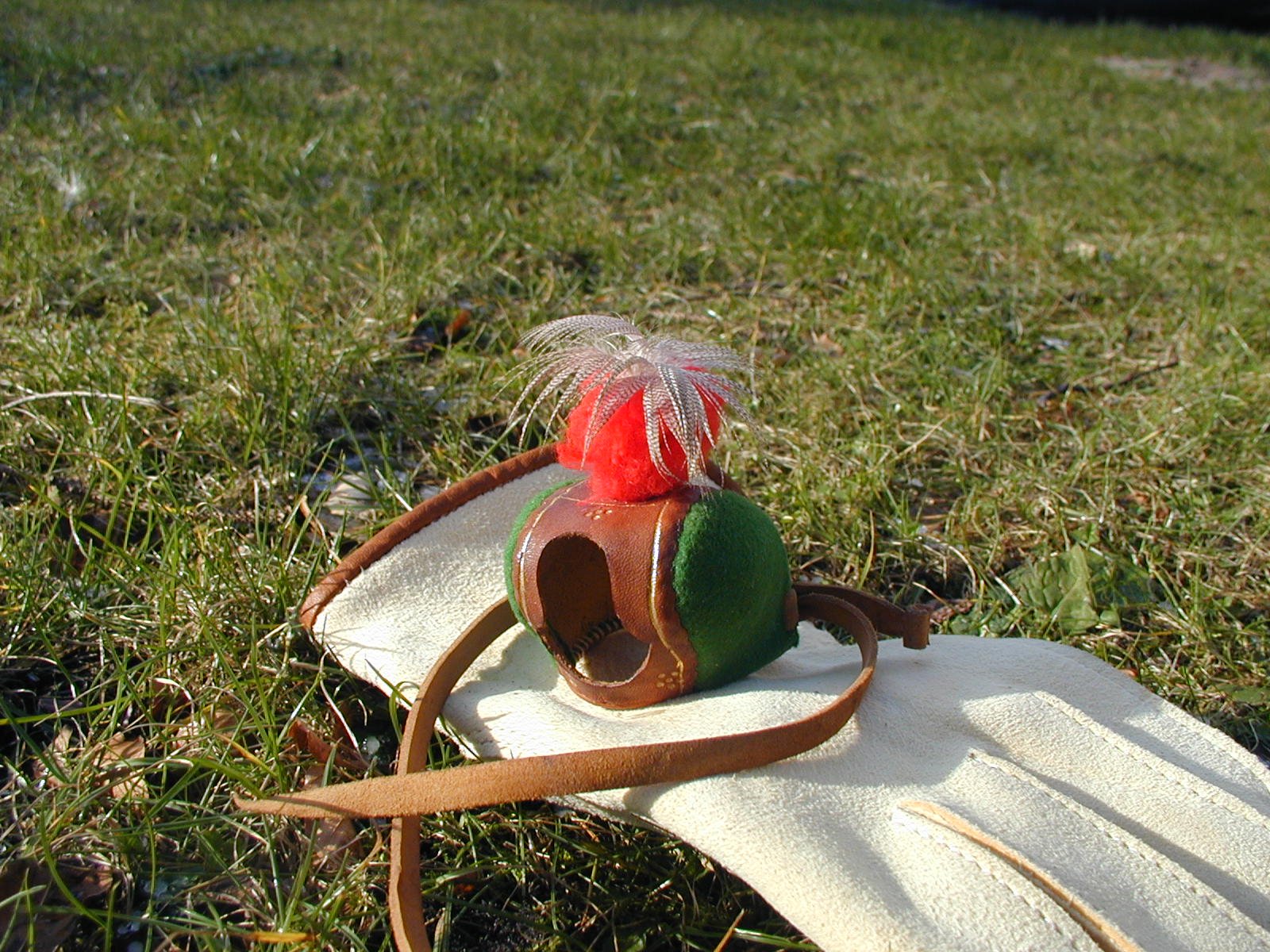
A Dutch-type hood with braces and top-knot. It gets its shape from a hood block.
Hoods of the East: Arab, Persian, Indian
In Arabic the hood is called burqa (also spelled burga).828 The National Museum of Qatar holds a 19th-century Arab hood. The museum calls the hood the most important piece of the falconer's equipment and stresses that it must fit the falcon comfortably, or the bird will reject it outright and training becomes very difficult. It is cut from a single piece of soft leather to an exact pattern, and when the braces are pulled, the back gathers into pleats.28 This pleated back is often called an accordion back.
In the Persian falconry treatise Bāz-nāma-yi Nāṣirī (1868), translated into English by D. C. Phillott in 1908, the translator notes that the Persian hood, "unlike the Indian", is opened and loosened by straps at the back. He adds that in a good Indian hood a hawk can, with a little difficulty, both eat and cast, but in the Persian hood it cannot open its beak wide enough to cast.29 The Persian text even has its own word for a hood-shy hawk: bad-kulāh.29
Japan. According to The Archives of Falconry, Japanese falconers used a hood resembling a paper bag for centuries.1 (Not verified in Japanese sources.)

The Arab hood, the burqa, is cut from a single piece of soft leather and gathered into pleats at the back.
The eagle's hood: the Kazakh tomaga
Among the Kazakh eagle hunters of Mongolia and Kazakhstan, the hood is called tomaga. According to a 2005 report in Saudi Aramco World, it is "the most emblematic" item of the eagle hunter's gear. It is put on the eagle as soon as it is caught, and it is cut by pattern from a single piece of cowhide and "modified to fit the head of each individual bird, so it does not leak light and cannot be shaken off".30 A tomaga in a Kazakh museum is described as helmet-shaped, with a protrusion for the beak and a cord at the throat.31 The eagle rides blindfolded on the arm and only gets its sight back when it is time to scan for prey.32
Many traditions, many materials
Facts
There are different traditions for how hoods are made: in Asia, for example in Pakistan and Mongolia, where hoods are used for the golden eagle; in Arabia, for falcons; and in Europe. The traditions differ a little, in practical matters, in use and in materials. The materials range from soft leather to snakeskin, kangaroo and deer skin and much more – the possibilities are countless.
Anglo-Indian and American: the hood reinvented
In the 19th and 20th centuries, British falconers combined the Indian cut with Dutch braces, creating the Anglo-Indian hood. It is made from one piece without a block and is lighter and simpler. The broad chin opening lets the bird eat and cast while hooded.133 The Danish Falconry Club recommends the Anglo-Indian hood as the type a falconer can start sewing from a pattern.2
When the supply of Dutch hoods stopped in the 1930s, American falconers began to experiment. According to The Archives of Falconry, the German Otto Kals and the French saddler Henri Ondet became models. American hood makers later developed light, moulded hoods, and Gene Johnson was the first in the US to combine the Arab accordion back with a three-piece Dutch hood.1 Today many hood makers carve their own blocks, and some, such as Steve Tait, use 3D scanning of raptor skulls and CNC milling.1
The craft: how a hood is made for one particular bird
This is where the hood maker's art truly shows. A hood must fit to the millimetre.
1. Measuring. The hood maker needs the bird's species, sex and flying weight, and ideally a head measurement, often taken across the top of the head just behind the eyes.34 Heads vary even within a species, and in birds of prey the female is usually larger than the male. A hood maker therefore keeps a block for each species and size.234
2. The block. The block is a model of the bird's head in wood (or today also milled plastic or metal). The damp leather is moulded over it so that the hood gets room around the eyes and a domed crown.12
3. Leather and stitching. Thin, firm leather such as calfskin or kangaroo is used, stitched with waxed thread. Smooth leather around the face can be cleaned if the bird eats while hooded.35
4. The beak opening. The hardest part is the beak opening. According to the Danish Falconry Club, the final fitting is done by the falconer. You can only cut and file a little at a time. If the opening becomes too large and lets light in, the hood is ruined for that bird.2 The hood must never cover the nostrils or the gape, and a badly fitted hood can cause pressure sores on the cere, the soft skin at the base of the beak.2
Quote
"Now I shew her the hoode, which my care hath before-hand prouided, and made very large, I thinke somewhat larger then is usuall, but much larger at the top of the beake then I euer saw vsed. My hoode made fit and easie …"
— Edmund Bert, An Approved Treatise of Hawkes and Hawking (London 1619), p. 15.36
5. Testing. The bird should settle down when hooded. If a falcon turns its head from side to side, "watching for passing trains", the hood is too big and lets in light. If it scratches at the hood a lot, it may not have accepted it.2 When a perfect hood comes off, the feathers on the head lie smooth and unmarked.35 That is why the club recommends having two hoods ready for a new falcon: one will probably fit better than the other.2
Quote
"… some would giue fiue pounds, and some other would giue ten pounds that their hawke would hoode well. […] At length I thoght of feeding a hawke through the hoode, cutting the hole for her beake very wide, it is but the marring of a hoode."
— Edmund Bert (1619), pp. 43–44.36
It is no wonder that the best hoods are regarded as small works of art. According to the Danish Falconry Club, the world's best hood makers compete to make the most beautiful hoods with specially chosen feathers, and the waiting lists are often long.2
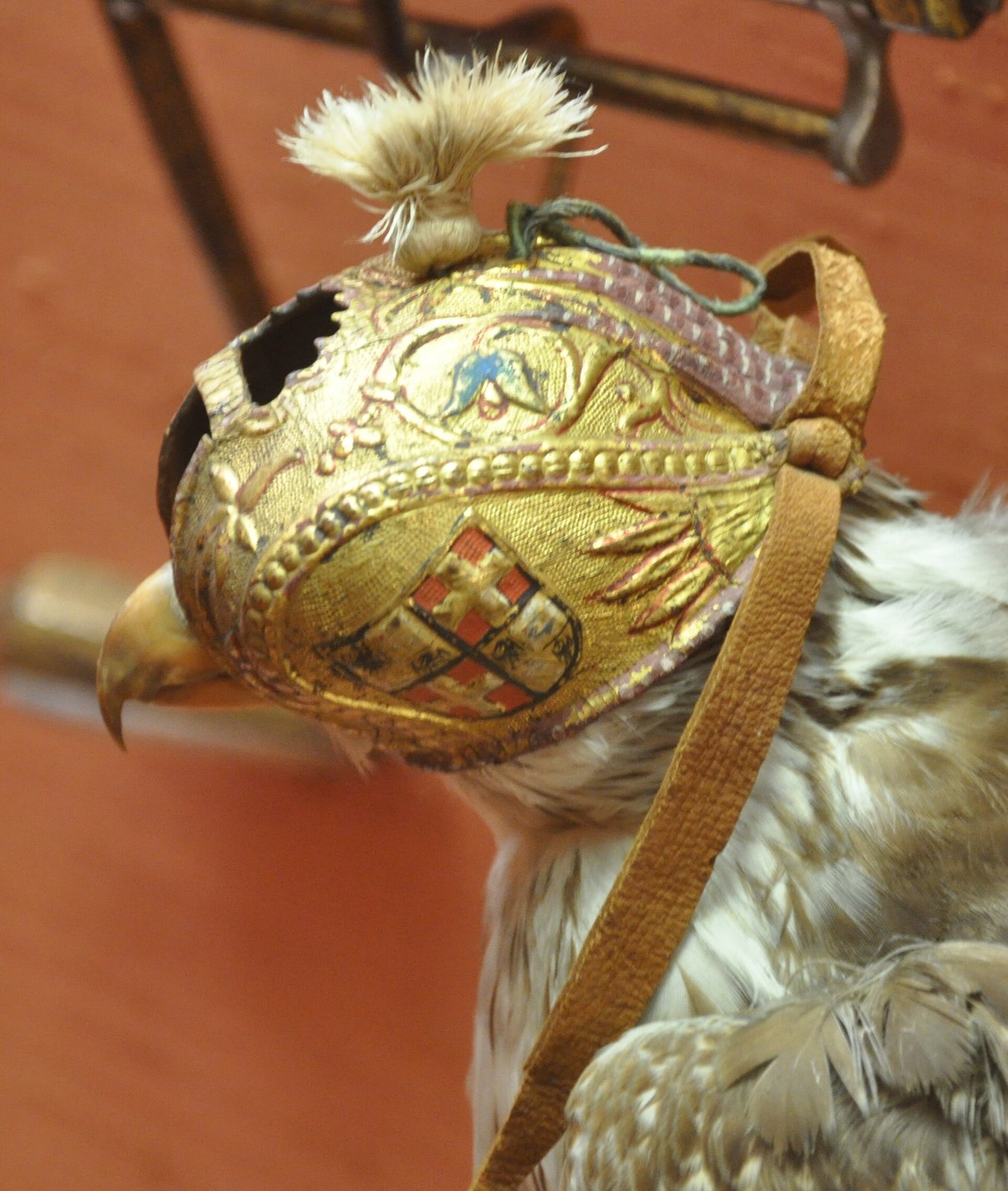
Gilded falcon hood from the falconry of Emperor Maximilian I or Bianca Sforza, northern Italy, 1494–1508. Kunsthistorisches Museum Vienna, Hofjagd- und Rüstkammer (inv. D 48). Photo: Andreas Praefcke, Wikimedia Commons (public domain).
The hood today
In 2010 falconry was inscribed on UNESCO's list of the Intangible Cultural Heritage of Humanity, and after an extension in 2021 the inscription covers 24 countries.937 UNESCO counts the traditional equipment makers as part of the falconry community.9 The hood is perhaps the clearest example of this living tradition: the technique goes back to Frederick II, yet hoods are still made by hand, one bird at a time.
Today the hood is used above all during transport, in busy surroundings and when hunting "out of the hood", when the falconer removes the hood and the falcon flies straight from the glove at its quarry.38 According to the Danish Falconry Club, hoods can also protect birds from stress during transport, as an alternative to dark transport boxes.2
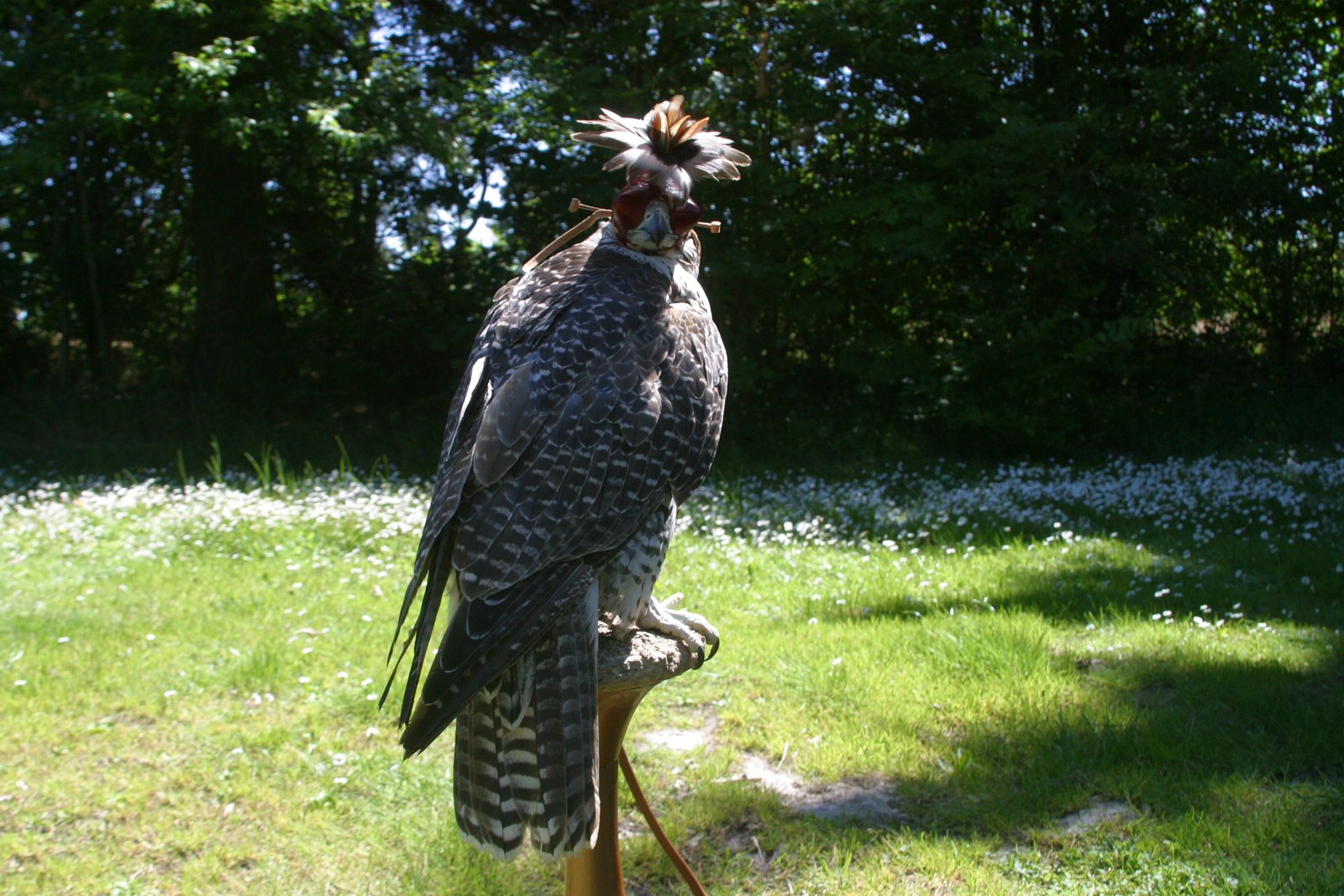
Wearing the hood Ivan, the female gyrfalcon can sit calmly even when a lot is going on around it.
The hood at the Eagle Reserve
When you visit Eagle World – the Eagle Reserve (Ørnereservatet) at Skagensvej 107, look out for the falconer's equipment: the glove, the jesses on the bird's legs, the lure and the hood. Feel free to ask our falconers after the demonstration how a hood should sit, and why not every bird wears one. At the Eagle Reserve, hoods are mainly used on saker falcons, gyrfalcons and peregrine falcons – not always, only when there is a particular need. The Eagle Reserve has no hood block. The hoods are either bought from falconers working at the reserve who can make hoods, or ordered from specialist suppliers.
Read more: Being a falconer – a craft with wings, worldwide.
Further reading: James W. Nelson, Hoods, Hooding and Hoodmaking (2016). John Cummins, The Hound and the Hawk (1988). Frank Wenzel, Kongernes jagtfalke (2010, in Danish), on the gyrfalcon's importance to Denmark: https://issuu.com/eagleworld/docs/kongernes_jagtfalke
Notes
- The Archives of Falconry (Boise, Idaho): "The American Hood – An Evolution of Craft in the New World", virtual exhibition (curators Kent Carnie, John M. Goodell and James W. Nelson). https://falconry.org/virtual_exhibits/falconry_hoods/
- Dansk Falkejagt Klub: Vejledning for falkonerer, rev. 1.1, 2023, esp. pp. 16–17 (section "Hætter", i.e. Hoods). https://www.danskfalkejagtklub.dk/onewebmedia/Vejledning%20for%20falkonerer_Rev1.1.2023.pdf
- Encyclopaedia Britannica: Emma Ford et al., "Falconry". https://www.britannica.com/sports/falconry
- William Shakespeare: Romeo and Juliet 3.2.14–15, Folger Shakespeare Library. https://www.folger.edu/explore/shakespeares-works/romeo-and-juliet/read/3/2/
- Grayson A. Doss and Christoph Mans: "Changes in Physiologic Parameters and Effects of Hooding in Red-tailed Hawks (Buteo jamaicensis) During Manual Restraint", Journal of Avian Medicine and Surgery 30(2), 2016, pp. 127–132. https://doi.org/10.1647/2015-096
- Kevin T. Patton, Mary Jo Croonquist and Walter C. Crawford Jr.: "Management-related stress in the red-shouldered hawk", Zoo Biology 4(3), 1985. https://doi.org/10.1002/zoo.1430040304
- The Hawk Board: "Guidelines to demonstration givers". https://www.hawkboard.uk/guidance/guidelines-to-demonstration-givers
- Ithra – King Abdulaziz Center for World Culture, Ithraeyat: "The Art of Falcon Hoods", 30.06.2025. https://ithraeyat.ithra.com/editions/art-of-sports/the-art-of-falcon-hoods
- UNESCO, Intangible Cultural Heritage: "Falconry, a living human heritage" (no. 01708). https://ich.unesco.org/en/RL/falconry-a-living-human-heritage-01708
- Hans J. Epstein: "The Origin and Earliest History of Falconry", Isis 34(6), 1943, pp. 497–509. https://doi.org/10.1086/347874
- Oliver Grimm: "Raptor on the fist … – a synthesis", i O. Grimm (ed.), Raptor on the Fist (ZBSA, Schleswig 2020). https://zbsa.eu/wp-content/uploads/2020/08/synthese.pdf
- Encyclopaedia Britannica: "Sixth Crusade". https://www.britannica.com/event/Sixth-Crusade
- Frederick II: The Art of Falconry, being the De arte venandi cum avibus, trans. and ed. Casey A. Wood and F. Marjorie Fyfe (Stanford University Press, 1943), introduction and Book II, chs. LXXVII–LXXVIII, pp. 205–206. https://archive.org/details/McGillLibrary-rbsc_art-falconry_casey-wood_SK321F87-18001
- Biblioteca Apostolica Vaticana: Pal. lat. 1071, digitised. https://digi.vatlib.it/mss/detail/Pal.lat.1071
- Orden Deutscher Falkoniere, LV NRW: "Falknereigeschichte". https://www.odf-nrw.de/uber-uns/falknereigeschichte/
- James Edmund Harting: Bibliotheca Accipitraria (London 1891), glossary: "Hood". https://archive.org/details/bibliothecaaccip00hartrich
- Maria Vretemark (Västergötlands museum): "The Vendel Period royal follower's grave at Swedish Rickeby as starting point for reflections about falconry in Northern Europe" (PDF). http://texts.archeurope.com/Library/The_Vendel_Period_royal_follower_s_grave.pdf
- Hanns-Hermann Müller: "Falconry in central Europe in the Middle Ages", in Exploitation des animaux sauvages à travers le temps. XIIIe Rencontres internationales d'archéologie et d'histoire d'Antibes (APDCA, Juan-les-Pins 1993), pp. 431–437. https://sciencepress.mnhn.fr/sites/default/files/articles/pdf/az1993hs1a34.pdf
- Vestfold fylkeskommune: "Gokstadhaugens hønsehauker". https://www.vestfoldfylke.no/no/meny/tjenester/kultur/kulturarv/kulturarvartikler/gokstadhaugens-honsehauker/
- National Museum – Palace of the Grand Dukes of Lithuania: "Falcon hood", 14th century. https://www.valdovurumai.lt/en/virtual-exhibition/i/10121/falcon-hood/
- Zinoviev: "Leather straps with avian tarsometatarsi from the medieval Russia: Jesses or amulets?", Environmental Archaeology, 2016. https://doi.org/10.1080/14614103.2016.1169350
- Victoria and Albert Museum: "Falcon's hood", England, early 17th century, T.244-1960. https://collections.vam.ac.uk/item/O318742/falcons-hood-unknown/
- The Metropolitan Museum of Art: "Hood for Falcon", 17th century, 29.150.153. https://www.metmuseum.org/art/collection/search/34337
- William Shakespeare: Henry V 3.7, Folger Shakespeare Library. https://www.folger.edu/explore/shakespeares-works/henry-v/read/3/7/
- Valkerij en Sigarenmakerij Museum Valkenswaard: "Valkerijmuseum". https://vsmm.nl/valkerijmuseum/
- Falconry Heritage Trust: "The Falconers of Valkenswaard" (PDF based on a publication of the Cultuur Historisch Museum Valkenswaard). https://www.falconryheritage.org/uploads/itemUploads/2071/Valkenswaard.pdf
- Lecturis: Karel Mollen – de laatste valkenier (publisher's description). https://lecturis.nl/en/product/karel-mollen/
- National Museum of Qatar: "Falcon hood, burga", Arabia, 19th century, QNM.2011.234.1. https://explorer.nmoq.org.qa/
- Ḥusām al-Dawlah Taimūr Mīrzā: The Bāz-nāma-yi Nāṣirī, a Persian Treatise on Falconry, trans. D. C. Phillott (London 1908), notes 403, 432 and 434. https://www.gutenberg.org/ebooks/74303
- Saudi Aramco World: "The Eagle Hunters", Jan./Feb. 2005. https://archive.aramcoworld.com/issue/200501/the.eagle.hunters.htm
- e-museum.kz: "Tomaga", Mukhamedzhan Tynyshbayuly Historical and Local Lore Museum, Zhetysu-region. https://e-museum.kz/en/exhibit/68da7f76332283f61-en/
- National Geographic: "Kazakh Eagle Hunter, Western Mongolia", 19.05.2009. https://www.nationalgeographic.com/photo-of-the-day/photo/kazakh-eagle-hunter-pod
- H. J. Slijper: article on Anglo-Indian hoods, Falconry News and Notes 2(2), 1959, PDF at The Archives of Falconry. https://falconry.org/resources/downloads/Slijper-1959.pdf
- Hooded Talons (British hood maker): "Falconry Hood Sizing". https://hoodedtalons.co.uk/falconry-hood-sizing/
- The Modern Apprentice: "Hoods" (American guide for falconers). https://www.themodernapprentice.com/hoods.htm
- Edmund Bert: An Approved Treatise of Hawkes and Hawking (London 1619), pp. 15 and 43–44, reprinted by J. E. Harting (London 1891). https://archive.org/details/bertstreatiseofh00bert
- UNESCO ICH: "Find out the newly inscribed elements on the 2003 Convention Lists" (2021). https://ich.unesco.org/en/news/find-out-the-newly-inscribed-elements-on-the-2003-convention-lists-13359