


When horse, rider and bird of prey become one
There is a moment in our programme that we never tire of. The horse steps out in front of the stands, the rider raises the glove – and then the bird comes in. A few wingbeats, a soft grip on the glove, and suddenly the three are one. That moment is why we love this work.
The birds of prey often catch the eye first. But in the roughly hour-long programme, the horses take part on equal terms. They are not scenery; they are working partners and colleagues in the classical discipline in which the falconer rides and the bird flies to the glove.
Right now we have three horses: one Friesian and two Andalusians. Each has its own name, its own breed and its own place in the partnership that binds people, horses and birds of prey together. Here you get to meet them – and further down, a little about the history and research behind the two breeds.
Sleipner — the Friesian
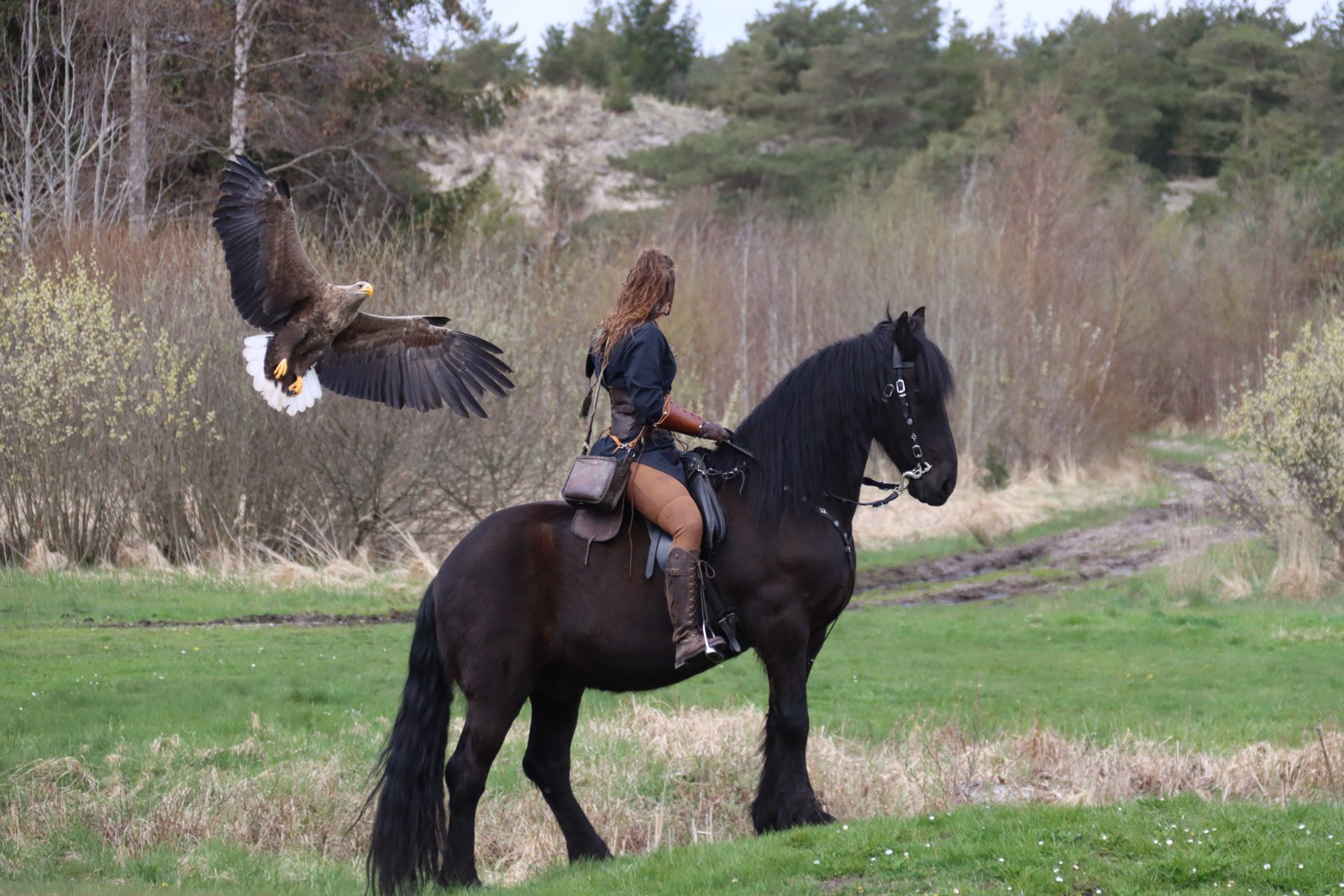 Sleipner, our Friesian
Sleipner is our Friesian. Many people know the breed from films: often black, with a flowing mane and feathered fetlocks – a baroque horse of Dutch origin. We chose the Friesian because the breed can be both clever and calm (and at times spirited), and because it is a good cross-country horse.
He takes his name from Norse mythology: Odin's eight-legged stallion, who could travel both on the ground and through the air. It feels right in a place where horse and eagle meet.
What makes Sleipner truly special is his friendship with the white-tailed eagle. Over the years we have trained one of our large North Atlantic white-tailed eagles to fly to a falconer on horseback – and it is the Friesian that this friendship belongs to. The white-tailed eagle Floke and Sleipner have shown our visitors what it looks like: the eagle lands on the rider's glove close to the stands, its great wings spread wide over the black horse. It is a sight that still makes us hold our breath.
Maximus — the Andalusian
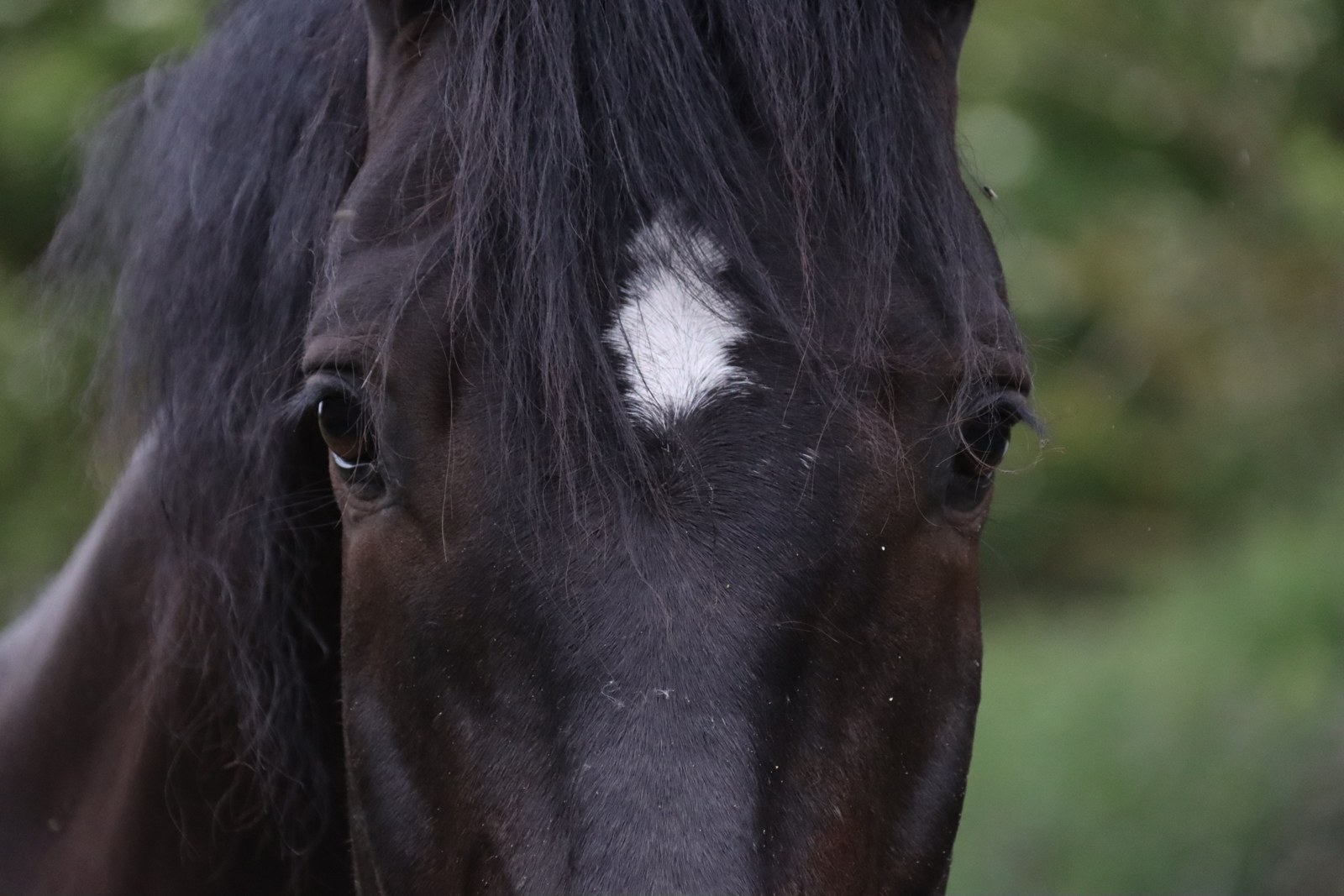 Maximus, our Andalusian
Maximus is an Andalusian – in Spanish Pura Raza Española (PRE). The Andalusian is athletic and supple, with keen senses: exactly what you want when lightning-fast falcons come in from changing angles. Historically the breed belonged at European courts and in classical dressage, and because falconry was long associated with the nobility, it is natural to see the Andalusian as a horse for mounted falconers – that is our own interpretation, not a research finding.
With us, Maximus is the big black Andalusian. Together with Apollon he makes up the Spanish part of our small group of horses.
Apollon — the Andalusian
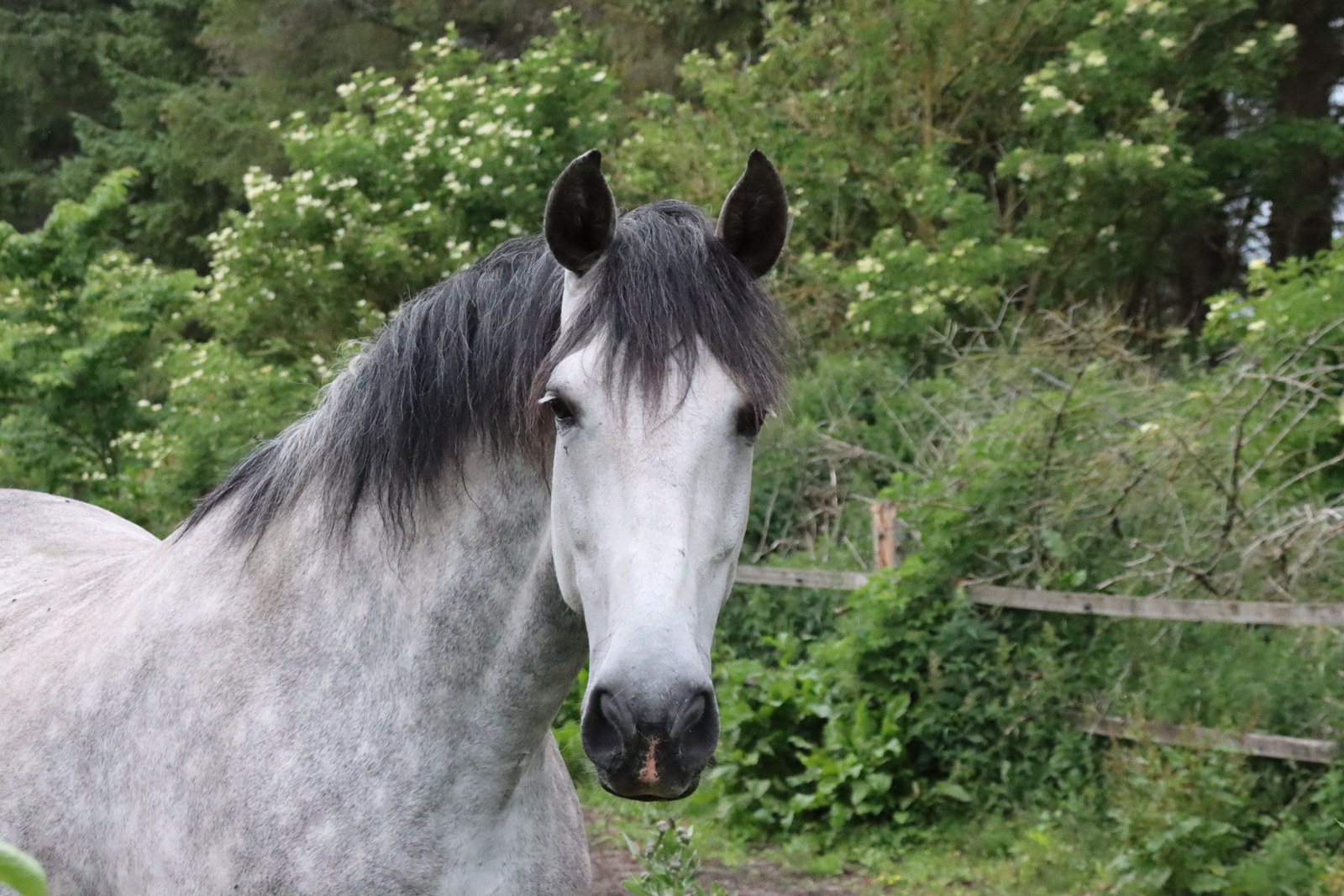 Apollon, our Andalusian
Apollon is an Andalusian too. In our annual review for 2021 we called him "the elegant Spanish horse", and he has earned the name. Back then Peter rode him, and together with the saker falcons Albert and Blonde they formed a trinity in front of the audience.
Apollon is our white Andalusian. Together with Maximus and Sleipner he is part of the team our guests meet when riding and birds of prey come together in front of the stands.
Why horses at an eagle reserve — and for how long?
Falconry on horseback is not something we made up. It is an ancient way of working – recognised by UNESCO as intangible cultural heritage (2012) – in which rider, horse and bird must be able to trust one another completely. The discipline reaches back several thousand years, out onto the steppes of Asia, where rider, horse and falcon or eagle hunted together. In Europe we know it from classical, medieval falconry on horseback. That original partnership is what we build on.
Here at the reserve there have been horses for more than forty years. Right from the very beginning, the legendary white-tailed eagle Nøkke and the Arabian horse Karim worked alongside the Wenzel family out in the open countryside. Horse and bird of prey belonged together here from the start – the same trinity our guests meet today, just with different names.
As early as around 1980, training with horses and eagles was part of everyday life. A photo from that time – used among other things as a book cover – shows Peter's sister Edith, aged 17, on horseback with an eagle. It is a picture we are very fond of, because it shows that this is not a new idea, but a practice the family has carried forward for decades.
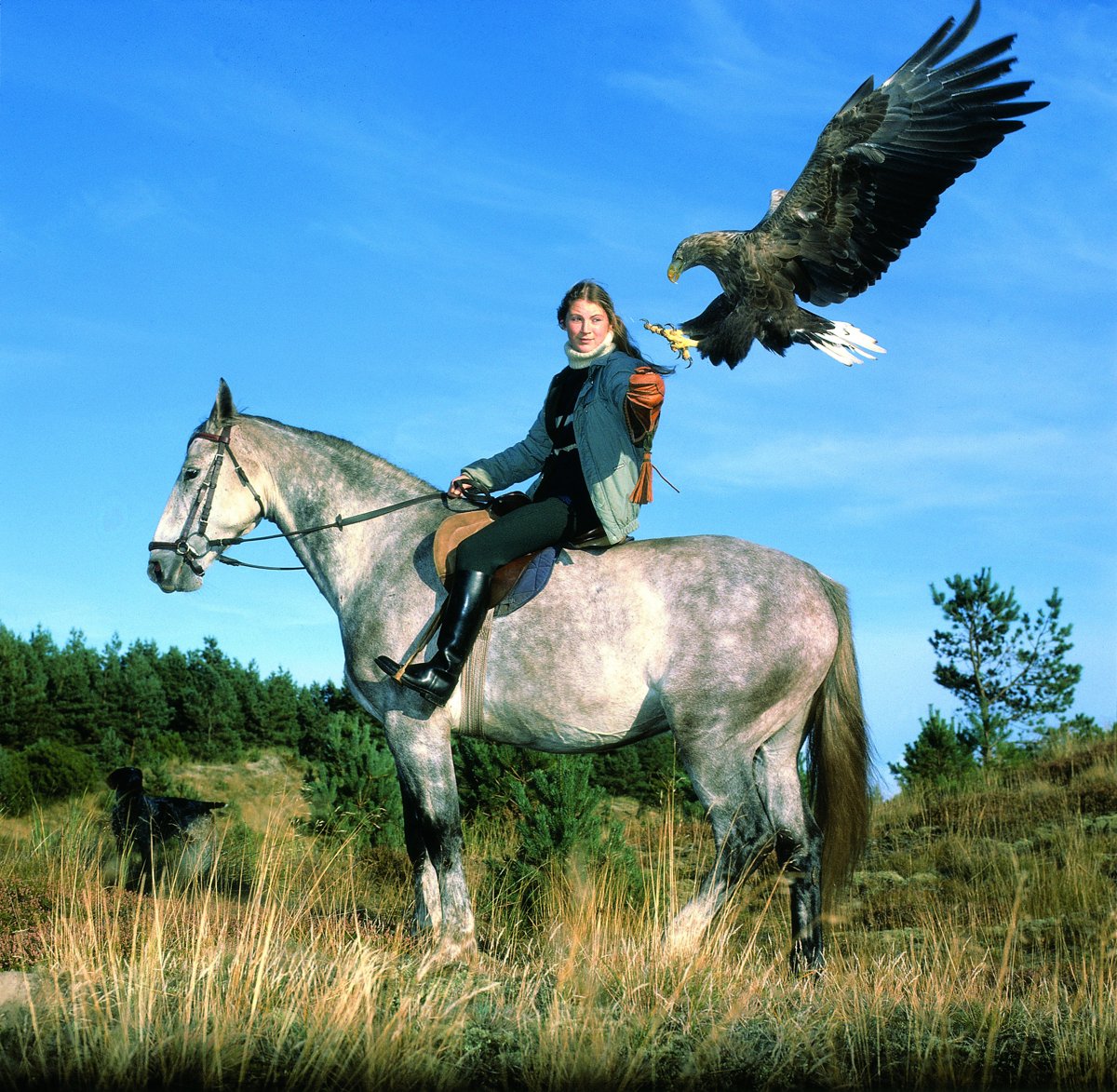 Edith, aged 17, on horseback with an eagle, around 1980
The horses have changed over time: Oldenburg, then Danish Warmblood, and now Friesian and Andalusian. Today it is Sleipner, Maximus and Apollon who carry the tradition forward.
Over the years many horses and birds of prey have worked together with us, and there will certainly be new ones. Because we want to keep this wonderful partnership alive. There are not many places in the world where you can still experience and tell this very story. If no one carries it forward, we risk an old craft, a living tradition and a truly special partnership between people, horses and birds of prey being forgotten. That is something we want to help prevent.
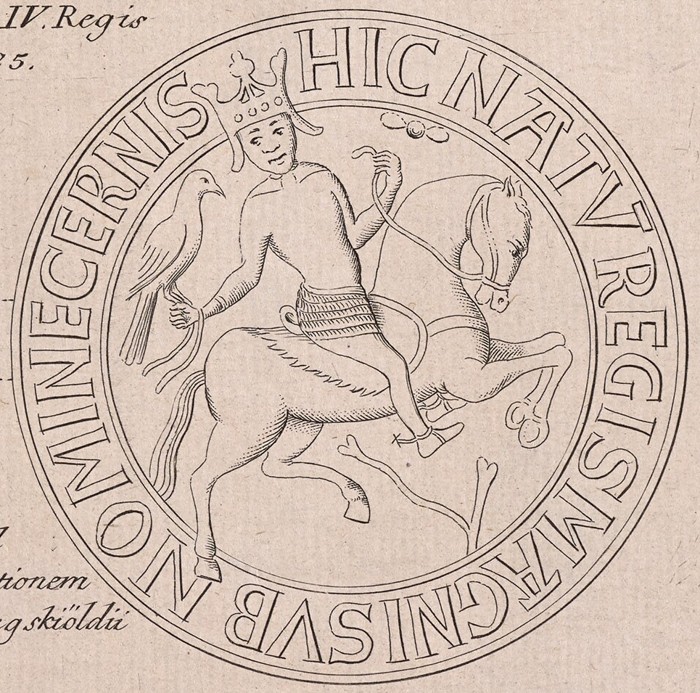 The seal of Canute IV (St Canute), reverse: the king on horseback with a bird of prey on his hand. Copper engraving by C.F. Müller, 1786 · Royal Danish Library / Wikimedia Commons · Public domain
Why it matters so much to us. Much of our inspiration comes from Canute IV (St Canute). Almost 1,000 years ago, the Danish king was a skilled falconer and rider, and his seal shows him on horseback with a bird of prey. He was a keen hunter and a lover of nature, and in many ways probably ahead of his time in his wish to be at one with nature. For Peter in particular, St Canute has been a huge source of inspiration for many years. He reminds us that the partnership between people, horses and birds of prey is also part of our own Danish history. It is a heritage we are proud to keep alive, so that it can be experienced here and now, and not only read about in books.
Outside the flight demonstrations, the horses are also out in the countryside: riding, checks and the daily training that keeps them happy and sharp for the season.
How we work towards a harmonious partnership
When rider, horse and bird of prey meet in front of the stands, it looks easy. It isn't. It is the fruit of daily practice, patience and a deliberate choice: we start from the original partnership. Not the horse alone, not the bird alone, and not a rider who "controls" the other two. The goal is a trinity: rider, horse and bird of prey as equal partners who read one another, so that the interplay becomes calm, precise and harmonious.
This is the classical discipline of mounted falconry – the same spirit UNESCO recognises in falconry. For us, the trinity is not decoration. It is the method.
First the horse and the rider. The horse must feel safe with the rider, with the reins and with working in open terrain close to the audience. That is why we also ride out: through forest, heath and the open landscape around the reserve. It builds balance and body control – and the ability to read animals, which is exactly the same skill you need when training birds of prey. Both horse and bird are shaped by their instincts; our job is to listen, adapt and build trust.
Then the bird. The bird of prey must be able to follow the rider's movements, land on the glove and work with a horse in motion. Horse, rider and bird have to learn to understand one another – and that takes practice and attention. The Andalusian is here partly because it is agile and has keen senses, which suit falcons coming in from changing angles. The Friesian is here partly because it can stand calmly and work closely with a large white-tailed eagle.
Then the trinity comes together. We don't introduce everything at once. In the Condor Hall we have shown the process in small steps: the horse gets used to the rider through horsemanship and familiarity with falconry; finally the bird of prey is introduced; and the culmination is when horse, rider and bird of prey become true partners. The same applies in the daily programme: safety before anything else. The more at ease the horse is, the calmer the bird can work – and the more precisely the rider can handle both reins and glove. When it succeeds, the audience is not watching three separate acts. They are watching one whole.
Shared will – or no partnership. All three have to want the same thing. The horse feels the rider. The bird of prey feels both horse and human. If the rider is restless – in the body, in the breathing, in the reins – no real partnership emerges. The bird does not return with the same confidence, and the horse tenses up. That is why mounted falconry is not for everyone. You can be a skilled rider or a skilled falconer on your own and still lack the calm and mutual trust that make the trinity possible. It is a demanding discipline: three partners who, in the same moment, must want each other. And when it happens, it is one of the most beautiful things we know.
On the animals' terms. We work under the open sky. Wind, weather and the animals' form on the day decide what is possible. Once in a while a horse or a bird has the day off. That is not a failure – it is part of working with living partners we care about, so that the interplay stays safe for horse, bird and audience.
During the season you can meet them in the programme. The gates are closed after the season; we reopen at Easter 2027. Until then we take good care of the horses, and they keep working behind the scenes. We look forward to showing them to you again.
Research and history: the Friesian and the Andalusian
Two breeds. Two geographies. Both are "baroque" in the sense that they belong to the European horse culture in which form, movement and work for people have been closely linked for centuries. Here is what research and serious historical sources say — briefly, and without promising more than the studies can support.
The Friesian: from Frisian landrace to black studbook horse
According to the historian Jorien Savelkouls (KNAW / De Vrije Fries, 2015), "Frisian horses" existed for a long time as a local landrace in the northern Dutch and north-west German region — tied to people and landscape — before the modern Friesian breed was formalised. The studbook (the Royal Friesian studbook) was established in 1879. The studbook brought restrictions, including the requirement of solid black colouring. This made the breed more uniform — and set it apart from the older, more varied-coloured landrace. According to the studbook definition, a chestnut Friesian is technically not a "Friesian".
Genetically, Friesians often stand out among Dutch horse populations. A study of nine horse populations in the Netherlands (Schurink et al., Animals, 2019) shows that closed, selected populations — including the Friesian — typically have more inbreeding and longer "runs of homozygosity" than populations with more genetic exchange. This is not a verdict on the individual horse, but a signal to breeders: diversity needs looking after. In 2025 researchers also published a high-quality Friesian reference genome (BMC Genomics), specifically to support breeding, disease genetics and conservation with less bias from other breeds' reference genomes.
In our own programme we use the Friesian partly because it can stand still and work closely with a large white-tailed eagle — the "unlikely friendship" we show in front of the audience. That is our practice here in North Jutland; the research above is about breed history and genetics, not about eagles.
The Andalusian / PRE: Iberian bloodlines and the baroque
The Andalusian — Pura Raza Española — belongs to a different story: the Iberian Peninsula. A large genomic study in Nature Communications (Lira Garrido et al., 2025) maps horses in Iberia over roughly 26,000 years. A now-extinct wild lineage (IBE) lived there for a long time; the modern domestic horses (the DOM2 lineage from the Pontic-Caspian steppe) were, according to the authors, present in Iberia as early as around 1850 BC. In the Iron Age and antiquity, Iberia emerges as an important horse centre whose bloodlines left their mark on Europe and North Africa — and later, in the colonial era, on the Americas too.
In baroque-horse genetics, today's PRE is described as one of the southern "baroque" breeds, closely related to Portugal's Lusitano and with historical influence on other breeds (Cosentino et al., Italian Journal of Animal Science, 2026). Within the PRE there is, among others, the Carthusian strain, which according to a genealogical and genomic study has been bred as a closed line for centuries — with a unique signature, but also signs of a bottleneck in recent times (Poyato-Bonilla et al., Journal of Animal Breeding and Genetics, 2022).
Horse, rider and bird of prey — what the sources can say
UNESCO lists falconry as intangible cultural heritage in a long list of countries, including Spain. Mounted falconry is rare in Europe today; according to UNESCO's Silk Roads materials, the style is most alive among Kazakh and Mongolian eagle hunters, among others. This does not mean that Iberian or Dutch horses "invented" the discipline — but that horses and birds of prey have historically belonged together in several cultures.
On the Iberian Peninsula, Espí Forcén and García Cano (Anthropozoologica, 2022) point to Iberian imagery from the 3rd–2nd centuries BC showing riders with birds of prey, which they interpret as early falconry — an exception in antiquity, if the reading holds. This is a research argument, not proof that today's PRE descends directly from those riders. So we hedge it: according to the two researchers, the iconography makes it more likely that the Iberians knew falconry early on.
With us, the connection is concrete and present-day: Sleipner the Friesian with the white-tailed eagle Floke; the Andalusians Maximus and Apollon in the classical mounted falconry described on our programme page. History provides the background. The animals in the arena bring it to life.
Sources (selection)
Eagle World
- Programme – the reserve's horses (Danish): https://eagleworld.dk/planlaeg-dit-besoeg/program
- Sleipner – the 8-legged horse from Valhalla (2019, Danish): https://eagleworld.dk/artikler/sleipner-den-8-benede-hest-fra-valhalla
- The year 2021 (Danish): https://eagleworld.dk/artikler/aaret-2021
- Riding and birds of prey… (2025, Danish): https://eagleworld.dk/artikler/ridning-og-rovfugle-to-sider-af-samme-sag-hos-oernereservatet
Friesian
- Savelkouls, J. (2015). The Friesian horse and the Frisian horse… KNAW / De Vrije Fries. https://pure.knaw.nl/ws/files/2110356/Savelkouls_Vrije_Fries_2015.pdf
- Schurink, A. et al. (2019). The Genomic Makeup of Nine Horse Populations Sampled in the Netherlands. Animals 9(7): 389. https://doi.org/10.3390/ani9070389
- Bouwman, A.C. et al. (2025). … reference genomes of the Dutch warmblood horse and Friesian horse… BMC Genomics. https://doi.org/10.1186/s12864-025-11985-0
Andalusian / PRE & falconry
- Lira Garrido, J. et al. (2025). The genomic history of Iberian horses since the last Ice Age. Nature Communications. https://doi.org/10.1038/s41467-025-62266-z
- Cosentino, E. et al. (2026). The genome-wide legacy of Baroque horse breeds. Italian Journal of Animal Science. https://doi.org/10.1080/1828051x.2026.2626608
- Poyato-Bonilla, J. et al. (2022). 500 years of breeding in the Carthusian Strain of Pura Raza Español horse… J. Anim. Breed. Genet. https://doi.org/10.1111/jbg.12641
- Espí Forcén, C. & García Cano, J.M. (2022). Martial’s hawk and Iberian falconry… Anthropozoologica 57(5). https://doi.org/10.5252/anthropozoologica2022v57a5
- UNESCO: Falconry, a living human heritage. https://ich.unesco.org/en/RL/falconry-a-living-human-heritage-01708