


Moult – when the eagles change their feathers
A feather is dead material – a bit like our hair and nails. It cannot repair itself, and it wears a little every single day. That is why all birds change their feathers, and for a bird of prey it is one of the most important projects of the year. Here we explain how moult works, why the birds fly less during it, and what it means for our season.
From a few centimetres to more than half a metre
Feathers come in all sizes. The world's smallest owl, the North American elf owl (Micrathene whitneyi), is only 12–14 cm long. Its tail is 4.5–5.3 cm, and the closed wing measures 9.9–11.5 cm from the wrist to the tip of the longest flight feather.
At the other end is the Andean condor, the species our Molina belongs to. Its tail is 33–38 cm, and the closed wing measures 75.7–85.2 cm. The condor has the largest wing area of any living bird.
Where do the feathers sit – and what are they for?
Before you can understand moult, you need to know where the different feathers sit. The drawing below depicts a raptor's right wing seen from above and the tail spread out. The numbers on the drawing are the same as the ones we use in the text. (The labels in the drawing are in Danish: håndsvingfjer = primaries, armsvingfjer = secondaries, tertiærer = tertials, dækfjer = coverts, halefjer = tail feathers.)
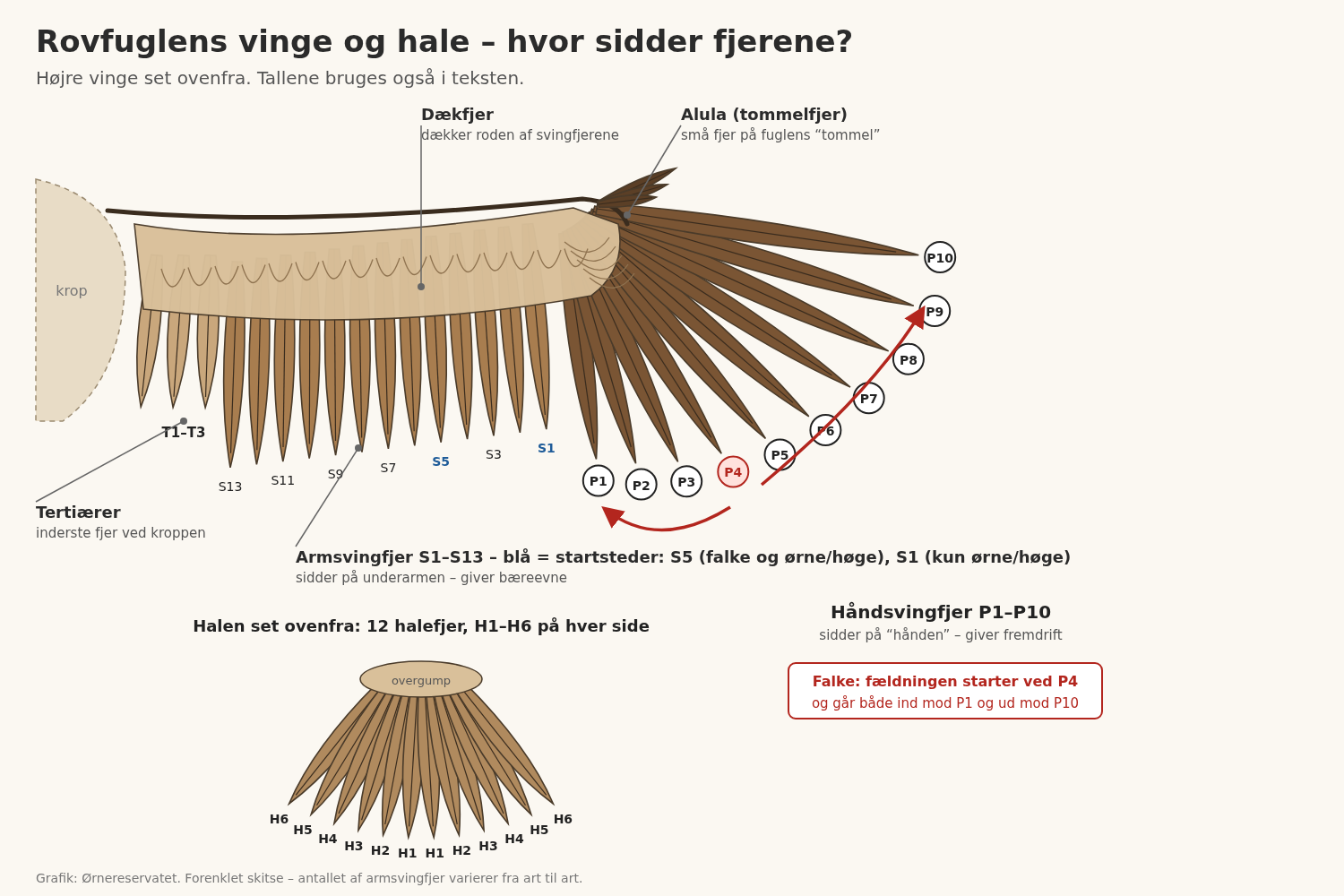
The feather groups of the wing and tail. P4 is marked with arrows because the falcons' moult starts here. Click the drawing to see it in full size. Graphic: Ørnereservatet
- Primaries (P1–P10) sit at the outer part of the wing, on the bird's "hand". They are the longest feathers, and the bird can turn them one by one almost like fingers. They provide most of the forward thrust. We count from the inside: P1 sits innermost by the wrist, P10 right out at the wingtip.
- Secondaries (S1, S2, S3 …) sit on the forearm, between the wrist and the elbow. They lie close together and form the wing's lifting surface, so they provide most of the lift. We count from the wrist in towards the body: S1 sits right next to P1. The number varies from species to species – the bigger the bird, the more there are.
- The tertials are the innermost feathers right next to the body. They close the gap between wing and body.
- The coverts lie like roof tiles over the base of the flight feathers. They cover and protect the base and give the wing its smooth, curved upper side so that the air flows evenly over it.
- The alula – or bastard wing – is a small group of feathers on the bird's "thumb" at the leading edge of the wing. In slow flight and landing the bird raises it so that a small slot forms. This helps the wing hold on to the air so the bird does not stall – a bit like the flaps on an aircraft wing.
- The tail feathers (H1–H6 on each side; in English often called R1–R6) sit in a fan. Birds of prey normally have six on each side, twelve in all. H1 are the two central ones, and H6 the outermost. The tail is used for steering, braking and balance.
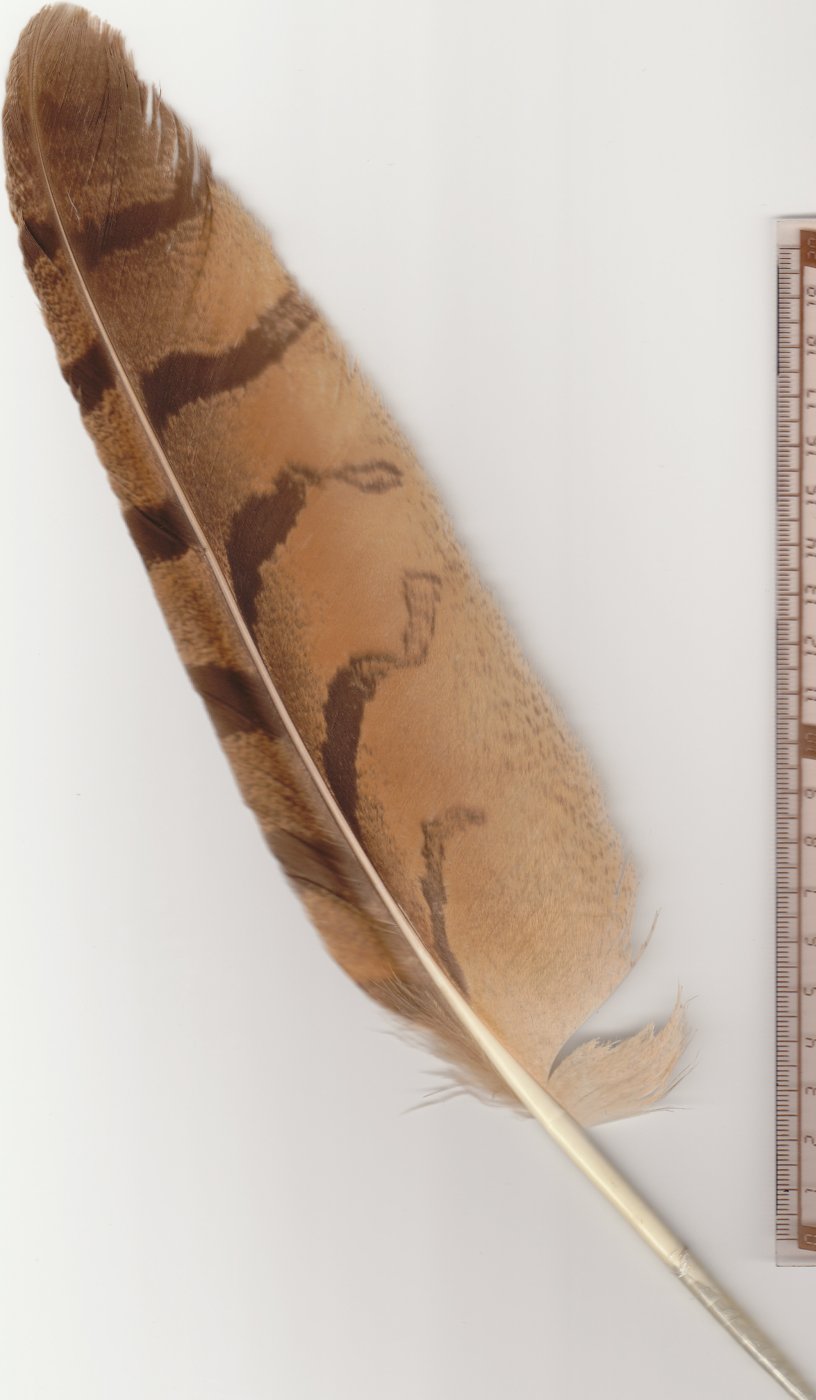
A primary feather from a Eurasian eagle-owl, scanned with a scale. Photo: BirdingInSpain, CC BY-SA 3.0, Wikimedia Commons

The sequence – step by step
A bird of prey cannot drop all its flight feathers at once, because then it would not be able to fly. That is why they are replaced in a fixed order. The order is almost the same in all birds of the same group, but eagles and hawks, falcons and owls each do it their own way. Keep the drawing beside you as you read.
Falcons (e.g. peregrine falcon and saker falcon):
- The first feather to drop is normally P4 – the fourth primary counted from the inside. Occasionally it starts at P5.
- From there the moult goes both ways at the same time: inwards towards P3, P2 and P1 and outwards towards P5, P6 and on.
- The last primary to be replaced is P10 right out at the tip.
- Once a couple of primaries have been replaced, the secondaries begin. In falcons they start at S5 and go both ways from there – out towards S1 and in towards the body. In most falcons the moult also starts at a second point among the tertials, usually at the middle one.
- Falcons normally replace the whole wing and tail in one year, and the next year they start at the same places again.
Eagles and hawks (e.g. white-tailed eagle, golden eagle and common buzzard):
- The primaries are replaced from the inside out: first P1, then P2, P3 and so on out to P10.
- The secondaries are replaced from three places at once: from S1 the moult goes inwards, from S5 it also goes inwards, and from the innermost secondary it goes outwards.
- Small and medium-sized species usually manage it all in one year.
- Large eagles such as the white-tailed eagle and golden eagle do not. The moult stops in winter, and the next spring it continues where it left off. At the same time a new round starts again from P1. That is why you can see two, three and sometimes four "waves" of feathers of different ages in the same wing. This is called stepwise moult or staffelmauser. In adult white-tailed eagles it typically takes three, occasionally four, years to replace all the primaries.
The tail:
- In birds of prey the tail almost always starts with H1, the two central feathers.
- After that the order varies from species to species. In many eagles and hawks the outermost feathers (H6) come early.
- In white-tailed eagles in Schleswig-Holstein, researchers found that the tail feathers were most often replaced in the order H1-H6-H3-H4-H2-H5.
- Large eagles do not always manage the whole tail in one year.
Owls are the most varied. Many genera have their very own sequence. In the barn owl, for example, primary moult begins at P6 (occasionally at P5 or P7) and spreads from there to both sides, often over several years. Body feathers are replaced continuously and more irregularly in all groups.
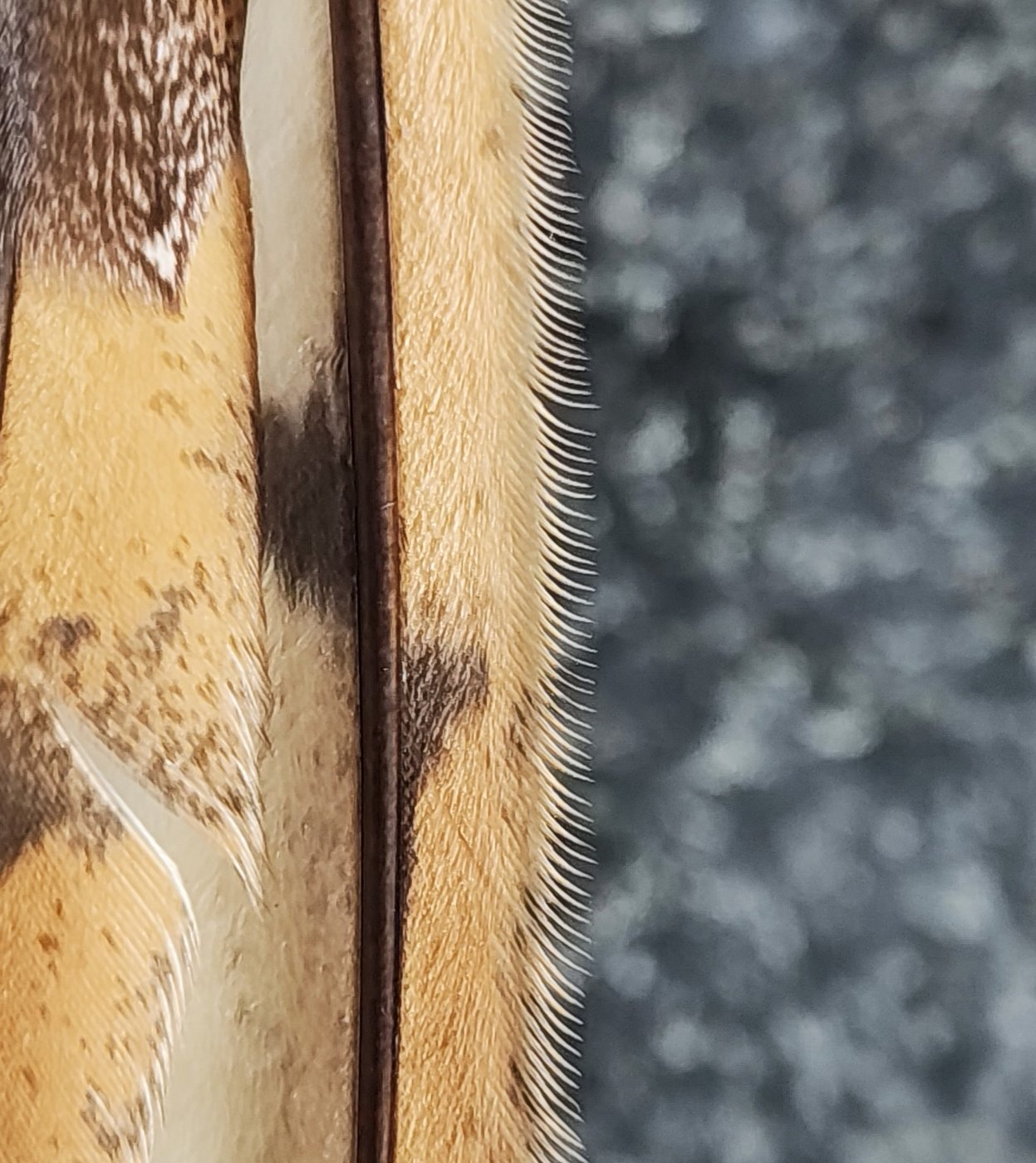
The leading edge of a barn owl's primary feather. The fine "comb teeth" dampen the sound so the owl flies silently. Photo: Vedant Raju Kasambe, CC BY 4.0, Wikimedia Commons

Why is the sequence so clever?
- The bird can still fly. Only a few feathers are replaced at a time, and the new feathers grow in next to feathers that are intact. The wing is never "empty".
- The gaps are spread out. When moult starts at several places in the wing, e.g. at P4 and S5 in falcons, the gaps that appear are small and spread out. The wing does not lose a large, continuous area.
- Both wings keep pace. The bird normally replaces the same feathers in the right and left wing at roughly the same time, so the wings are the same size and the bird flies straight. Asymmetries are seen a little more often in the tail than in the wings.
- Big birds get more time. The large eagles cannot grow all their big feathers in one summer. By spreading the work over several years in waves, they always have a wing they can fly with.
When – and why
In most birds of prey in our part of the world, moult takes place in the summer half of the year. In wild white-tailed eagles in Schleswig-Holstein, flight and tail feathers were replaced between April and October, especially from May to August. The same study found that moult went faster in warm, dry summers and in years without young, while breeding birds began about a month and a half later. Food, weather, breeding success and day length all play a part. Feathers wear, and that is an important reason why they have to be replaced.
The birds need plenty of good food while they moult. New feathers are built from protein, and as early as the 1240s Frederick II warned that too little food produced poor feathers with "hunger bars".
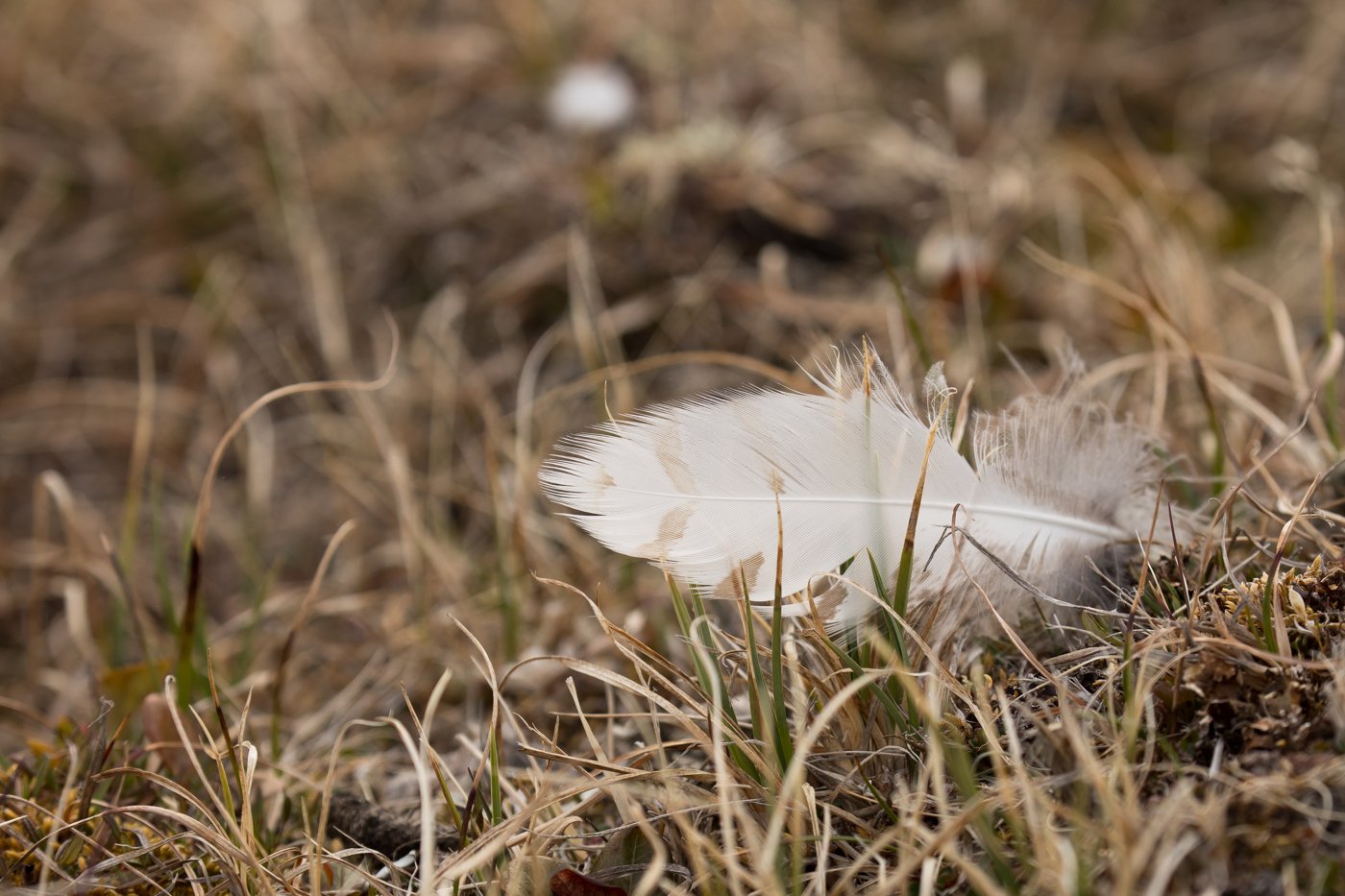
A snowy owl feather in the grass. Photo: Lisa Hupp/USFWS (USFWS Alaska), Public domain, Wikimedia Commons

That is why they fly less
When a large flight feather has dropped out and the new one is growing in, there is a gap in the wing. The new feather is filled with blood while it grows, and it is vulnerable until it is finished. The bird flies less efficiently, and a damaged blood feather can bleed. That is why we fly the birds less during the moulting period.
When moult happens actually differs from bird to bird. Some moult mostly in summer, others in winter, and the bird's condition also plays a part. That is why we follow each individual bird and adapt the training to how far it has come in its moult.
The old falconers' art: setting in a feather
If a flight feather breaks, the falconer can repair it with a technique called imping. The broken feather is cut through, and a matching feather from an earlier moult is attached with a thin needle or peg and a little glue. It does not hurt, because the feather is dead. The earliest written description is known from Frederick II's work on falconry from the 1240s. It is one of the reasons why falconers keep moulted feathers.
We go through all the feathers the birds drop, and over the years this has become an enormous feather archive. It is a treasure in itself: the feathers tell the story of each bird's moult, and they are exactly what a falconer needs if a feather one day has to be repaired.
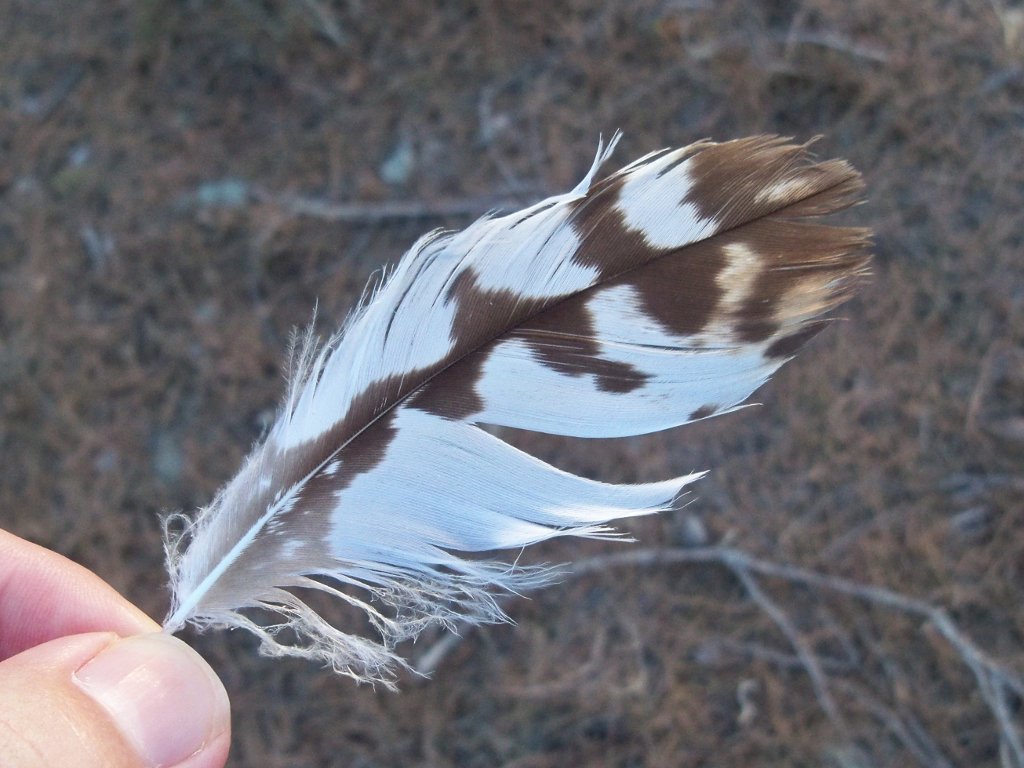
A common buzzard feather, photographed in Montes de Málaga, Spain. Photo: Daniel Capilla, CC BY-SA 4.0, Wikimedia Commons

Feathers are older than birds
Feathers did not appear with the birds. In the 1990s, fossils of small predatory dinosaurs (theropods) with feathers were found in Liaoning, China. The first, Sinosauropteryx, was covered in fine, filament-like feathers. Today around 40 species of feathered dinosaurs are known. According to one developmental model, the feather evolved in steps: first a simple tube, then a tuft, later a branched feather and finally the closed, asymmetrical flight feather needed for flight. Microraptor had asymmetrical feathers on both its fore and hind limbs, and the early bird Archaeopteryx is the oldest known species with flight feathers whose barbs hook together just as in our eagles today. So the wing existed before flight did.
The reserve is closed for the winter, and the birds have peace and quiet to get ready for Easter 2027.
Read also (in Danish)
Vinteren bag kulisserne · Dinosaurernes bemærkelsesværdige evolutionære transformation · Fra fjerdragt til stjernestøv
Sources
- Zuberogoitia, I. et al. (2018): Moult in Birds of Prey: A Review of Current Knowledge and Future Challenges for Research. Ardeola 65(2)
- Clark, W.S. (2004): article on stepwise moult (staffelmauser) in raptors in Raptors Worldwide, pp. 795–804
- Journal für Ornithologie: Zur Mauser des Großgefieders beim Seeadler (Haliaeetus albicilla) in Schleswig-Holstein
- North American Bird Bander: Molt and Sequence of Plumages of Golden Eagles (vol. 26, no. 3)
- Scottish Raptor Monitoring Scheme: Raptors – a field guide for surveys and monitoring, part 3 (Feathers)
- The Owl Pages: Elf Owl (Micrathene whitneyi); Animal Diversity Web: Micrathene whitneyi
- Wikipedia: Andean condor (tail and wing measurements)
- Audubon: An Introduction to Imping, the Ancient Art of Feather-Mending
- Frederick II of Hohenstaufen: De arte venandi cum avibus, English ed. The Art of Falconry (Wood & Fyfe)
- Current Biology (2020): Feathered dinosaurs
- Prum, R.O. & Brush, A.H. (2002): The Evolutionary Origin and Diversification of Feathers. Quarterly Review of Biology 77(3)
- Norell, M.A. & Xu, X. (2005): Feathered Dinosaurs. Annual Review of Earth and Planetary Sciences 33
- North American Bird Bander: Molt in Burrowing Owls (Athene cunicularia) (vol. 37, no. 1) – on the different starting points in owls, incl. P6 in the barn owl
- Brinzal: Lechuza común / Common Barn-Owl Tyto alba – datado y sexado (moult pattern in the barn owl)
- Pyle, P. (2013): Evolutionary Implications of Synapomorphic Wing-Molt Sequences among Falcons (Falconiformes) and Parrots (Psittaciformes). The Condor 115(3)
- Raptor Research Foundation: Raptor Research and Management Techniques, ch. 2: Raptor Identification, Ageing, and Sexing (moult of flight and tail feathers)
- Cornell Lab of Ornithology, Bird Academy: Everything You Need To Know About Feathers
- EPJ Web of Conferences 114 (2016): Aerodynamics of bird flight (primaries, secondaries and alula)
- Images from Wikimedia Commons: BirdingInSpain, Eagle Owl, Bubo bubo, primary feather (CC BY-SA 3.0); Vedant Raju Kasambe, Barn Owl feather macro (CC BY 4.0); USFWS Alaska, Feather of a snowy owl (Public domain); Daniel Capilla, Common Buzzard Feather (Buteo buteo) (CC BY-SA 4.0)