


Steller's sea eagle: a giant from another world
Here at Ørnereservatet, Eagle World, a giant eagle from the North Pacific lives in a North Jutland dune. Her name is Kamtjatka. In a new film I tell her story, and the Danish thread that runs back to Vitus Bering.
By Peter Frank Wenzel, Ørnereservatet / Eagle World
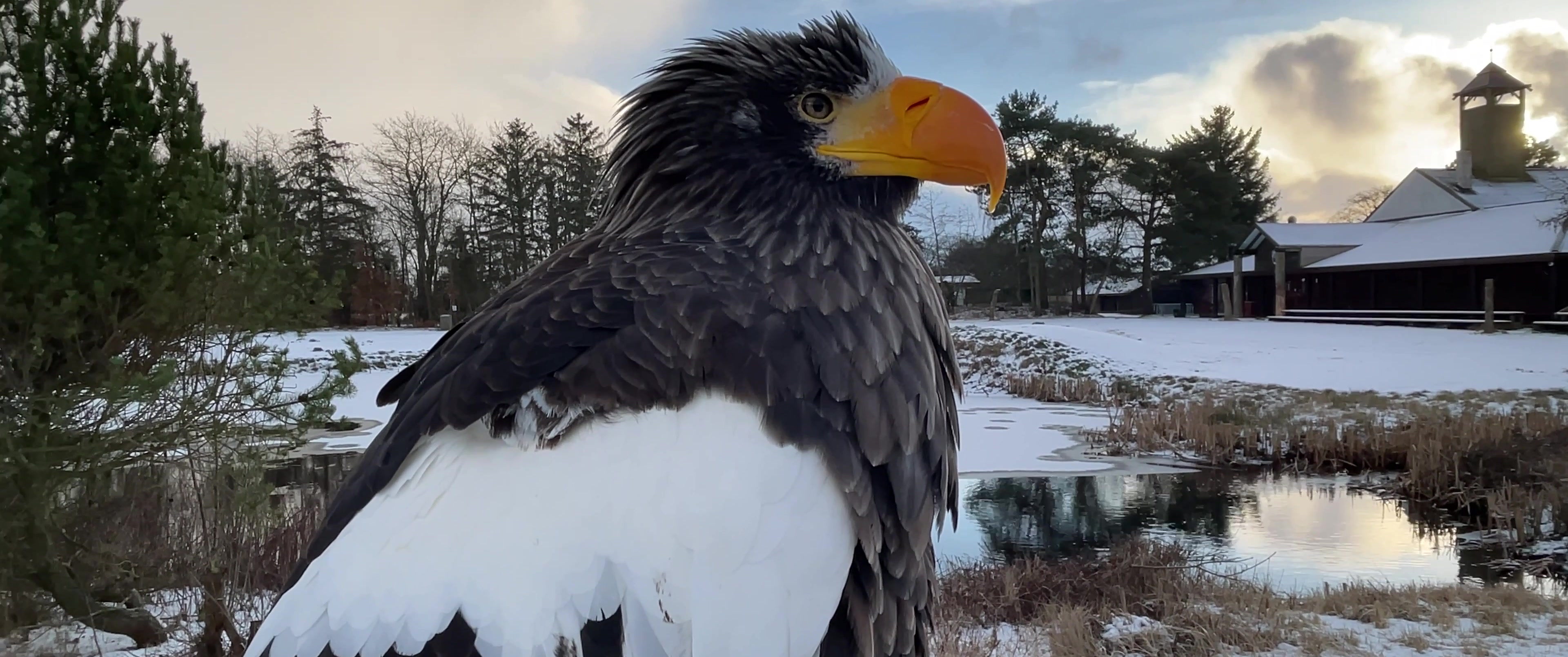
Kamtjatka close up, at Ørnereservatet.
Here at Ørnereservatet, in a dune in North Jutland, lives a giant eagle from another world. Her name is Kamtjatka. She is a Steller's sea eagle, one of the largest eagles on Earth, and she came here from a breeding programme.
The Danish thread in her story does not begin in these dunes. It begins in Horsens, in East Jutland. Vitus Bering was baptised there in 1681. Peter the Great was building a modern navy, and he recruited seafarers from Denmark and the Netherlands. After voyages as far as the East Indies, Bering met the admiral Cornelius Cruys in Amsterdam and entered the Russian navy. In that service he later led the great expedition east.
It was not Bering who discovered this bird. The people of those coasts already knew it. It was Georg Wilhelm Steller, the German physician and naturalist who sailed with Bering, who described it.
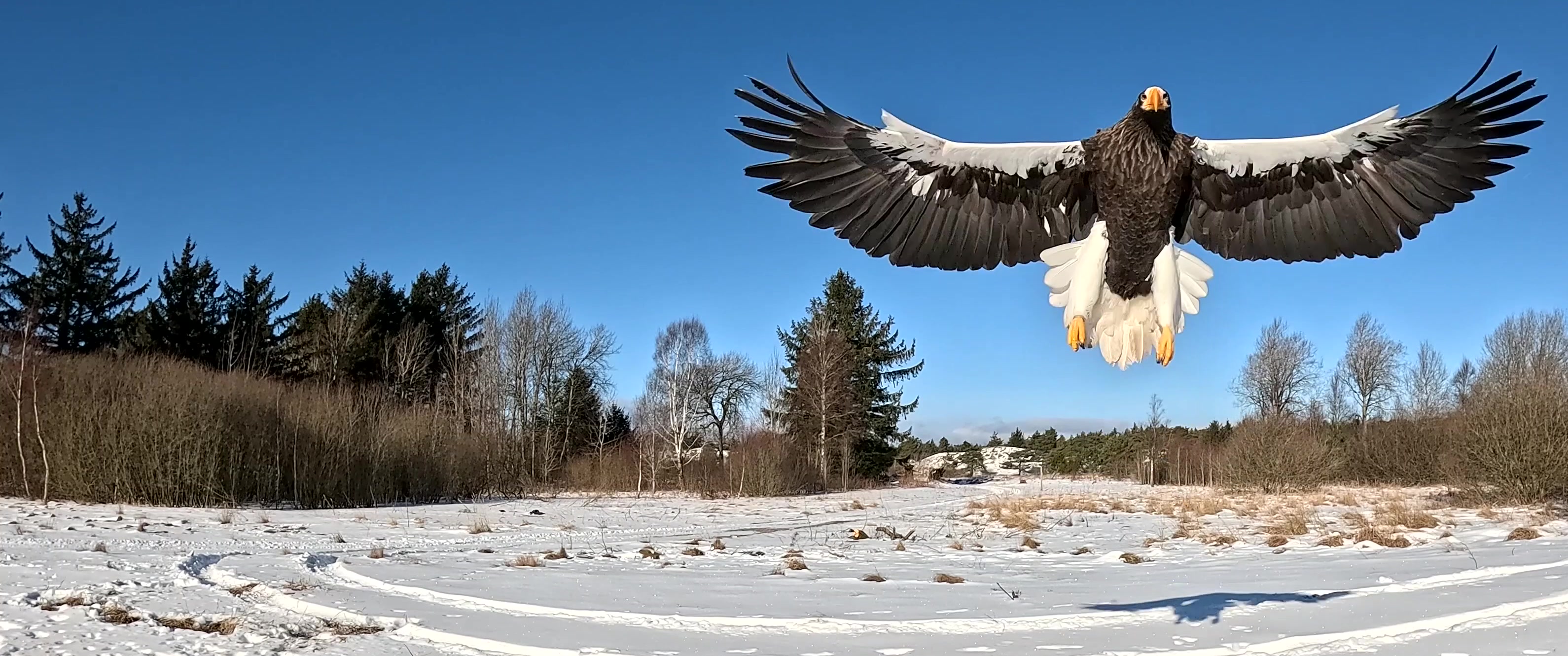
Kamtjatka in flight over Ørnereservatet.
In the summer of 1741, two ships left Kamchatka. Bering commanded the St. Peter. In July they reached the coast of Alaska. On the way home the storms rose, and scurvy took hold of the crew. In November 1741 the St. Peter was wrecked on an island in the Commander Islands, the island later named for Bering. In December 1741, Vitus Bering died there, quietly, on that shore.
In the midst of that winter, Steller saw a great sea eagle and wrote down what he saw. In 1811, Peter Simon Pallas gave the bird its scientific name, Haliaeetus pelagicus, from Steller's notes, and from the island where Bering was lost.
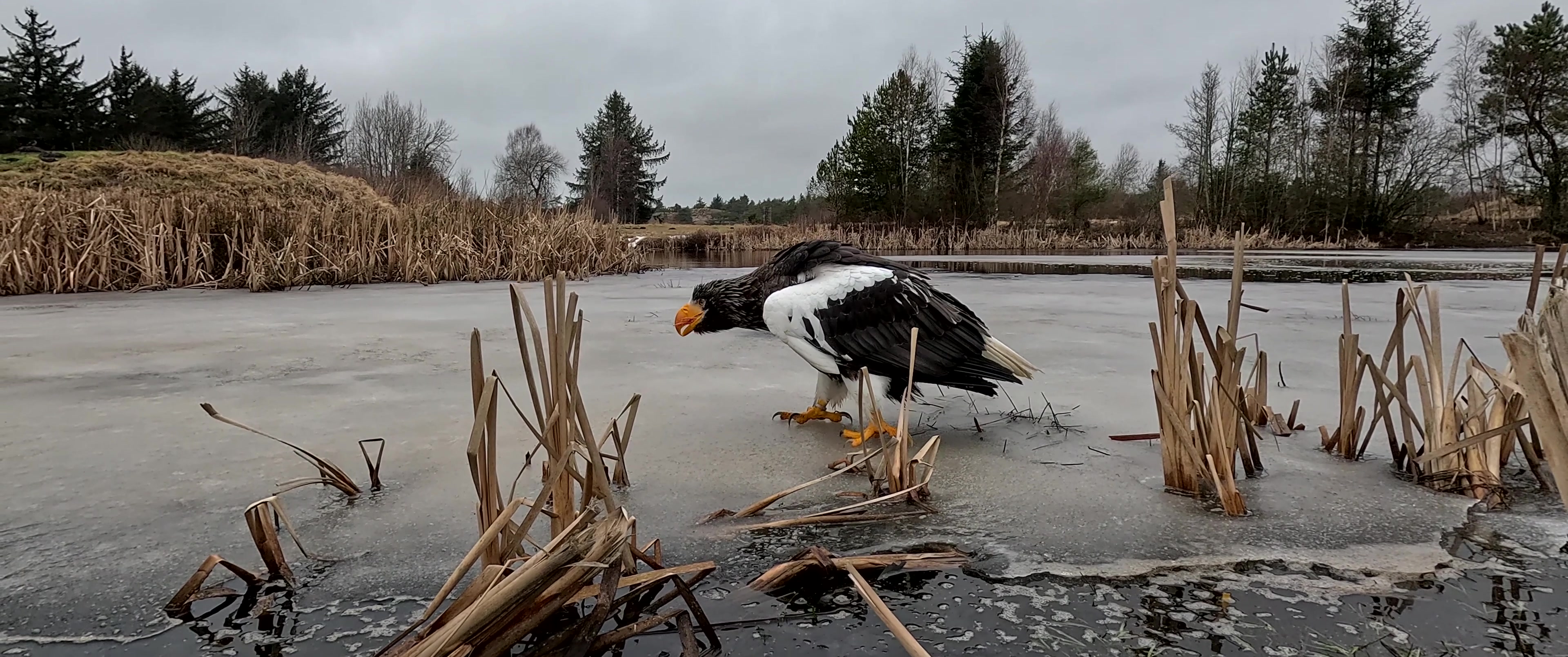
Kamtjatka on the ice at Ørnereservatet.
The species still belongs to those coasts. Kamchatka. The Sea of Okhotsk. In winter, many of these eagles seek open water, among them the shores of Hokkaido, and the fish the sea and the rivers give, especially salmon. Researchers have documented lead in the food chain, and pressure on the fish and the ice this bird depends on. The species is vulnerable. What we leave in nature, and what we take from the rivers, matters.
And one of them lives here, in a North Jutland dune.
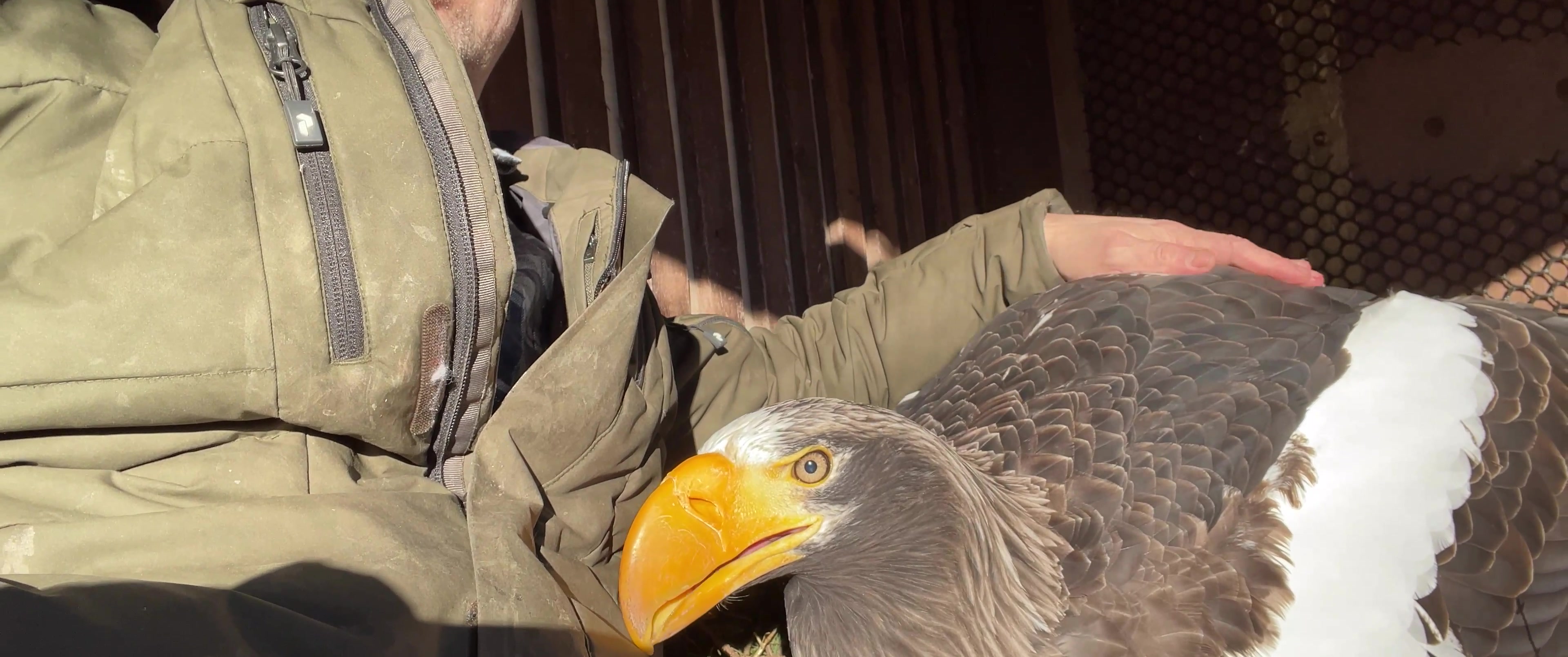
Peter in the nest with Beringa.
Kamtjatka is not alone in this. Her sister is Beringa. There was no mate for them. So they turned to the man who stands with them. I was invited up into the nest. I became part of their family life. In their world, I became their mate. And they laid their eggs because of me. Both sisters have laid several eggs.
The meaning is not whether a chick hatches. It is the trust: that a man may walk to the nest, and be received as family.
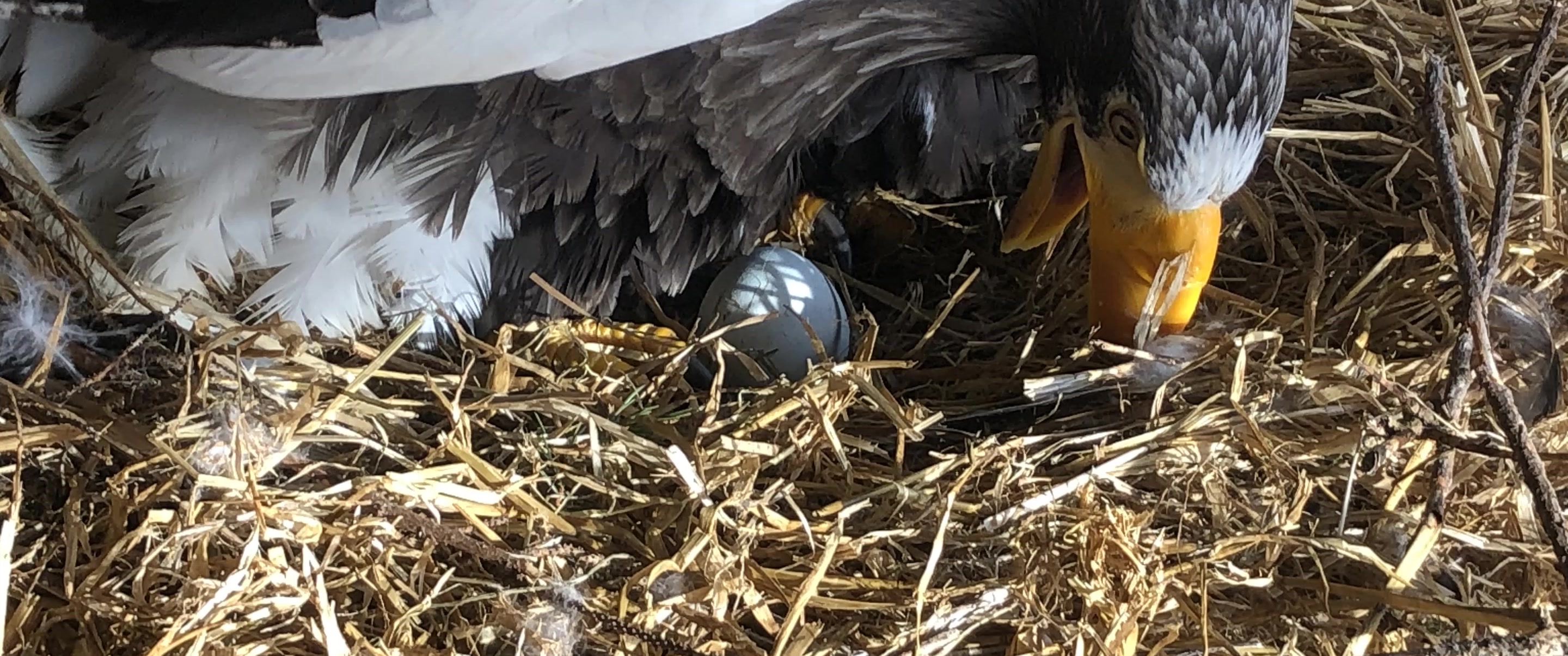
Beringa in the nest with an egg.
That is what I wanted to say in the film. It is in English, and the pictures of the eagles are our own footage, filmed here at the reserve. The scenes from 1741 are AI reconstructions, clearly marked, and the maps are illustrations.
Sources for every factual claim are listed below. You are always welcome here at Ørnereservatet.
Watch the film on YouTube: Steller's sea eagle: a giant from another world
Sources
Vitus Bering, baptism in Horsens in 1681, the meeting with Cornelius Cruys in Amsterdam in 1703, and entry into Russian service: Dansk Biografisk Leksikon.
https://biografiskleksikon.lex.dk/Vitus_Bering_-_opdagelsesrejsende
Store norske leksikon: https://snl.no/Vitus_Bering
Orcutt Frost, Bering: The Russian Discovery of America, Yale University Press, 2003.
The voyage of 1741, the wreck, and Bering's death in December 1741: G. W. Steller, Journal of a Voyage with Bering, 1741–1742, ed. O. W. Frost, Stanford University Press, 1993.
Frost, Bering: The Russian Discovery of America, 2003.
The scientific name Haliaeetus pelagicus (Pallas, 1811): P. S. Pallas, Zoographia Rosso-Asiatica, vol. 1, p. 343, 1811.
Range, diet (especially salmon) and Vulnerable status: IUCN Red List / BirdLife International, Haliaeetus pelagicus.
https://www.iucnredlist.org
V. Masterov and M. Romanov, Steller's Sea Eagle.
Lead in the food chain, and pressure on the fish and the ice this bird depends on, follow the same conservation literature, especially IUCN/BirdLife and Masterov and Romanov.
eagleworld.dk